
[[{“value”:”

By: Frederick Reiber
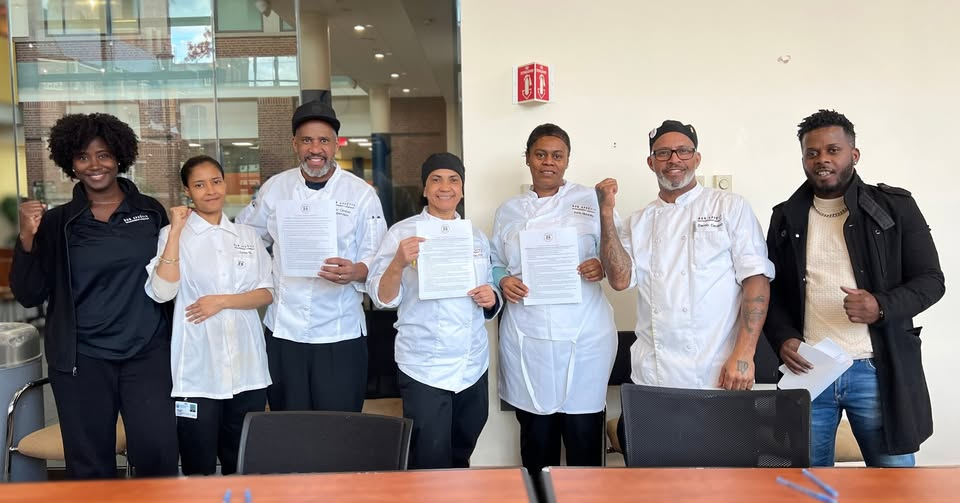
BOSTON, MA – Dining hall workers at Emmanuel College voted to unionize with UNITE HERE Local 26 and signed their first collectively-bargained contract in November 2025, joining a union rapidly organizing small shops and similar ones.
The workers, employed by the food service contract Bon Appétit Management Company, had originally begun organizing four or five years ago. That original push fizzled out. However, as one of the employees, Cesar Salazar, highlighted – workers had really begun to notice the union difference. They lacked union insurance and a pension plan, and held significant grievances around handling worker seniority.
At the center of the campaign was what organizers describe as a worker-driven approach to building power inside the workplace. Rather than relying on outside messaging alone, workers focused on identifying trusted colleagues and strengthening relationships across shifts and roles.
Cesar Salazar, a 14-year employee involved in the effort, highlighted how the campaign drew on the Organizing for Power playbook — a method centered on mapping workplace relationships and working through respected leaders. Workers met to identify who others turned to for advice, who influenced conversations in the kitchen or serving lines, and how support could spread person to person. That process meant thinking carefully about who to approach and when. It required workers to assess not just formal job titles, but informal networks of trust.
The work was intensive. Salazar described “meeting after meeting” as employees gathered before shifts, after work and on days off to build majority support. At the same time, they had to remain discreet, keeping organizing conversations away from management while building confidence among co-workers.
The University as a Multi-Employer Arena
Organizing inside a university setting brought both challenges and advantages. The dining workers are employed by Bon Appétit Management Company, a national food service contractor. However, many aspects of their daily working conditions are shaped by the standards and expectations of Emmanuel College itself.
In some workplaces, that kind of “fissured” employment structure — where a contractor technically employs workers while another institution sets conditions — can complicate organizing drives. The same case applies in many workplaces, such as in the structure of Fenway Park, which impacted the 2025 strike of concessions workers. In the case of Emmanuel College, workers indicated that fissuring was not a significant barrier. They moved forward with a clear understanding of how the workplace functioned and focused on building unity among themselves, internally.
One of the campaign’s strengths, organizers said, was the presence of an already established worker community on campus. Workers across Emmanuel College showed support during the drive. The support from other unionized workers helped normalize the effort and underscored what organizers described as “the union difference.”
First Contract Negotiations
After winning union recognition, workers entered negotiations for a first contract and won in November 2025.
The contract includes significant economic gains. Workers secured a total wage increase of over $9 per hour, a substantial boost that addressed long-standing concerns about pay. The agreement also provides increased vacation time and new parental protections, expanding benefits beyond wages alone. In addition to these financial and leave-related improvements, workers won changes to the scheduling system and formal recognition of employees’ commitment to their jobs. As workers explained, their employer had often failed to acknowledge seniority or properly compensate long-time staff for their service. The new agreement helps to rectify this by providing four weeks of vacation for senior members and a fair scheduling system based on seniority.
The scheduling victory is especially meaningful because it shows that union campaigns can secure more than traditional “bread and butter” issues like pay and benefits. By reshaping how schedules are structured and communicated, the contract reaches into the everyday rhythms of work life, giving workers greater predictability, stability, and respect on the job.
For these workers, the first contract is not just a list of new benefits—it is a framework for a more secure, dignified workplace, and a signal that organizing can deliver tangible changes that are felt long after the picket signs come down.
Frederick Reiber is a contributing writer to Working Mass.
The post Emmanuel College Dining Hall Workers Win First Contract with UNITE HERE Local 26 appeared first on Working Mass.
“}]]