
[[{“value”:”

By: Jake S
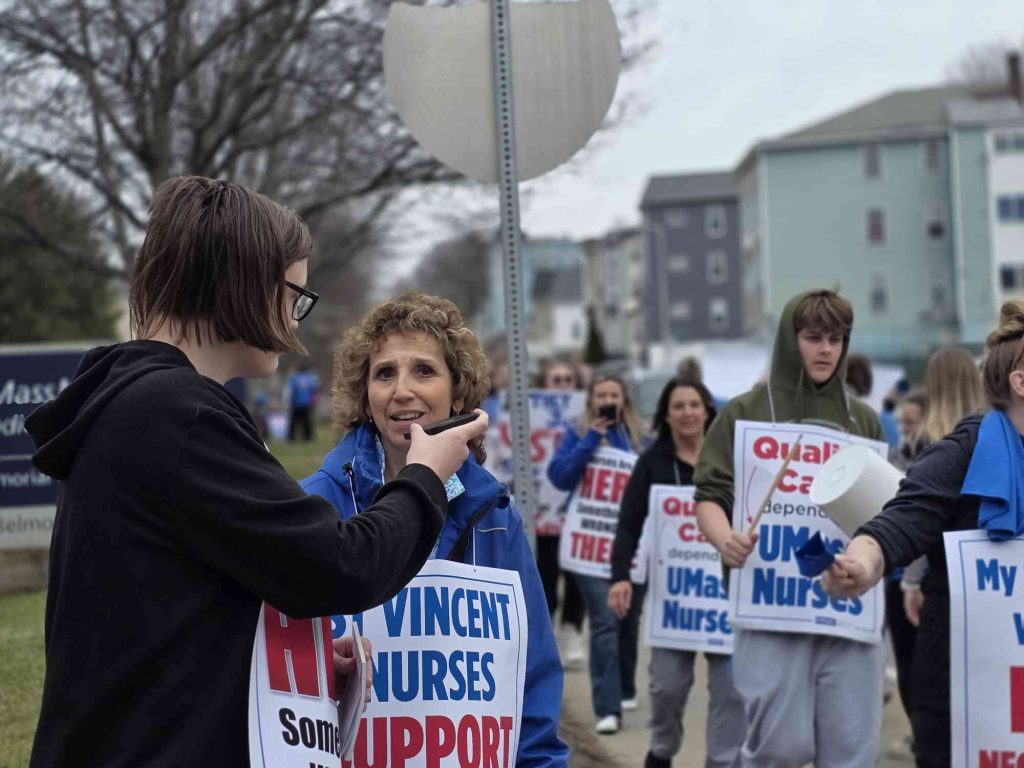
WORCESTER COUNTY – On Thursday, March 26, UMass workers organized within the Massachusetts Nurses Association (MNA) — the largest union of registered nurses in the Commonwealth with over 26,000 members — held informational pickets for their contract fight across five hospital campuses: in Worcester, at Memorial, University, and Hahnemann; in Clinton, at UMass Memorial Health-Alliance; and in Marlborough, at UMass Memorial Medical Center.
Nurses have been in contract negotiations since as early as June 2025 with many forced to work without a ratified contract for nearly a year.
Hundreds of nurses gathered, marched, and chanted — some with children in tow, others staying out for as long as their 15-minute shift break would allow, but all bursting with energy. The message to UMass was clear: MNA members are ready to fight.

Negotiations with UMass
Bonnie S is an operating room nurse at UMass Memorial and the treasurer of her bargaining unit. She has worked at UMass Memorial for twenty-eight years, after a previous stint in the NICU.
Bonnie told Working Mass:
We’re here because we’ve been trying to negotiate our contract for many months, coming up on a year. UMass hasn’t moved much at all in negotiations. Anything that has to do with what we’re really passionate about has gotten nothing. We just want to give our patients the best quality and safest care that we can – we need these things in order to do that. Management hasn’t really worked with us. A lot of talk, but not a lot of movement.
The escalation by workers arrived as Worcester approaches the five-year anniversary of the historic MNA strike at Saint Vincent’s Hospital, which launched in April 2021 and extended, uninterrupted, for 301 days. Nurses who served as co-chairs of the Saint Vincent’s bargaining unit during their strike walked alongside UMass nurses for their picket. Nurses with decades-long careers — some long enough to recall UMass hospital strikes of the past — held their signs and their heads high.
Passers-by on the streets and sidewalk of each and every one of the five campuses cheered, honked, and waved.
Ben P, vice chair of the Hahnemann Campus bargaining unit and an operating nurse of seventeen years, told Working Mass that safer staffing levels and working conditions, fair wages, and limits to shift rotations are top concerns for MNA members which UMass has yet to address at the bargaining table.

Safe Staffing Levels and Retention
“Number one is safe staffing and patient care,” said Phil B.
Phil works in a recently-constructed building on the University campus. He’s worked for UMass for eight years as a nurse and now operates in his third year of acute care nursing.
We have contract language about staffing now that isn’t even respected. The hospital doesn’t follow through on any of their staffing policies. Resource nurses — the ones that are meant as all-around support on their floors, especially in emergencies — have upwards of half a dozen patients at a time, which is more than a regular floor nurse should have. The whole unit becomes strapped. Care doesn’t get done; things get missed; we have negative outcomes.
We file unsafe staffing reports, and UMass just sits on stacks of them until their staffing committee just writes them all off at once. So, you could be in an emergency, but staffing problems haven’t been resolved when you really need them to be. There’s all kinds of red tape around it.
Beyond the hospital’s lack of follow-through and overload on staff, rank-and-file nurses report that Worcester County hospitals can’t retain nursing staff in the long haul. A lack of “new blood” to take on their roles leaves an older, aging staff pool to take on increased burdens at work, and low wages at UMass force younger nurses to seek opportunities elsewhere. At the time of writing, the bargaining unit at University has been offered annual wage increases as low as 1% by management.
Since 2022, when many MNA nurses ratified their last contract with UMass hospitals, electric bills in Massachusetts have increased by about 30%.
Heather J, a registered nurse of twenty-seven years in the maternity postpartum unit at UMass Memorial, said:
We need new, young talent in the hospital because we’re all getting older. Some of us are going to be retiring soon, so we need new nurses to come along and pick up where we leave off.
Heather L works in Marlborough’s cancer center. She told Working Mass:
I became a nurse twenty-five years ago so I can sit there to hold their hands in the worst of times, and to celebrate with them in the best of times. That’s what I want to continue to do, but in order to do that, we have to retain our staff — we lose seasoned and specialized workers to other areas where the prospects and the wages are better and the hospitals are safer.

The Political as Personal
For Heather L, there was also a personal element to the contract fight. Unions are most successful when people see the individual texture of their dreams in the organization’s.
My daughter is a nursing student. I want this to be a great profession for her to join. She’s my baby, I want it to be safe for her and I want her to be able to pay her loans off.
Phil B also focused on the impact of student debt.
It makes more sense for new nurses to eat the cost of a commute than to stay here, especially when you need to get a Bachelor’s degree to work at UMass. You’re telling us we need to take on huge amounts of student debt, then pull ourselves up by our bootstraps — all while we’re trying to pay outrageous rents in the city!
Roughly 1 in 6 households in Massachusetts spend more than half their income on housing.
I have coworkers who have families and kids, and they’re having trouble making ends meet in a dual-income household! People can’t afford their basic necessities.
Working Mass asked Phil how UMass justified new building projects, recent hospital acquisitions, and large administrative pay packages in contract negotiations while offering nurses no meaningful improvements to wages or working conditions.
Phil laughed: “they don’t touch it with a 10-foot pole. It doesn’t look very good for them. There’s never a conversation about executive pay or where they’re going to get the staff for all these new developments. Did you know our CEO has a stable of horses at home?”
Dr. Eric Dickerson, President and CEO of UMass Memorial Health, owns 9 horses and a 35-acre ranch in Princeton, Massachusetts.
In 2023 — not long after many UMass nurses had ratified their most recent agreement — Dickerson was paid a total of over 3 million dollars, placing him as the highest-paid nonprofit chief executive in Central Mass for his third year in a row. His pay has more than doubled since he was hired. Including Dickson, UMass Memorial Health executives accounted for 6 of the 18 highest-paid nonprofit executives in Central Mass that year.
As Phil indicated:
We’ll have a real healthcare desert in our community if we can’t fill these roles with new nurses. Hundreds and hundreds of us are getting close to retirement. There’ll be a lapse in nursing care, and patients will suffer.

Solidarity from Within and Without
Members of other unions representing thousands of non-nursing staff workers across UMass — the United Food and Commercial Workers (UFCW) whose members had a contract fight of their own with the University hospital just last summer, the State Healthcare and Research Employees Union (an affiliate of AFSCME), and the United Auto Workers — joined the picket. So too did MNA nurses working at Saint Vincent’s.
Marlena P has been a nurse at Saint Vincent’s for thirty-nine years. When asked why she and her coworkers showed up at the UMass pickets, she said:
You know the old saying: an injury to one is an injury to all. Our sisters and brothers are hurting out here, they’ve been fighting for a fair contract — better wages, safety, staffing — for many, many months. When their needs aren’t being met, it means all of our patients aren’t being cared for. That affects our whole city. UMass Memorial is one of the premier hospitals in the city, and we’re their sister hospital, and it’s important that we all show solidarity and our power in numbers. It’s not just a cliche, it works, and these big corporations who make billions of dollars off of our hard work need to know that. So it’s very important to stick together. It’s that simple: stick together.
The Steering Committee of Worcester DSA issued the following statement supporting the rank-and-file nurses:
Central Mass and Worcester DSA stands in complete and unwavering solidarity with nurses at UMass. 5 years ago, our chapter was built around the historic MNA strike at St. Vincent’s Hospital. Many of us work in these hospitals as nurses ourselves. By our own lived experience, we know that the purpose of the healthcare industry in this country is not to provide quality care, but to line the pockets of executives and investors. We will commit ourselves wholeheartedly to the working-class struggle until that’s no longer the case. On the hospital floors — not in the C-suites or boardrooms — are where we find some of the strongest and most dignified human beings in our communities.
When asked what their union meant to them, UMass nurses responded.
“My union? My union, it’s our family, it’s our support, it’s our strength, it’s the soul of everything that we have.”
“We can be stuck with things as they are, or we can push for something bigger, together.”
“Oh, it means solidarity, it means pride, it means honor. The honor to stand up for our patients, for our profession — it really means everything.”
“It means sisterhood and brotherhood, standing for and with each other and making sure that the big corporations and the hospitals aren’t taking advantage of us or our patients. You know, not looking at our patients or our coworkers like they’re just a profit margin. It means everything.”
Jake S is a member of Worcester DSA and a Working Mass correspondent. Interviews were conducted by Worcester DSA members and Working Mass correspondents Jason M, Lewis L, Lily L, and Jake S.
As we approach 5 years since the historic strike at St. Vincent’s hospital, hundreds of MNA nurses across 5 hospitals launched info pickets to demand fair contracts from UMass!
Tons of DSAers walked the line with nurses, and we joined all 5 pickets across Central Mass!
1/3 pic.twitter.com/huwhVqv7gv
— 𝗪𝗼𝗿𝗰𝗲𝘀𝘁𝗲𝗿 𝗗𝗦𝗔
(@WorcDSA) March 29, 2026

The post UMass Nurses Sound Alarm of Depraved Working Conditions Amidst Contract Fight appeared first on Working Mass.
“}]]