[[{“value”:”

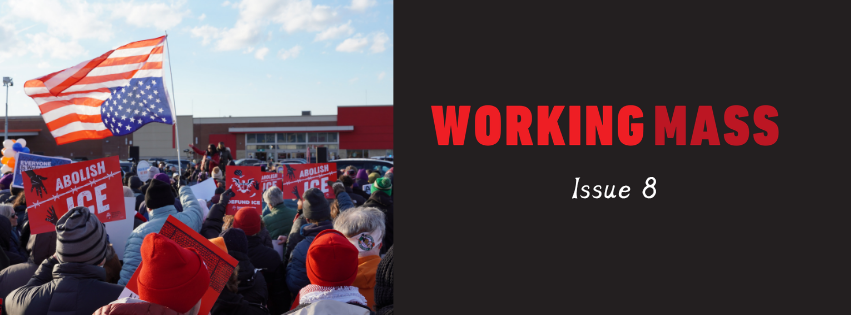
Our 2026 spring edition, Issue 8, is DSA at 100k. To receive a bimonthly full copy of the magazine issue delivered to your door knowing your funds directly support the independent media we represent, you can subscribe here.
Working Mass is a project of union members and members of the Democratic Socialists of America (DSA) in Massachusetts and beyond. We cover strikes, new organizing, and contract campaigns, as well as labor strategy, the reform movement, and socialist politics.
History has changed. Welcome to Issue 8.
In 1912, the Socialist Party of America had grown to surpass 100,000 members. They held two congressional districts, mayoral seats, and countless council seats nationwide. That eve of the Great War was their peak.
For the first time since the SPA’s decline, DSA has reached the coveted milestone of 100,000 members. This is uncharted territory for U.S. organizers today. A mass organization of this magnitude has not been seen in generations of the socialist movement. In Massachusetts alone, thousands organize in five chapters: Boston, Worcester, Cape Cod, River Valley, and the Berkshires, membership rising across all of them, with party offices for members in Holyoke while organizers secure one in Boston to serve over thirteen neighborhood groups, many with memberships exceeding small chapters. There are socialists in workplaces and apartment complexes agitating tenants. There are socialists fighting in the streets and organizing rapid-response efforts against ICE. And there’s a pantheon of socialist officials, once again: hundreds of councilors, legislators, some mayors, while other comrades challenge our opposition for seats in the U.S. Congress to directly confront fascism and the imperialist war machine from the halls of power.
In this issue, we interview workers organizing for their first contract at breweries and dining halls; we follow carpenters fighting against bad developers; we witness marches against each successive war and invasion, from Venezuela to Iran to Cuba; we see labor’s continued work, alongside ICE watch, to muster the capabilities and unity needed to defend us. We review a deeply personal memoir about how one comrade became an organizer through revolution. She’s not the only one. Throughout the issue, DSA leaders share their personal stories of how they came into organization: as unionists, radicals, nurses, field directors, red diaper babies, and single moms involved in the first 100K Drive.
Together, we are a fighting organization.
It’s ours to choose what to do with it.
In Solidarity,
Travis Wayne
Issue 8 Contributors: Maritza S, Robin, Ben A, Tefa G, Jake S, Ezra S, Francesca M, Hayley B-B, Cerena E, Frederick Reiber, Megan Romer
How Did You Become An Organizer? (Part 1)
Tefa G, Chapter Co-Chair, Boston DSA:
I went to Labor Notes in 2018 [a national conference for union activists] and met people from DSA there. And then when AOC got elected in 2018, I decided that I wanted to continue to do this work, but I needed to do it somewhere where it is going to work. So I moved to New York City in 2019 and became a fully active member of NYC-DSA.
I believe in this organization because in organized strategic efforts. As a Marxist, I need a platform to organize people who are disorganized, so that we can actually do something. I believe in civil disobedience protests, but it is important to have a plan – knowing your long-term goals, being strategic about your messaging, knowing what the next step is going to be. What you are gonna get people to do next? Who are gonna be involved? What are the repercussions?
Ezra S, Political Education Chair, Worcester DSA:
I knew what socialism was, but never called myself a socialist. I joined DSA in the summer of 2020, in the midst of COVID and the George Floyd protests. After seeing how the Democrats sabotaged Bernie’s campaign, the failure of the privatized healthcare system, and deepening my understanding about the police force’s relationship with the capitalist state, I began to ascribe the socialist label to my own politics. After nearly eleven months in NYC-DSA, I left to join a Marxist-Leninist microsect called the People’s Revolutionary Party, since disbanded.
In 2024, I found myself returning to DSA: to Worcester DSA, specifically, after I had moved to Worcester for school. The genocide in Palestine had motivated me to want to do more and be more active, and I was especially deflated by Clark SJP’s refusal to hold an encampment. I found Worcester DSA through its statements on October 7th, which I thought were incredibly strong and principled, so I joined the chapter to give it another shot. Two years later, DSA has become my sole political home. I cannot believe there was a time in my life when I debated that fact.
Francesca M, National Political Committee
I’m a red diaper baby: I was born into a socialist family. My childhood memories are dotted with candle-lit marches against the Iraq War; my brother leading a rally against education cuts; falling asleep on a plastic chair at the back of the union hall during my dad’s Party meetings; the ’70s feminist chants I sang with my mum in the car. Yet as I entered adolescence, the contradictions between my home life, the goodness and intuitive correct-ness of my family’s beliefs, and the pervasive social consensus around me — the photographs of Che Guevara on our walls, and my best friend describing Cuba as a ‘dictatorship’ with a knowing look — caused me to live with a sort of split consciousness. If asked about my political identity, I choked.
I had to first experience politics before I could articulate my politics. High school catapulted me into the student movement: every government, it seemed, took a turn at slicing off a piece of the public education system, so there was always something to fight for. And so we did: student strikes, occupations of school buildings, assemblies, bus rides to national marches, picket lines, fundraisers, panel discussions. I participated in everything, and brought my friends along too, but I didn’t have the confidence, or the certainty yet, to lead anything. I was organized, but not organizing. I did, however, begin to claim ideas: I read Marx, and anarchist anthologies, and learnt to distinguish between radical and assimilatory kinds of feminism.
After a stint in Students for Justice in Palestine during grad school, the moment that turned me into an organizer in my own right was the May 2021 Unity Intifada triggered by the Sheikh Jarrah evictions and the 11 days war on Gaza. For two weeks, I had thought of nothing but the war and how to stop it. I took time off work, turned my house into a headquarters, learned to give speeches, rehearsed talking points, travelled to every rally, allowed my friends to bring me groceries and make me coffee and offer their couch, talked to a thousand people, painted banners in my backyard, cold-emailed journalists, yelled at other journalists, yelled at politicians, yelled at the sky and God and Joe Biden, and by the time a friend in Gaza sent me videos from the street celebrations of the ceasefire, I knew I was an irreversibly changed person.
Four months later, I joined DSA.
Articles Featured in Issue 8:
1. Lamplighter Brewers Win Union Vote, Becoming the First Union Brewery Statewide
2. Is the Labor Movement Growing or Shrinking? The Incredible Views of the AFL-CIO
3. Bad Blueprints: Worcester Building Trades Challenge Subsidies to Developers
How Did You Become An Organizer? (Part 2)
Hayley B.B., National Political Committee:
Growing up, my grandmother would reminisce about her organizing efforts in Southern California: walking side by side with the United Farm Workers, protecting women outside of Planned Parenthood, and mobilizing for the passage of the Equal Rights Amendment. I did not realize what this would mean to me years later as a 31 year-old socialist union organizer. She passed when I was a freshman in high school, long before I had the chance to ask her all the questions I now wish I could ask. Throughout high school during Obama’s presidency, I found myself angrier about ongoing political issues than my peers, but I never moved my anger to action beyond posting on social media. In 2016, while attending the University of Colorado Boulder, I yearned to get involved with the inspiring movement that was building around the Bernie Sanders campaign, but I never found a place on my campus to do this. I stumbled around working various low-wage jobs while attempting to “soul search” for a career path. When relatives suggested I do politics when I was consumed by the Kavanaugh trials, their suggestion was eye-opening to me. Within a few months, I was working for a Berniecrat legislator at the State Capitol, where I met Lorena Garcia, a current Colorado State Legislator, who in 2019, was running for the US Senate with a grassroots, socialist campaign endorsed by all four Colorado DSA chapters that took a major gamble and hired me as her full-time field director. I developed relationships with socialists all around the state. After the 2020 COVID shutdown ground her campaign to a halt, I plunged in and joined Denver DSA and was elected as electoral chair within months. In that same period, I led a successful organizing campaign with a fellow Denver DSA comrade to unionize the nonprofit we were working at under a Communication Workers of America (CWA) local. I’ve been a union member ever since and currently work as a union organizer for AFT-Oregon.
In 2022, I visited my grandmother’s home country of Slovakia for the first time to learn about my family history and visit her cousin, Martin Bútora, who still lives there. This cousin is a sociologist, writer, and professor. At the time, he was also an active advisor for Zuzana Čaputová, the first woman and youngest person ever elected to be Slovakia’s president as a member of the Progressive Slovakian Political Party. In 1948, as a teenager, he worked as a reporter when the Communist Party took over Slovakia and transitioned it into a Soviet satellite state. By November 1989, he co-founded Public Against Violence, the leading movement of the democratic revolution (The Velvet Revolution) in Slovakia, then served as the human rights advisor for a former president of Slovakia, was appointed the Slovak Ambassador to the United States from 1999 to 2003, and even ran for president of Slovakia in 2004. I spent each night during this trip gathering as much information as I possibly could from him about his own years of organizing experiences and his relationship to my grandmother, which he self-described as someone he wrote back and forth with frequently to discuss the politics of the world, and learn from each other’s organizing in their respective countries. Through our conversations I learned that throughout his lifetime, he had lived under almost every form of government, so I asked a simple question: “What form of government is the best?” He answered immediately, “Democratic socialism is the only form of government that will save our world.” This moment solidified everything for me and made me realize I didn’t come into socialism and organizing on my own; my grandmother has been leading me here the entire time. After my trip to Slovakia, I chanced upon my grandmother’s CWA union pamphlet. I never knew she was also a unionist herself, let alone the same union I first belonged to. This further crystallized what I already knew: my life path has roots much deeper than myself.
Cerena E, National Political Committee:
My parents were newly-immigrated Filipinos to NYC when my mom gave birth to me at the hospital where she worked. Their first jobs as US citizens were as nurses, with my mother being the first union nurse in my family. For most of my childhood, my parents never seemed to be in the same room at the same time unless we were on vacation with extended family. After my brother was born, I was raised nearly full-time by my godparents, both of whom were also nurses. The stories my elders would repeat to my brother and me sought to color my understanding of the world: according to them, by overcoming poverty through sheer grit and hard work, they raised me to embody their aspiration for a better life in the US. We moved to Houston in the summer before I began second grade, when my parents were able to afford a decent standard of living for my family on the combined salaries of two nurses.
To my parents’ chagrin, much of my adolescence was spent questioning whether hard work actually pays off in the real world. I dove into the nonprofit world, part with the naivete of an ambitious high school student authoring a college resume, and part out of the simmering rage I’ve come to associate with unabashed expressions of wealth in the US. I volunteered hundreds of hours at a local food bank, and fundraised, before quickly learning that nonprofits could never address the root of poverty. As long as there existed a class of wealthy donors who would sooner lift a finger to write a grant than confront the ugly economic system through which they enriched themselves, what good was my volunteer labor?
The absence of any competent opposition from the Democratic Party during Trump’s first term left me hopeless until I joined YDSA in my sophomore year of college at the University of Texas, Austin, nearly eight years ago to this day. Armed with clipboards, a YDSA banner, and a Bernie Sanders cardboard cutout, the students who took me on as a future socialist organizer raised my expectations of what we must demand of the world to change it. I joined my first union, the Texas State Employees Union (TSEU), as an undergraduate student worker. Unsurprisingly, my mentors in TSEU were also my mentors in DSA. From campaigns to protect students and university workers in the face of austerity during the COVID-19 pandemic, to electoral campaigns like Heidi Sloan’s run for Congress as an open democratic socialist in Central Texas, I saw myself and the people I organized with in Y/DSA transformed into working class champions of socialism. Now with over a year of experience working as a union nurse, just as my mother once was, and standing toe-to-toe against capitalism on a regular basis — the courage I feel to organize and fight for a just world would not be possible without the thousands of socialists I’m proud to call comrades in DSA.
4. Losing Your Whole World To Win a World – A Review of Defiance by Loubna Mrie
5. Emmanuel College Dining Hall Workers Win First Contract with UNITE HERE Local 26
6. Boston Labor Unites to Face ICE As Minneapolis Leads First General Strike in 80 Years
How Did You Become An Organizer? (Part 3)
Megan Romer, National Co-Chair:
My first official title in DSA was 100K Captain, during the original 2021 100K Drive. I’d started organizing with my local chapter, Southwest Louisiana DSA, a little over a year before, but knew quickly that I had a lot of catching up to do — though I had been in activist spaces before, becoming an organizer (and becoming a socialist in any meaningful way) was new to me. My job for the first several months: snacks. (Self-imposed.) In that year, because of my comrades, I’d gone from a wobbly “Elizabeth Warren is probably the compromise choice we need” voter to a full-time Bernie 2020 super-volunteer, helped my chapter pivot to digital organizing during the pandemic, and worked on the leadership team of our chapter’s massive mutual aid response to Hurricanes Laura and Delta.
When the 100K Drive rolled around, my chapter’s leadership team, exhausted from our ongoing hurricane response, asked if I’d be willing to be the 100K Captain, our chapter’s lead for recruiting efforts, and I nervously accepted — I wasn’t sure I was ready for a formal position, but I stepped in. Our little bayou-side chapter grew by nearly double during that drive, solidifying a Top 3 spot on the chapter leaderboard and the legendary pink prize hat for several of our members. We had a distinct advantage, in that we were actively working on a campaign that was extremely easy to tap people into in the short term. Where we struggled was, of course, retention.
No chapter in the country figured out the magic potion that retained members through the Biden presidency. With Trump out of office and the daily news “back to normal” (such as it was), combined with the long tail of pandemic lockdowns, our numbers dwindled — we didn’t get all the way to 100K during that drive. It took years of rebuilding, combined with obvious external political conditions (some of which were of DSA’s own making, like the Mamdani campaign) to finally hit that big number, but we did. And now we’re here, we made it! But the work isn’t done. A DSA that is able to stop massive wars, shut down the supply chain to demand working class rights, protect our most vulnerable, and build a real democracy? That’s a DSA in the millions, and those millions need to be activated, trained, and ready to take on that fight.
We still haven’t solved the equation of retention, but when I look back at my own arc – just a regular slightly weird and artsy working-class mom who went from left-lib to communist through the social practice of collective organizing and collective learning. The question of how to pull people into that social practice — to make folks feel empowered about organizing and enthusiastic about learning both skills and theory — is one I’m still working on but which I try to bring back to my own experience. You are probably also working on this question – how to make DSA stick – and I’m so glad to be in this organization to work on it together. To the next 100K!
The post Announcing Issue 8: DSA at 100K appeared first on Working Mass.
“}]]