[[{“value”:”

By: Chris Brady, James N, Dan Albright, Mitch Gayns
MASSACHUSETTS – Working people and unionists coalesced in May Day events throughout Massachusetts on May 1, 2026, which is likely to be seen as a moment of a historic cultural revival for the holiday in the United States.
Also known as International Workers Day, May Day honors the martyrs of the 1886 Haymarket Massacre in the fight for the 8-hour workday. May Day is a seminal holiday across most of the world, where red banners are unfurled down major thoroughfares, but the holiday has largely been confined to the margins on its home turf of the United States. Instead, influenced by anti-labor sentiments, the United States moved to officialize and honor the much more patriotic Labor Day on an entirely different part of the calendar.
But as Working Mass uncovered in several events and actions in Massachusetts throughout the day, May Day is turning mainstream once again. The mainstream ‘No Kings’ pages share ads about May Day actions in their own networks that have emerged since Trump’s election, the unions use the holiday for actions, and pro-worker organizations hold their socials with genuine joy everywhere from Boston to Worcester to Holyoke. While May Day revives across the country in massive actions of tens of thousands from New York to Portland to Minneapolis, in Massachusetts, May Day shows a labor movement captured in time.

Boston Logan Workers Take Off
EAST BOSTON – The day’s packed itinerary kicked off with the Coalition of Boston Logan Airport Workers (CLAW) rallying at East Boston Memorial Park. CLAW, a consolidated coalitioon of ten unions that split bargaining representation of Boston Logan’s pilots, flight attendants, food service workers, and baggage handlers, had rallied between four and five hundred workers to march.
One of the key issues the unions marched against alongside their allies was a management policy that limited pickets on airport property to an arbitrary ten people, effectively demobilizing workers. Luke Williams, President of the Boston Association of Flight Attendants, told Working Mass:
We’ve been told if United Airlines is having a picket today, then American can’t have a picket, or you can have five and five people each and split it. We’ve been limited to ten people for any action at the airport – point blank.
Williams represents 900 flight attendants at Logan.
Addressing the limitation, Rep. Ayanna Pressley highlighted the importance of organizing against authoritarianism:
We need to be able to organize to apply pressure…no one should be intimidated from exercising their constitutional right to free speech.
Workers also rallied for better wages and healthcare, many wearing lobster iconography. Signs read “CLAWing back our rights.”
Four to five hundred unionists marched from Memorial Park to Logan Airport. At the edge of airport property, an airport management official flanked by state police officers forced the march to stop, which action planners anticipated. In a dramatic exchange with hundreds of workers looking on, management spoke to SEIU 32BJ Executive Vice President Kevin Brown.
According to Brown in an announcement to the crowd, management had “committed that they will review the policy so that airport workers can protest with more than ten people at a time.” The primary demand of CLAW, in its action, had been won.

Worcester Celebrates its Annual May Day, Alongside Rhode Islanders
WORCESTER — Workers across trades, academia, and professions gathered in University Park around 6 p.m. on Friday, May 1st, for the Worcester DSA’s annual May Day rally. Speakers from the Worcester and Rhode Island DSA spoke to working people across the crowd with a clear message: generations of workers across the world have fought, and continue to fight, for a better world.
Worcester DSA Steering Committee member Jake S read a speech from Peter Fay, a longtime labor organizer and Rhode Island DSA member. Fay’s speech traced the history of the labor movement in the city and its bond with immigrants, often victims of capitalism.
“We didn’t come here looking for freedom or entrepreneurship,” he said. “We came because capital pushed our ancestors off of their land.”

Political violence against communists, socialists, and labor organizers in the early 20th century spread across the country. The textile mills and factories across New England were home to workers fighting for a better world, like labor leader “Seditious Annie” Anne Burlak Timpson, and the capital looking to stop them.
Fay said:
She unflinchingly organized Black and white workers together, despite all of capital’s best attempts to set them against each other, to buy off and bribe some at the expense of others.

One common theme throughout the rally was the failure of both political parties in America, and their unified support of international violence. James L said:
A U.S.-backed genocide in Palestine, war in Iran, war in Lebanon, rampant looting of public funds by conspiring billionaires, attacks on the rights of trans people, abduction, extraordinary rendition, and murder of immigrants, political dissidents, now heads of state in Venezuela and Iran, by our completely unaccountable government. Most of the so-called opposition party happy to collaborate, sign off and roll over.
James noted Rep. Jim McGovern (D-MA) called for a general strike last year, but offered no vision, organizational structure, or demands for a general strike.
While speakers noted the failures of the two dominant political parties, the historic and ongoing repression of workers rights, and capital’s division of the working class, all offered a message of hope and solidarity that starts with labor organization. Cayla Dodd, a bus driver, union activist, and member of IBT Local 170, said:
The problem isn’t that workers are asking for too much, the problem is that capitalism requires workers to live on too little. It requires instability. It requires fear. It requires workers to be one emergency away from disaster, because a worker who is scared of losing everything is easier to control. That’s why they hate workers talking to each other, because the moments that workers stop seeing ourselves as isolated individuals and start seeing ourselves as a class, everything changes.

Boston Worker Organizations Touch Grass
NORTH END – Back in Boston, as the airport action concluded, socialists gathered in a harbor park in the North End at midday to socialize and hear speakers from the labor movement.
Evan McKay, Boston DSA-endorsed candidate for state representative in the 25th Middlesex District, spoke on how union work fighting harassment as President of Harvard Graduate Students Union (HGSU), currently on strike, led them to socialism:
We need to have the union in these circumstances. That was one of the things that brought me into socialism, the sense that we need to have fighting unions in order to take on these struggles.

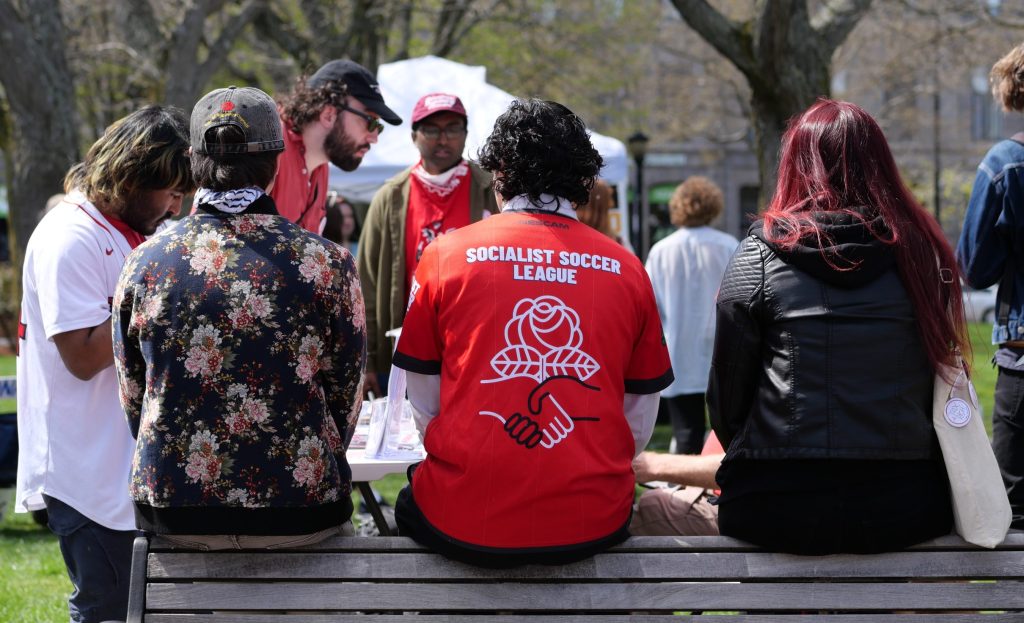
Energy at Field Day was high. Organizers had set up a volleyball net in the corner of the field. Although the net was left largely unused, organizers assured Working Mass that DSA is actually a very athletic group. Socialist soccer jerseys were on display, and given the high level of active recruitment for the Boston chapter’s running league, they may have a point.
Tables prominently featured the chapter’s campaigns for rent control in Massachusetts, an upcoming socialist job fair, as well as pamphlets for different working groups and the Emergency Workplace Organizing Committee.
Dr. Anisah Hashmi, a Resident Physician at Boston Medical Center and a delegate for the Committee for Interns and Residents (CIR-SEIU) compared the conditions of resident physicians to academic workers.
Like grad workers, hospital corporations label us students and trainees. It’s a slap in the face to the 80-hour work weeks that we put in to deliver high quality patient care. It’s unsustainable to expect us to fully show up for our patients as we struggle to afford to live in the city of Boston.
DSA then marched through Downtown Crossing to join the rest of the labor movement for the premier rally at the Boston Common.

On May Day, Western Mass Shows Itself as Focal Point for a More Militant Labor Movement
This was originally published as video footage for Working Mass digital on Instagram. Reporting was supplemented for print.
HOLYOKE – Even further west from Worcester, in the River Valley, hundreds of unionists and workers marched through downtown Holyoke to rally for working peoples’ rights and pay and against war, as well as signal a new moment in the history of the Western Mass labor movement.
The rally was organized by the Western Mass Labor Federation and led by the Holyoke Teachers Association. Holyoke teachers are approaching a full year without a contract, and centered the day’s militancy around pressuring Mayor Garcia and statewide leaders.
Labor Federation President Jeff Jones spoke to Working Mass about the systemic defunding of education.
They never seem to have a problem allocating money for war, but the moment we talk about funding schools like these Holyoke teachers are here today, all of a sudden it’s a problem, and all of a sudden we can’t accommodate it.
Western Massachusetts’s Pioneer Valley is a historic progressive stronghold with a strong labor history, dominated by industries in higher education and agriculture. Holyoke has the highest concentration of Puerto Ricans per capita outside of Puerto Rico.
The labor collective has been intentional about cultivating militancy and rank-and-file democracy. According to Ethel Everett, a social worker and union leader with SEIU, innovation in the labor movement is urgently needed.
We have these shared values about what’s happening in this country, what’s happening in this world. We have to think differently and not be so focused on this is the way labor has always been.
The connection to May Day was also intentional, organizers argue. “May Day is Workers’ Day, a communist holiday,” said Barbara Madeloni, former president of the Massachusetts Teachers Association and Education Coordinator at Labor Notes. She continued:
The history of May Day is the history of working people accessing the fullness of their collective power to say, damn it, these are our demands and we’re going to do whatever we need to do to win those demands.
Western Mass unionists are pushing their politics upward.
The Western Mass Area Labor Federation has moved beyond traditional bread-and-butter unionism: launching political education programs, building deeper ties with rank-and-file workers, supporting new organizing in collaboration with the Emergency Workplace Organizing Committee and River Valley DSA, and taking public positions on international issues that many U.S. labor bodies have avoided.
In November 2023, the federation voted unanimously to call for a ceasefire in Gaza, breaking a gag order imposed by the national AFL-CIO on the issue. In 2024, it went further, backing a call for an arms embargo. And this year, the federation condemned the war with Iran and what it described as the kidnapping of Venezuela’s head of state.
Holyoke teachers are still fighting for a contract. But on May Day and after, they will be supported by the collective Western Mass. labor movement. The rest of the country would benefit from taking notes on how labor itself can support the networks of the rank-and-file across the region.

Boston Teachers Fight Cuts and Pour Hundreds Into the Common
BOSTON COMMON – In a finale of the day before workers wrapped up to hit bars and socials, workers marched on the Common. The Boston Teachers Union (BTU) was a key player in the rally at Boston’s traditional heart, aimed directly at Mayor Michelle Wu: stop the layoffs.
BTU speakers noted that the Mayor’s proposed budget spared all departments from staffing cuts – with the exception of 400 teachers and paraprofessionals at Boston Public Schools.
While the Mayor and major news outlets cite enrollment declines of 3-4%, these cuts represent more than 5% of total staff, with the paraprofessionals (who are overwhelmingly Black and Latino) especially hard hit. These cuts are contradictory to BPS’s stated desire to move toward a ‘co-teaching’ model, the gold standard in K-12 education finally beginning implementation due to the unrelenting advocacy of students, parents, and educators.
Boston Public Schools (BPS), and the national education landscape at large, has been constrained by Medicaid cuts increasing the city’s healthcare cost burden and attack on immigrants undercutting student enrollment.
The Mayor chose to cut critical education staff at a time when they are needed more than ever. Her decision is all the more alarming in contrast to her laissez-faire attitude toward police overtime, which consistently lands 70-100% over budget, significantly higher than her predecessor Mayor Walsh.

Shortly afterward, at the Boston Common, BTU joined hundreds of workers who turned out for the keynote May Day event. A tapestry of eclectic unions, pro-worker organizations, and liberal groups joined together with shared interest in fighting for the labor movement.
“Today is International Workers Day,” said Greater Boston Labor Council President Darlene Lombos. Lombos explicitly acknowledging the legacy of the Haymarket Massacre as “the courage and the sacrifice of those majority immigrant workers sent a beacon seen around the world.”
Party of Socialism and Liberation (PSL)-endorsed U.S. Senate candidate Joe Tache spoke about the suppression of May Day actions in the United States:
For the most part, May Day in our country has been pushed to the margins, because the billionaires and the politicians that represent them, don’t want us to know our history. But here in Boston we’re shaking things up…we’re putting May Day back on the table.
DSA wrapped up the rally marathon at Democracy Brewing, a worker-owned cooperative near the center of the city and host to many worker-organized meetings. Discussions turned to moving workers from mobilizing to organizing. The central challenge remains taking energy from the rally turnout and funneling it into sustained political action. But after reclaiming May Day, workers are one step closer to doing just that.
Chris Brady is a member of Boston DSA and an editor of Working Mass.
James N is a member of Worcester DSA and contributing writer to Working Mass.
Dan Albright is the chair and an editor of Working Mass.
Mitch Gayns is a digital creator and campaign organizer based north of Boston.

The post May Day is Turning Mainstream Again appeared first on Working Mass.
“}]]