[[{“value”:”

By: Nicholas W
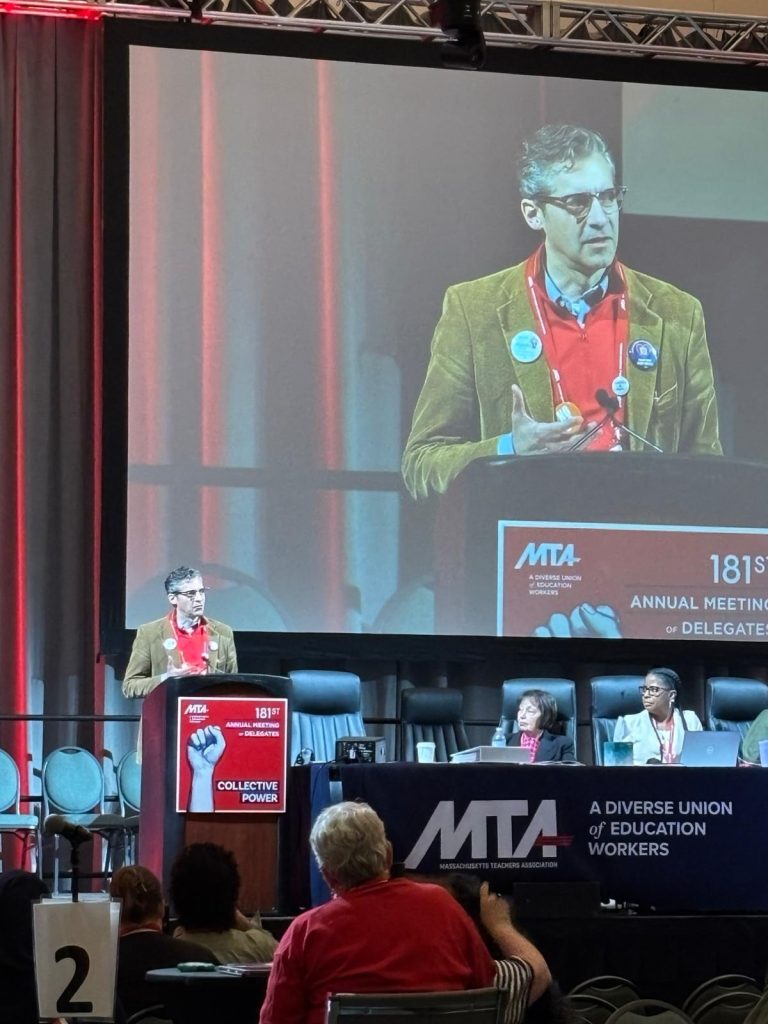
BOSTON – On May 8-9, 2026, the Massachusetts Teachers Association (MTA) held its 181st Annual Meeting at the Hynes Convention Center..
The Massachusetts Teachers Association (MTA) is the largest union in Massachusetts and the state affiliate of the National Education Association. Alongside 36 fellow delegates elected from the Cambridge Education Association, we met over 1500 delegates from across the state representing K-12 and higher education workers.
I have organized as a rank-and-file educator ever since I became a teacher over ten years ago. In 2019, I joined Educators for a Democratic Union (EDU), a militant rank-and-file caucus within the MTA, after learning about their involvement in the Dedham Education Association’s strike the same year. Not only was this my first time attending the annual convention as a delegate, it was my first time as a member of a caucus that was competing to maintain leadership in my statewide union.
Contentious Politics – Organizing for Palestine
The Annual Convention is the highest decision body of the MTA, where we elect our leadership, including both President and Vice President, as well as the Executive Board and Board of Directors. Membership utilizes Roberts’ Rules to debate and vote on resolutions, elect the President and Executive Board, budgets and operations. The Convention is where the magic happens outside of the shopfloor: which political path our union should take and what priorities our union should organize around.
This year’s convention was packed with resolutions and bylaw changes, along with a very contentious leadership election.
The MTA Rank and File for Palestine (MTA-RFP) introduced six New Business Items (NBIs), which included endorsing the #DropTheADL campaign and protecting the freedom of speech of rank-and-file educators who speak up against genocide and war. NBIs are the last items to be voted on at the convention; because of that, many of them do not get to be voted on by the delegates and get assigned to the incoming Executive Board to decide.
This year was no different. Seeing that time was running out to vote on the MTA-RFP NBIs, a delegate decided to make a rule change that allowed members to vote in a straw poll in an effort to move through the items quicker. The results of the straw poll would then be given to the incoming leadership to guide them in whether to adopt specific NBIs not formally voted on by the membership. As the straw poll began, many teachers, tired and exhausted from two days of deliberating, began to leave the convention hall. A tiny Zionist contingent with support from outside organizations, such as Jewish Community Relations Council of Greater Boston, called for quorum three times to end the vote of the straw poll and ultimately had their way before members were allowed to vote on the MTA Rank and File for Palestine backed NBIs.
Other contentious battles revolved around the budget. One central question involved increasing dues to expand our organizing budget for 2026/2027 year, as well as changing our bylaws to allow for a direct vote of all MTA members for the office of president. Currently, only elected delegates to the annual meeting are allowed to vote for union leadership, but this would open up the election to all rank-and-file members. Concerns over the integrity of the election, such as lack of guardrails to block outside groups from taking advantage of our democracy, and the cost of setting up a brand new election system animated the debate.

Battle for Leadership
By far the most contentious battle was over the MTA presidency and vice presidency.
Three candidates ran for president with running mates for vice president. Representing the old guard of union politics was John Sullivan of Belmont Education Association and Gayle Carvalho, of the Quincy Education Association. The old guard has historically played a non-confrontational role with the state and has shied away from taking a stance on political issues. This year was no different, as both Sullivan and Carvalho’s campaigns highlighted going back to “bread and butter issues,” and not getting entangled in controversial political fights, such as solidarity with Palestine.
In the middle was current Vice President Deb McCarthy of the Hull Teachers Association running for president and Dean Robinson, of the Massachusetts Society of Professors running as VP. McCarthy, who has a history of union militancy throughout her career as an educator, largely highlighted her experience as the Vice President of the MTA and the accomplishments she and the outgoing President, Max Page, worked on. This included passing the Fair Share amendment, which imposes a 4% surtax on annual income exceeding $1 million that funds public education and transportation and the elimination of the Massachusetts Comprehensive Assessment System (MCAS) exam as a high school graduation requirement through a ballot initiative in 2024. Robinson focused on his contributions to policy, such as expanding Mass Health and working on single payer initiatives in the state. Their supporters made up a mix of former EDU members and MTA-RFP members which demonstrates that they had support from other left factions within the MTA.
To the left were Matt Bach of the Andover Education Association and Deb Gesualdo of the Malden Education Association running for President and Vice President respectively, who are also members of Educators for a Democratic Union (EDU).

Educators for a Democratic Union (EDU)
EDU members have a record of winning positions in leadership. Barbara Madeloni was first — she won the presidency unexpectedly in 2014 to take the first step in ousting a largely moribund and undemocratic business union leadership that ran the MTA for decades. Merrie Najimy and Max Page were Madeloni’s successors. Each election brought a stronger slate of EDU members to push the union left and focus on issues that members most cared about. Since 2019, under EDU leadership, Massachusetts educators have gone on strike multiple times, despite Massachusetts state law prohibiting any form of work stoppage, and won large concessions from their bosses.
In 2019, Dedham teachers became the first local to strike since 2007. They were followed by Brookline, Haverhill, Andover, Woburn, Malden, Newton, and, most recently, the historic and coordinated strike of North Shore educators in Beverly, Gloucester and Marblehead. All of these strikes were substantial victories for their members, including increased pay, especially for the lowest paid education workers, such as paraprofessionals, smaller class sizes and contract language that protects students and staff from ICE. Throughout these outbursts of increased worker militancy, EDU has led the charge by transferring their strike program to different MTA locals throughout the state. It is also important to point out that the Dedham, Brookline, Andover, Malden, and Haverhill strikes were led by presidents who are also members of EDU.
Internal Divisions of EDU
During each MTA election cycle, EDU endorses candidates from their membership to run for office. While there is no hard rule within the caucus barring candidates to run for leadership within the MTA who did not receive an EDU endorsement, usually, EDU members accept results and campaign for their union sibling.
That was not the case this year. While Matt Bach and Deb Gesualdo won the endorsement from EDU after a lengthy runoff election, outgoing MTA VP Deb McCarthy and college professor Dean Robinson decided to run for office even though they lost the EDU endorsement. This effectively split the “left” vote and gave room for the old guard, represented by John Sullivan and Gayle Carvalho, a stronger chance of winning at the Annual Meeting. Max Page, EDU member and outgoing president, stayed true to his EDU commitments and endorsed Bach and Guasaldo despite working alongside McCarthy over two terms.
Ultimately, Bach and Gesualdo, who both received the most votes during the initial election and runoff election against Sullivan and Carvalho, were elected to the presidency which means that EDU has continued its streak of winning leadership within the MTA. EDU also maintained a solid leadership on the Executive Committee and Board of Directors. Nonetheless, this election has exposed real divisions within EDU and inside the MTA itself.
Endless debates over what was actually “germane” to a resolution, cranks punishing their fellow delegates with their endless amendments, and most importantly, serious debate over the strategy and politics of our organization all characterized the MTA Annual Convention. Nonetheless, what made the experience of union democracy feel so much more real was that all of this was happening within the context of my workplace; the location I spend so much of my time and energy teaching my students and organizing my coworkers so we can build a better world for us, our students, and their families.
Under those conditions, the stakes feel — and are — different.
Nicholas W is a rank-and-file member of Cambridge Education Association (CEA) and Educators for a Democratic Union (EDU), a rank-and-file caucus within the MTA.
The post Militant Rank-and-File Stays in Leadership of Massachusetts’ Largest Labor Union appeared first on Working Mass.
“}]]