
[[{“value”:”

By: Chris Brady
BOSTON – Healthcare is in a private-equity induced freefall. But after a historic strike and ongoing negotiations, including a lock-out confrontation with the bosses, nurses at Brigham Women’s Hospital stand in between the Commonwealth’s healthcare unions and coordinated management destruction.
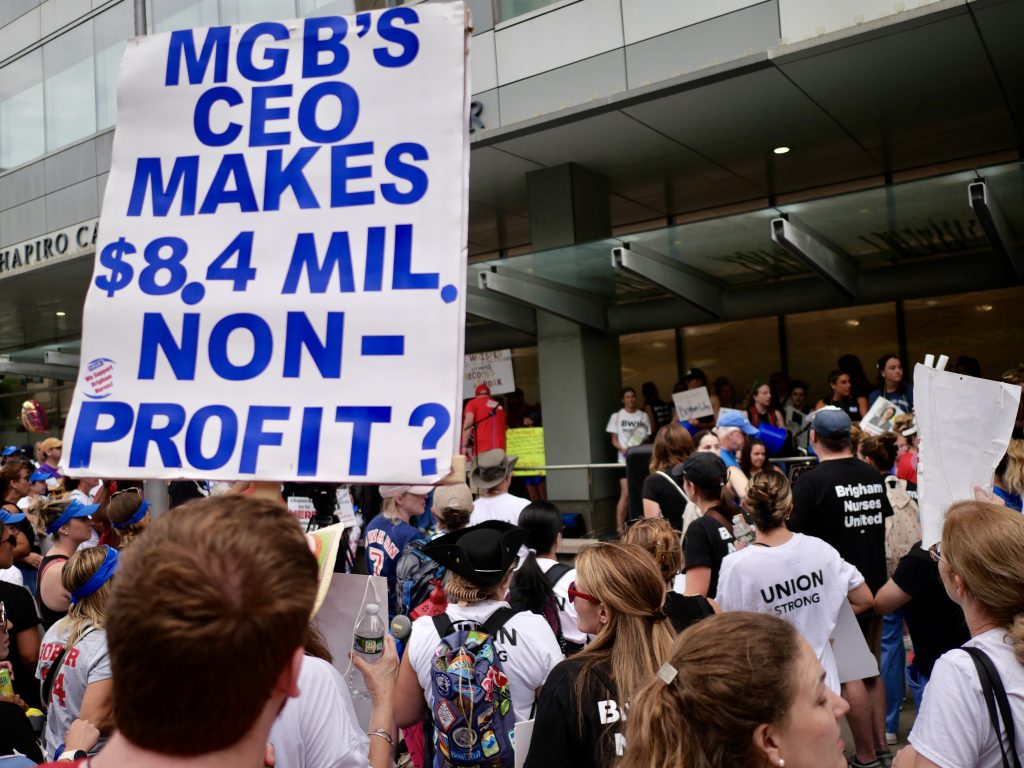
On Wednesday, July 8, 4,700 Mass General Brigham (MGB) nurses and home care clinicians at Brigham Women’s Hospital went on a 24-hour strike after 99.6 percent of Massachusetts Nurses Association (MNA) members at MGB voted in favor of the largest nurses’ strike in state history. The work stoppage comes after 23 failed negotiation attempts since November and after the nurses’ contract expired in early April.
Hospital management responded to the strike with a five-day lockout so they could justify shipping in 1,300 travel nurses, understood by union nurses as scabs for management. Management also retained a notorious union-busting law firm at the heart of many employers’ anti-labor inventory.
Mnagement still hasn’t conceded any demands and nurses are back working for patients, in spite of the historic action, but the workplace issues and the war associated with them remain — now louder than ever before.

Wages, Safety, and PTSD
Nurses point to a long list of grievances, including but not limited to pay.
Kelly Morgan, chair of the Massachusetts Nurses Association bargaining unit at Brigham Women’s Hospital and a labor and delivery nurse, told Working Mass that the strike came after months of stonewalling from hospital management.
Nurses were offered a laughable 0 percent cost-of-living increase for almost all nurses. MGB is one of the best hospitals in the country, and nurses deal with patients with some of the most complex conditions in the world. Brigham’s prestige requires high-level skill, but nurses said that their compensation doesn’t come close to meeting the job’s demands.
“We deal with the sickest of the sick,” Jim McCarthy said, a PACU nurse and vice chair of the bargaining committee. “We want to make sure the nurses that we have stay skilled, but also that they want to stay here.”
Despite Brigham’s assurance that their nurses are the best in the country, Dana Farber Cancer Institute nurses are paid more than MGB. The union is seeking pay parity with Dana Farber and compensation commensurate with their experience, McCarthy indicated. Morgan added that MGB is located in Boston’s affluent Longwood Medical area, subjecting nurses to significant commuting and cost-of-living concerns, each another brick in their walls. Nurses are demanding a reasonable wage adjustment for the growing expenses of living in Greater Boston.
“To live in the city of Boston, you need as a single person to make $120,000 a year at a minimum,” she argued. On June 15, MGB Anesthesiology posted a CNA job application which advertises $18.50 to $27.50 an hour.

Another chief concern was healthcare costs, an almost ironic fact not lost on strike organizers.
This demand had some historical context, Morgan said, as hospital management had bungled a 2024 health insurance plan offered to nurses. The resulting benefit put some nurses at risk to pay Massachusetts tax for technically having inadequate coverage. The hospital consequently renegotiated and raised worker deductibles to cover themselves from their own error.
“That really put a sour taste in our mouth,” Morgan said.
In a remarkable demonstration of shamelessness, hospital management attempted to force yet another increase in nurses’ premiums. The 0 percent cost-of-living increase is causing MGB nurses to be pushed to accept an effective across-the-board pay cut due to the increased premiums.
Beyond this, McCarthy outlined that nurses are fighting for fair nurse-to-patient staffing ratios, one of the most common bargaining issues in healthcare. Management prefers to stretch nurses as thin as possible in order to save on labor costs. Consequently, nurses are often forced to work in overwhelming conditions and patient care suffers as a result, he said.
“They don’t hire enough staff,” McCarthy continued, adding that management prefers to rely on travel nurses or frantic ‘please come in’ messages blasted to staff before busy periods.
This status-quo is preferable for management than hiring union nurses. But travelers, in particular, are another point of significant contention. McCarthy believes that sometimes up to 30 to 40 percent of nurses at the hospital are non-benefitted, non-union travel nurses. Travel nurses typically constitute 8 to 10 percent of total nurses in any given hospital on average. He contested that relying on travelers is problematic because they take away from what should be union jobs, and given a general lack of experience, put patient lives at risk.
“It’ll turn your hair gray. They’re like mercenaries,” he said.
When the scabs take over — this is so scary — but the death rate in the hospital goes up.
Working Mass could not independently verify this claim.

The most pressing issue, though, is safety. Morgan outlined truly concerning instances of systemic violence nurses face:
The violence in the workplace is ridiculous. It’s there every day, verbal assaults on nurses, by patients, patients’ families.
Morgan described that nurses repeatedly identified “frequent fliers,” or patients that regularly came into the hospital and threatened nurses. Despite flagging them to security, she said that the officers were rarely helpful. The day after one such patient had been identified as threatening, she continued, the patient attacked a nurse, grabbing her by the throat and reportedly slamming her head against the wall. Morgan said:
That nurse has not been back to work since. She has significant PTSD. She doesn’t even know if she wants to return to nursing.
She explained a separate incident where a nurse checked bathrooms looking for an absent patient, also previously flagged to security, only to be greeted by the patient cooking synthetic tranquilizer in the bathroom. Morgan recalled that the nurse inhaled the fumes and “had an altered mental status” that required an emergency room visit immediately. Nurses have even begun calling 911 to deal with physical threats because in-house security is less responsive than the Boston Police.
“(Management) was like, we have to look into that further,” Morgan said, in response to nurses raising concerns about workplace safety. “We don’t have all the details, blah, blah, blah. Then it’s crickets.”
Morgan said multiple workplace issues have shown that nurses and patients are relegated to second-tier for the hospital. The decision to strike was not just about wages, or safety, but about the dignity of patients and nurses themselves.

The Board of Chuds
MGB’s Board of Trustees provides a glimpse into why the hospital has stonewalled its workers.
Out of the 26 Trustees, 15 of them are former, current, or the spouses of corporate CEOs. An additional four Trustees are executives at private equity or venture capital firms.
There are some familiar faces among the Trustees as well. One os Jonathan Kraft, son of militant Zionist and New England Patriots owner Robert Kraft, and brother to Josh Kraft, who ran a failed primary campaign against Boston Mayor Michelle Wu in 2025. Another familiar face is that of the president and CEO of Lockheed Martin, James Taiclet, helming the world’s largest weapons manufacturer while also serving on the hospital board. Taiclet has overseen military transfers to Israel including: F-16 and F-35 fighter jets, which comprise 80 percent of the Israeli military’s fighter aircraft, AGM-114 Hellfire missiles, and M270 Multiple Launch Rocket Systems.
Diane Patrick, retired law partner at Ropes & Gray and spouse of former Governor Deval Patrick, also sits on the board. Her law specialty is employment law — on behalf of employers, naturally — with particular specialization in the healthcare sector.
Former Boston Mayor and Secretary of Labor and current NHLPA union Executive Director Marty Walsh is another Trustee. Despite his seeming labor bonafides, he hasn’t been very visible during the nurses’ strike. Morgan told Working Mass in a text message that Walsh has always been supportive of the union and likely continues to be, but that nurses believe “the MGB Board is silencing him.”

There are only two actively practicing physicians on the board, and predictably, no nurses. As the governing authority of the hospital system, the board has significant sway in contract negotiations. Given the overrepresentation of billionaires and absence of workers on the body, class-war delineations of the negotiations become clear.
MGB paid its executive staff a total of $35.9 million in 2024. MGB CEO earned over $8 million in compensation, prior to her bonus. Again, nurses were offered a 0 percent cost-of-living increase. The hospital is a non-profit organization.
Nurses understand that healthcare is in a precarious position, over a year out from damaging Trump cuts to research and Medicaid/Medicare has impacted industry staffing, as reported previously by Working Mass. But nurses consistently highlighted that they are cognizant of these factors outside of the hospital’s control. Management, however, is less motivated to cut a deal. McCarthy said:
If they had come to us and said, look, we’re in a tight bind, we could come back and say, yeah, I can understand that. But that’s not the case. You have a board of directors, run by hedge funds, venture capitalists.
The hospital has hired law firm Littler Mendelson to fight the nurses’ union effort. Littler Mendelson is the largest employment law firm in the country, pushing ethical boundaries for anti-worker outcomes, assisting Starbucks, Amazon, and Delta Air Lines with union-busting efforts. In an interview with SFGATE, labor lawyer Stewart Weinberg said that the firm has a nickname among union lawyers: “Hitler, Mussolini, and Fascist.”
“How much money are they paying them?” Morgan wondered, arguing that the cost of the law firm’s services, travel nurses-lodging and wages, and lost patients from the strike exceeded the cost of settling with the union by hundreds of thousands, if not millions of dollars.
Management’s strategy, she argued, is not motivated by near-term finances, but a once-in-a-generation opportunity to weaken MGB’s various healthcare unions.
“They’re making a long-term financial play,” she said. “They’re looking 20 years down the road. If they can break us, that means that the other (unions) are an easy target.”
Chris Brady is a member of Boston DSA and an editor of Working Mass.

The post “Union-Busting” Law Firm and Business-Backed Trustees Lead MGB Nurses to Largest Nurses’ Strike in State History appeared first on Working Mass.
“}]]