
[[{“value”:”

By: Matt Wolfinger
BOSTON – Last month, the Supreme Court handed the Trump administration a long-sought victory, setting the stage for the mass deportation of roughly 356,000 people out of the United States. The landmark decision paves the way for the cancelation of Temporary Protected Status (TPS) for Haitian and Syrian immigrants. The TPS program allows nearly 1.3 million people from 17 countries to live and work in the U.S. while conditions in their home countries are designated as unsafe by the U.S. State Department.
Temporary Protected Status and its Healthcare
TPS was created by Congress in 1990 to prevent deportation to countries destabilized by war, natural disasters, or any other set of circumstances that would place deportees in danger. Haiti was granted TPS status in 2010 after a devastating earthquake left hundreds of thousands dead and more than one million displaced. The Biden administration extended TPS for Haiti after the assassination of the Haitian president in 2021.
Although many Haitian immigrants have been deported since 2010, none were TPS holders. Those who apply and are accepted for TPS gain a special legal status and work authorization that protects them from deportation.
Deciding what countries qualify for TPS is up to the Secretary of Homeland Security. By the end of her 14 month term, former DHS Secretary Kristi Noem had canceled or attempted to cancel TPS for Venezuela, South Sudan, Ethiopia, Nicaragua, Nepal, Honduras, Myanmar, and Haiti.
According to the Massachusetts Immigrant & Refugee Advocacy Coalition (MIRA), a large number of Syrian TPS holders in Massachusetts work in healthcare and education. “When someone loses work authorization, it is not only their paycheck that disappears,” a MIRA representative wrote on their website.
It is the shift not covered at a hospital, the shuttered main street business, the family unable to make rent. Entire communities absorb that loss.
More than 45,000 Haitian residents in Massachusetts rely on TPS while playing vital roles in the state’s healthcare and homecare industries. Immigrants make up 54% of the nursing assistant workforce in Boston and 40% of Massachusetts nursing facility workers. Roughly one in four healthcare workers in Massachusetts are immigrants. By 2030, the U.S. will face a shortage of 3.5 million healthcare workers.
The largest nursing strike in Massachusetts history kicked off July 8, as Brigham and Women’s Hospital nurses became fed up with mediocre pay, little to no healthcare benefits, and severe understaffing. Mass deportation of TPS holders not only destroys lives and livelihoods; it further strains the healthcare shortage and places the burden on an already burnt-out and underpaid workforce. Decades of research have found worsening working conditions for healthcare providers also worsens the quality of patient care.
According to the American Immigration Council, the number of healthcare job postings requiring bilingual skills increased over 91% from 2018 to 2022, to communicate and establish connections with ESL patients, who will also have fewer multilingual providers available to them.
Roughly 75,000 Haitian TPS holders work in labor-short industries with significant workforce gaps. Now that the Supreme Court has ruled in Trump’s favor, Massachusetts could lose around 2,000 long-term caregivers. TPS recipients contribute more than just front-facing patient care – they play vital roles in keeping the rest of the gears turning.
“Salvadorans and Haitians are also drivers in public transportation,” Doris Landaverde, Coordinator of the Massachusetts TPS Committee, told Working Mass.
Salvadorans drive trucks that sometimes deliver clothes to the hospitals, and a large number of members in the Haitian community drive school buses. That will be impacted, too.
In 2000, Landaverde fled her home in El Salvador after the Reagan-orchestrated civil war of the 1980s made the country increasingly dangerous. Her mother fell ill and her family was left without the means to pay for healthcare. The next year, twin earthquakes hit El Salvador, and the U.S. granted TPS to Salvadorans. Landaverde applied and was accepted a few months later.
She said that the empowerment and courage she gained through labor organizing during her time at Harvard University inspired her to fight for permanent pathways to citizenship for her fellow TPS holders.
Immigration and the Workforce
In just the first year, Trump’s mass deportation blitz has already had devastating impacts on labor across the country. A study published last month by Boston Indicators and MassInc Policy Center found that Trump’s second term deportation blitz poses a massive threat to three key industries: healthcare, higher education, and construction. The study estimates that Massachusetts will need 60,000 new immigrants each year by 2030 to avoid worsening already dire labor shortages and slow economic growth. This is exacerbated by an aging population.
While immigrants make up only 17% of workers in America, they contribute 25% of GDP growth.
Research from the Economic Policy Institute found that if Trump achieves his goal of four million deportations in his second term, the supply of labor will plummet, and nearly six million jobs would be eliminated. For each immigrant deported, members of their family with legal status who wish to stay together would be forced to relocate as well.
The study also found that increased rates of immigrant arrests or deportations have left many immigrants fearful of seeking new work, settling for worse wages and working conditions. Some immigrants may hesitate to organize their workplace for fear of the boss retaliating by reporting them to ICE. Workplaces with more vulnerable Latine workers see less reporting of workplace safety violations and more frequent minimum wage violations.
Those decreased wages and conditions drag down the rest of the industry for both immigrant and non-immigrants workers. In turn, U.S.-born workers become increasingly unlikely to work in industries where wages continue to fall.
A press release from the office of Congresswoman and Co-Chair of the House Haiti Caucus Ayanna Pressley projects that “by 2050, the U.S. population aged 65 and older is projected to grow by 50%, while the country faces a shortage of 3.5 million healthcare workers by 2030.” A large number of Haitian TPS workers have patient-facing roles in hospitals, nursing homes, and home care, and Pressley has introduced legislation that would extend TPS for Haitians in Massachusetts by an additional three years.
During a debate on the House floor in April, Pressley shared the story of a Haitian constituent in her district named Rebecca, who came to the U.S. on TPS after surviving the 2010 earthquake and multiple kidnapping attempts. TPS allowed her to become a certified nursing assistant and carry out her work “with great joy, pride, and dedication.” Pressley argued:
Rebecca is not our enemy, and she should not have to live with shame nor fear of being deported solely because of where she was born.
ICE agents have been deployed to dozens of major U.S. cities to conduct mass arrests and deportations of people, both citizens and non-citizens, and have detained hundreds of TPS holders despite their legal status.
Trump’s Assault on Immigration
By the State Department’s own admission, Haiti is unsafe for U.S. citizens to visit. Yet that hasn’t stopped Trump from attempting to deport hundreds of thousands of people to the country. Since taking office last year, Trump has siphoned billions out of public services and increased ICE’s annual budget to more than $85 billion. ICE agents have been deployed to dozens of major U.S. cities and detained hundreds of TPS holders illegally.
A report from the Leah Zallman Center for Immigrant Health Research found that between 2024 and 2025, the amount of ICE removals in New England increased tenfold (from 933 to 9,987), including the notable abductions of the Allston Car Wash workers before their return. At least 53 people have died in ICE custody since the start of Trump’s second term, beyond those executed by the secret police. Overturning TPS would risk throwing 1.3 million people into this ruthless, inhumane system within the system.
DHS announced they’re offering $2,100 bribes to any former TPS holder willing to self-deport, a practice they’ve employed in the past.
“Either try to fill out the paperwork and be here underneath a permanent status or we’ll help you get back to your country,” Mullin said on CNN’s State of The Union.
This is a common line from Trump and his supporters, that immigrants should simply obtain lawful permanent residence (a green card), but the same administration has intentionally restricted pathways to obtaining asylum or citizenship. By definition, TPS does not provide holders with a path to a green card or citizenship. Instead, the government decides whether to renew these protections every six to 18 months.
A TPS recipient who has entered without inspection (EWI) to the U.S., meaning they entered without stopping for inspection by immigration officials, cannot apply for permanent residence. To try and adjust their eligibility, they must leave the U.S. and go through the visa process outside the country. For many TPS recipients, however, this would bar them from re-entering the U.S. for up to 10 years.
Last December, Trump halted all immigration applications from 19 countries – Haiti being one of them.
The Trump administration is now attempting to make it more expensive to apply for citizenship. Those who do attempt to follow the rules and obtain citizenship “the right way” are being arrested by ICE at their own immigration hearings.
Mullin claims they’ve offered immigrants a choice, but the system DHS has designed tells a different story. The goal is to block as many immigrants as possible from obtaining citizenship and deter anyone thinking to apply – fearful they’ll be deported even if they follow all the rules.
During the first year of Trump’s second term, the number of ICE detentions in Massachusetts courthouses increased 117% compared to 2024. ICE has continued to conduct courthouse arrests despite a recent ruling from a federal judge banning the practice.
This is, at least in part, due to perceived immunity, exemplified by the lack of prosecution of the ICE agents who killed Renee Good, Alex Pretti, and Lorenzo Salgado Araujo. White House Deputy Chief of Staff Steven Miller has promised ICE agents they’ll be shielded from any consequence.
In January, Massachusetts Governor Maura Healey signed an executive order to prevent ICE from entering schools, hospitals, courthouses, and places of worship without judicial warrant. ICE seems to be ignoring the order and taking advantage of those unfamiliar with the law, as Healey feebly continues to issue reminders and guidelines.
Massachusetts is the only blue state with a 287(g) contract, which deputizes local law enforcement to act as de facto ICE agents. The agreement lets city and county cops question anyone’s immigration status and detain them indefinitely until ICE arrives to take them. Healey has been pressed on the contract multiple times over the years, and every time the answer is the same – she has no intention of ending it.
The aforementioned executive order restricting ICE activity seems to address the 287(g) agreement, but its language is misleading. While the bill forbids any state agencies in Massachusetts from entering into new 287(g) contracts, the existing deal between ICE,the Department of Correction, and by proximity also the Healey administration still stands.
TPS in the Context of U.S. Empire
Once TPS for Haiti and Syria expires, hundreds of thousands of people will be placed directly in the crosshairs of ICE, with no legal protections to prevent mass arrests, deportations or disappearing to El Salvador’s infamous CECOT prison, whose conditions and use of torture have been compared to those of concentration camps.
El Salvador is one of many countries the U.S. has spent decades attempting to destabilize. The U.S. spent over $1 billion to arm and train El Salvador’s right-wing government during the country’s civil war in the 1980s. The government used those resources to slaughter civilians and leftist revolutionaries. More than 75,000 civilians were killed in this brutality. After bankrolling twelve years of bloodshed and throwing El Salvador into chaos, the U.S. refused to help the country rebuild.
“When people ask who is responsible for me being in this country, it’s the United States,” said Landaverde. “They invest $1 billion in El Salvador to buy bombs and weapons, but they don’t invest in education after the peace treaty was signed. They really forgot about El Salvador.”
This pattern of U.S. foreign intervention applies to multiple countries formerly or still on the TPS list. The U.S. continues to fund Israel’s scorched earth slaughter of civilians in Lebanon, Syria and Yemen. The U.S. government shielded Meta from consequence after Facebook’s algorithm spread hateful rhetoric, igniting a genocide in Myanmar. The U.S. armed and trained the Afghan Mujahideen in a proxy war with the Soviets that decimated the country, then invaded Afghanistan as part of their post-9/11 war on terror. The U.S. orchestrated the 2004 coup d’etat of Haitian president Jean-Bertrand Aristide, playing a large role in the destabilization of the country that goes on to this day.
In January, Trump invaded Venezuela to kidnap former president Nicolás Maduro and seize control of its oil industry. Discussions are ongoing about escalations and even direct military action against Cuba. The necessity of the TPS program comes as a direct result of the U.S. government’s constant, rapacious, and extractive foreign policy machine imposed on the rest of the world. These destructive policies create the conditions for people to need to seek asylum in the safety of the imperial core.
Collective Protection and Community
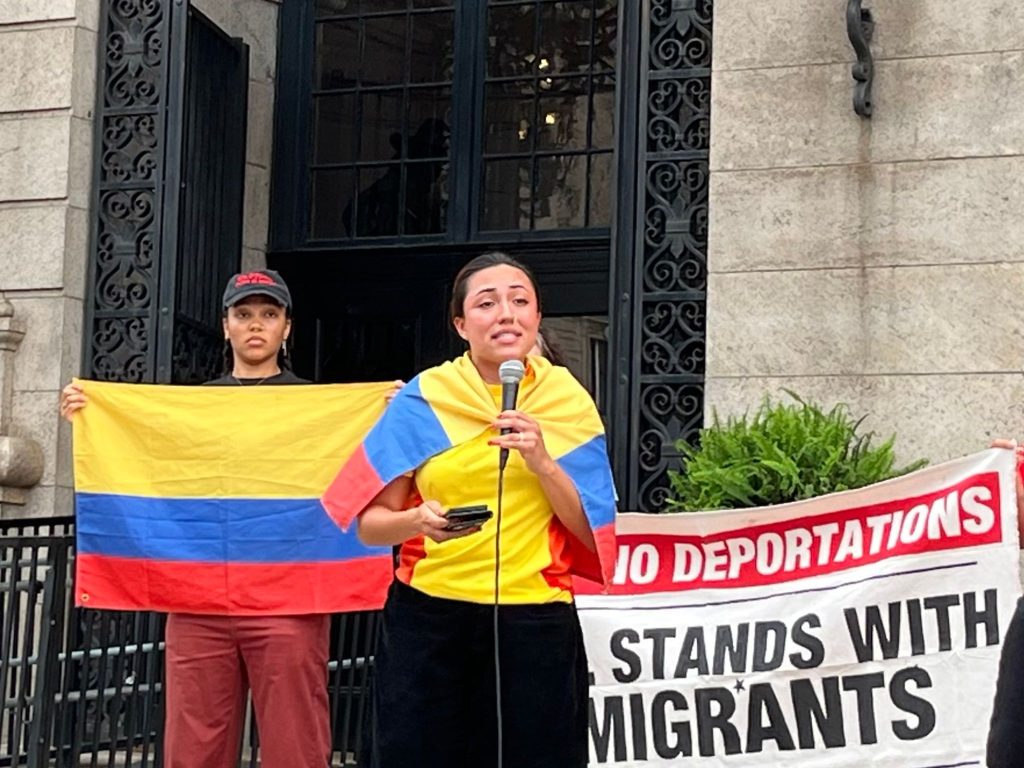
On the steps of the Boston Public Library, a woman stands with the flag of Colombia draped over her shoulders. Wearing a Colombian soccer jersey, Paola shares the stories of the immigrant families she works with in East Boston as a youth worker and organizer with a crowd gathered to demonstrate against ICE on June 14.
“My heart breaks,” said Paola. She continued:
Knowing that behind every Colombian restaurant worker, housekeeping worker, community salon worker, and lunch monitor who smiles at me and the kids … they’re choking down the fear that it might be their last day, here in a country where they deserve to feel safe and welcome.
Less than 24 hours prior, an ICE agent killed 25-year-old Joan Sebastián Durán Guerrero, a Colombian immigrant, in front of his three-year-old daughter in Biddeford, Maine. On July 7, ICE agents in Houston, Texas shot and killed 52-year-old Lorenzo Salgado Araujo, a Mexican immigrant and father to three children. ICE is now attempting to deport the three men who witnessed his murder.
ICE once again rolled out the story used to justify the murder of Good, claiming Durán Guerrero and Salgado Araujo attempted to use their vehicles as weapons.
Even if those allegations were true, which witness accounts indicate is highly unlikely, no one, regardless of their race, history, or legal status deserves to be subject to the violence and dehumanization that ICE has made its calling card.
Paola said:
‘Guerrero’ in Spanish means ‘warrior’. To be a Guerrero now is to not give in to fear tactics and to trust that the majority of us believe in justice and in citizenship for all, and then to turn that belief into a fight, because together we can beat back their terror.
There is no reforming an organization that refuses to cease its killing spree and whose agents ignore any laws passed to limit their power. The vast majority of Americans want ICE reform or abolition. But it is not enough to abolish ICE – the agents responsible for these gross misuses of power must be prosecuted, and reparations paid to every family robbed of their loved ones.
At a legislative level, organizations like the Mass TPS Committee and MIRA point to S.4814, a bill co-sponsored by Ed Markey and Elizabeth Warren that, if passed, would require the DHS Secretary to extend TPS for Haitians through early 2029. While the bill would protect many TPS holders, there must also be a long-term, concrete solution for everyone.
The Safe Environment from Countries Under Repression and Emergency (SECURE) Act would provide a path to green cards and eventual citizenship for all eligible TPS holders. The bill is supported by the National TPS Alliance, the Massachusetts TPS Committee, and the AFL-CIO as a more permanent solution, as protections would extend to all TPS holders, including those who’ve had their status revoked by the time it’s enacted.
While the exact date the Supreme Court’s ruling takes effect is unclear, Massachusetts home and nursing care facilities have already begun to lay off TPS holders. The Supreme Court’s siding with the Trump Administration will put 356,000 more people at risk of deportation. A dangerous precedent has been set for the remaining countries with TPS, and despite the narrow rejection of Trump’s attempt to abolish birthright citizenship, the lawsuits over TPS cancelation for other countries now face considerable hurdles. As the next few years unfold, the fates of nearly 1.3 million people have been placed in the hands of nine.
“Allowing the administration to strip TPS from these essential workers would severely disrupt care delivery, worsen workforce shortages, and directly threaten patient safety and access to care,” the Massachusetts Nurses Association said in a statement.
Haitian and Syrian TPS holders are long-standing members of our communities who work, pay taxes, and contribute meaningfully to the social and economic fabric of Massachusetts. They have followed the rules, built lives here, and earned the respect that comes with years of service. Their labor should be honored, not scapegoated.
Matt Wolfinger is a data journalist and a contributing writer to Working Mass
The post Supreme Court’s TPS Decision Threatens Millions, Precipitates Mass. Healthcare Staffing Collapse appeared first on Working Mass.
“}]]