[[{“value”:”

By: Cayla Dodd
MARLBOROUGH- A union contract campaign among school bus drivers and monitors has developed into something much larger than a dispute over wages and benefits. What is unfolding reveals in stark clarity the architecture of privatization – how private equity reshapes essential services, how union-busting operates under contemporary labor relations, and why even basic fights for dignity at work eventually run up against the larger structure of capitalism itself.
This is a story about a group of workers trying to win a decent contract. They want better wages, more stable hours, stronger benefits, safer buses, fairer route assignments, and protection from arbitrary discipline and on-the-job surveillance. They want, in other words, the same things workers have always wanted: security, respect, and some measure of control over the conditions under which they labor.
The question is why those demands are treated as unreasonable in the first place.
Workers who transport children every day can be left without meaningful retirement security, with subpar healthcare, and with schedules so fragmented and unstable that some cannot reliably afford housing, a car, or even their basic monthly bills. A sector plagued by chronic driver shortages continues to produce working conditions that drive experienced workers out. When workers begin organizing seriously enough to challenge those conditions, management responds with escalation.
Work Unseen by the Public
School bus driving is routinely misunderstood by people who don’t do its work. From the outside, school bus drivingt is often imagined as part-time work with limited responsibilities: a few hours in the morning, a few in the afternoon, summers off, and not much more to it. That caricature has done enormous ideological work on behalf of employers and municipalities alike, helping justify low standards, weak benefits, and public indifference. But it has very little to do with the actual labor involved.
In reality, school transportation is skilled, stressful, high-responsibility work. Drivers are responsible for safely transporting children through traffic, weather, construction, behavioral incidents, shifting route conditions, vehicle issues, and the endless unpredictability of day-to-day life. They are expected to exercise judgment constantly. They are responsible for operating large vehicles safely, managing student conduct, navigating difficult roads, responding to emergencies, and ensuring that students are released appropriately and arrive where they are supposed to be. A mistake can have enormous consequences. The job requires discipline, focus, and local knowledge. This is not a casual side gig. This is essential infrastructure.
Yet the structure of the work is built around instability. Drivers are commonly scheduled on split shifts, with a block of work in the morning and another in the afternoon. On paper, that can look manageable. In practice, it means the workday stretches across most of the day while providing only a fraction of full-time pay. A driver may start very early, finish a morning run, sit unpaid for hours in the middle of the day, and then return for afternoon routes. Those unpaid gaps are too large to ignore and too awkward to make a second job realistic. The result is a schedule that dominates your day without paying for your day.
That contradiction sits at the center of the economic misery so many school bus workers experience. They are not fully employed in a way that provides a stable living, but they are also not free enough to easily build a second source of income around the job. Workers can find themselves trapped between part-time pay and full-day obligation. From the standpoint of capital, that structure is useful. From the standpoint of labor, it is punishing.
Benefits do not compensate for that instability. Healthcare is often inadequate. Workers may technically have coverage while still facing costs substantial enough to make actually using that coverage a source of stress. Retirement security is rare. A worker can spend years performing essential public labor and still face old age with little to show for it beyond worn-out knees, accumulated stress, and a deep familiarity with financial precarity. That is one of the clearest expressions of what the system thinks workers are worth.
These conditions have real human consequences. Workers fall behind on rent. They fear eviction. They delay car repairs because they cannot afford them, even though a reliable car may be necessary just to get to work. They struggle to secure stable housing. Some take on humiliating and physically draining side measures just to survive, including selling plasma to cover everyday expenses. This is the lived reality produced when socially necessary labor is organized around cost minimization rather than human need.
Shortages as Tactic in the Class Strategy
Massachusetts has dealt for years with school bus driver shortages. Public discussion of this crisis is often shallow, described as though a natural disaster or demographic inevitability: a regrettable staffing problem that somehow descended on the industry from outside. Employers and public officials talk about recruitment, as if the main challenge is persuading enough people to enter the field.
Workers know better. The real crisis is retention. People leave because the job has been made unsustainable.
There is no mystery about why workers leave a job with unstable hours, weak benefits, inadequate retirement, rising surveillance, stagnant wages, and constant stress. There is no mystery about why new hires do not stay when they quickly realize the public image of the job bears little resemblance to its reality. There is no mystery about why experienced drivers burn out, seek better-paying work elsewhere, or leave the profession entirely. The shortage is the predictable result of labor conditions designed to suppress costs.
Once you see that clearly, much else comes into focus. The constant shortages intensify pressure on the workers who remain. Routes are stretched, doubled up, or constantly rearranged. Expectations increase. Management leans harder on flexibility. Workers are told to absorb more instability in the name of keeping the operation functioning. The strain accumulates. More people consider leaving. The shortage deepens. The system devours the very workforce it depends on. This is one of the ways capitalism presents its own contradictions as technical problems: treating the workforce as an input to be purchased as cheaply as possible, then acts confused when that workforce becomes difficult to sustain.
The conditions in school transportation did not emerge in a vacuum. They are the product of a political project. Municipalities were steered toward privatization over decades through austerity politics, anti-union ideology, and the broader neoliberal assault on public goods. Public services were increasingly reimagined as budget lines to be minimized rather than social obligations to be met. Outsourcing became attractive because private firms promised savings, but those savings had to come from somewhere.
They came, overwhelmingly, from labor.
Privatization is often defended in the language of efficiency. This is one of the ruling class’s great rhetorical tricks. Efficiency sounds neutral, modern, and practical. But in the context of public services, “efficiency” usually means shifting risk downward, stripping labor standards, weakening democratic accountability, and enabling more aggressive management over workers than would be politically tolerable in direct public employment. A private contractor can more easily suppress wages and benefits, fragment the workforce, impose unstable schedules, and retaliate against worker organization while local officials keep their hands clean and point to lower budget numbers.
That is the real social meaning of privatization: a class strategy. School bus workers are facing hardship through privatization. The whole model depends on labor being cheaper, more replaceable, and easier to discipline than it would be under more robust public-sector standards. Municipalities outsource because private companies are willing to do what public employers often cannot or will not: grind labor harder.
The worker experiences this as a thousand small humiliations and pressures. The politician experiences it as budget relief. The company experiences it as a business opportunity.
Sharpening the Blade of Capital
In this case, that logic runs through NRT Bus, Inc., its parent company Beacon Mobility, and, as workers understand it, the private equity firm Audax. Whatever the precise current corporate structure may be at the moment this article is read, the broader pattern is clear enough: school transportation has been folded into a larger world of corporate consolidation and financial ownership in which essential public services are treated as sites of extraction.
Privatization supplies the basic structure. Private equity intensifies its logic. When financial firms enter sectors like school transportation, the pressure to extract returns becomes even more relentless. The service itself becomes secondary to the imperatives of financial management. Essential public goods are treated as revenue streams. The workforce becomes a site of value extraction. Every wage increase, every improved benefit, every additional guarantee, and every reduction in management discretion is viewed through the lens of profitability.
This is what financialization does to work: it disciplines the entire enterprise around investor return. That means pressure for labor flexibility, tighter cost controls, consolidation, standardized management practices, and hostility toward anything that reduces managerial command over the workforce.
In a sector like school transportation, private equity’s influence is especially corrosive because the service is socially indispensable but politically neglected. Children still have to get to school. Families still depend on buses running. Municipalities still need contracts fulfilled. That creates a relatively stable flow of public money into the industry. For finance, that looks appealing. For workers, it means they are trapped inside a system where public necessity is being mined for private return.
This helps explain why even modest worker demands are so fiercely resisted. Better healthcare is a cost increase. Retirement security creates obligations that constrain extraction. Guaranteed hours reduce managerial flexibility and increase labor expense. Under a private-equity-influenced model, these become threats because they interfere with the deeper function of the enterprise.
Private equity brings a more concentrated and shameless form of capitalist discipline. It strips away even the remnants of paternalism or long-term stewardship some employers once used to legitimize themselves. What remains is naked extraction.
To Act in Concert
Against these conditions, workers built a contract campaign that aimed at more than symbolic change. The demands at its core were practical, concrete, and rooted in lived experience. Workers sought stronger hour guarantees because they knew unstable scheduling was wrecking their finances and their ability to remain in the job. They sought better wages because the existing structure was not keeping pace with the real cost of living. They sought improved healthcare because nominal coverage without actual affordability is not security. They sought retirement because a lifetime of work should not end in poverty. They sought safer buses, better route practices, and enforceable maintenance expectations because the labor itself is dangerous enough without being compounded by management neglect. They sought limits on surveillance and arbitrary discipline because “safety” rhetoric is too often weaponized as a tool of control rather than used to genuinely support workers and students.
None of these are fringe demands. They are exactly the kinds of demands any rational society would consider baseline. But because they conflict with the cost discipline built into privatized school transportation, they immediately become political.
What also distinguished this campaign was the way it was built. This was not simply a staff-driven process of bargaining behind closed doors, with workers receiving occasional updates. Rank-and-file workers themselves played a central role in the organizing. They held conversations with coworkers. They built visible solidarity actions. They created shared expectations that participation mattered. They used meetings, chats, and direct outreach to transform the campaign from something happening above workers into something workers were doing together.
Employers can tolerate a certain amount of passive dissatisfaction. They can tolerate symbolic complaints. They can even tolerate low-level grievances as long as the workforce remains fragmented and dependent. What they fear is organization: workers understanding themselves as a collective force with shared interests and the capacity to act in concert.
Visible Solidarity
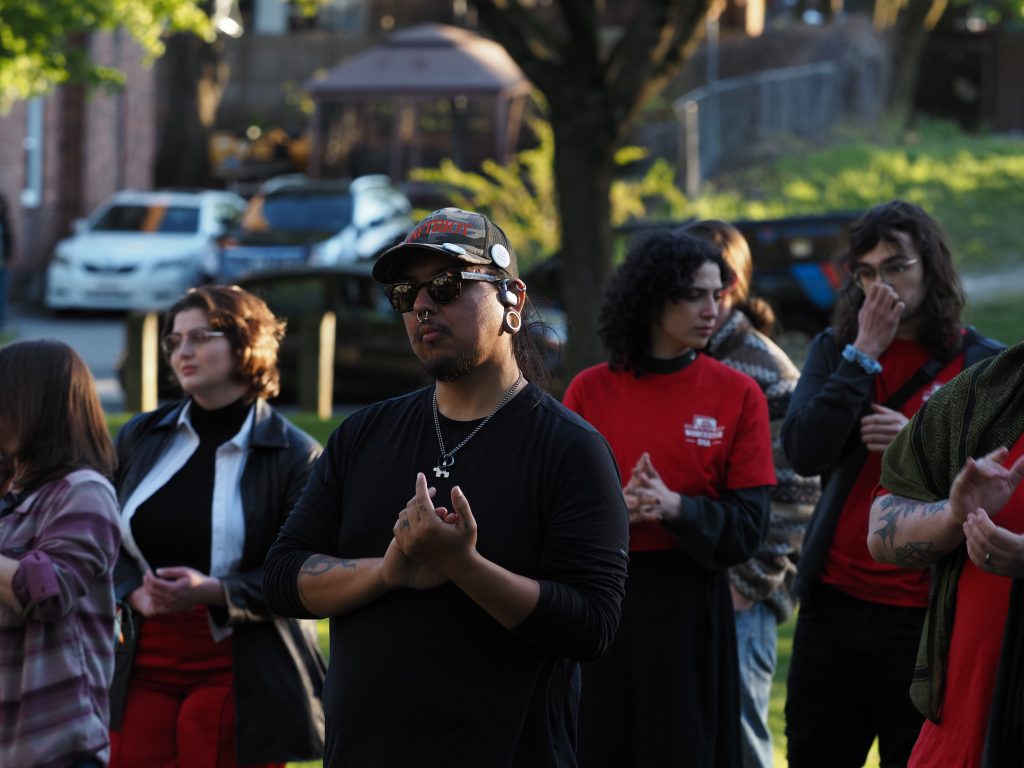
To outsiders, a solidarity action like a red-shirt day can look small. But that misunderstands the function such actions serve. In a workplace structured by isolation, where drivers are split across routes, schedules, and classifications, visible collective participation is not cosmetic. It is one of the first ways workers learn to see each other politically.
When a worker looks around and sees that many of their coworkers are willing to participate in a common action, however modest, something changes. Fear begins to loosen. A private frustration starts becoming a public alignment. What had previously existed as scattered grievances begins to cohere into an organized workforce. Small collective acts create the conditions for larger ones. They build confidence, social trust, and a sense that the employer’s authority is not total.
This is one reason bosses often react disproportionately even to low-risk collective actions. They understand what many observers do not: participation itself is dangerous. Once workers get used to acting together, more becomes possible.
By the time a campaign reaches the point of a strike authorization vote, much of the real work has already been done. Such votes are measurements of trust, political development, and collective will. A workforce does not produce an overwhelming yes vote by accident. It does so because countless conversations, tests of solidarity, and small decisions have accumulated into something stronger.
That is why a 98 percent yes vote matters so much. It is evidence that workers were crossing from grievance into power.
Retaliation
Management’s response must be understood in that light. When a key rank-and-file leader is terminated at a critical point in a campaign, the question is not only whether the stated justification is plausible on its own terms. The question is what function the action serves in the broader struggle.
People often expect union-busting to look dramatic and explicit. Sometimes it does. But under modern labor relations, employers often operate through deniability, selective discipline, legal complexity, and timing. A worker is targeted in a way that does not openly announce anti-union intent, but can be narrated as an individualized matter detached from the collective context. This does not prove anti-union motive is absent. It shows that employers have become more sophisticated.
The purpose of such discipline is larger than the individual case. The point is to introduce uncertainty into the workforce, to make workers wonder whether participation is worth the risk, to force organizers to divert time, energy, and emotional bandwidth into defense, to destabilize the social infrastructure of the campaign, and to remind everyone that management still claims the power to punish.
Retaliation belongs inside the contract fight. In fact, it often emerges precisely when workers are becoming effective enough that management sees no other way to regain initiative.
The same is true of broader escalation through legal threats or lawsuits. Whatever their technical merits, such moves function politically. They muddy the waters. They force workers and unions to defend themselves on terrain chosen by the employer. They attempt to recast the conflict from one about wages, benefits, and worker power into one about impropriety, scandal, or misconduct. They raise the stakes of participation and create a climate in which caution can start masquerading as prudence.
This too is union-busting, just adapted to a labor regime in which employers know how to use formal legality as a weapon.
Labor-Management Relations and Their Contradiction
Mainstream discourse often treats labor-management conflict as though it were a misunderstanding between stakeholders who ultimately want the same thing. That fiction is useful to employers and to the political class that mediates between labor and capital without ever wanting to resolve their antagonism. But it does not survive contact with reality.
Workers and employers do not stand in a neutral relationship. The employer purchases labor power and seeks to get as much from it as possible for as little as possible. The worker sells labor power because they must survive, but has every interest in increasing their compensation, securing their conditions, limiting arbitrary control, and preserving their body and time. There can be temporary accommodations. There can be negotiated settlements. There can even be periods of relative peace. But the underlying interests remain opposed.
In school transportation, that contradiction appears in condensed form. Workers need stable hours, strong benefits, safe equipment, and real voice on the job in order to make the work livable. The employer, especially under privatization and private equity pressure, needs labor costs contained, managerial flexibility maintained, and worker militancy suppressed in order to preserve margins and secure contracts. These are conflicting goals.
That is why so many workers eventually reach a political realization through workplace struggle: management is not simply failing to understand their needs. Management understands perfectly well and resists because meeting those needs would alter the balance of power and the distribution of resources.
That is class analysis born from experience.
None of this means contract fights do not matter. They matter deeply. Workers need better contracts. Workers need to defend themselves using every tool available, including grievances, bargaining, arbitration, public pressure, and strike readiness. But campaigns like this also reveal the limits of what can be won if the fight remains confined to the level of a single workplace and a single employer.
Even strong workplace organization is forced to operate within a broader structure that reproduces the same pressures. Competitive bidding pits contractors against one another on labor cost. Municipal austerity rewards cheapness over human need. Private equity demands returns. Labor law constrains worker power while legitimizing endless employer aggression. A union can win gains, but those gains are always under pressure so long as the structure remains in place.
This is one of the central political lessons of the campaign. Workers can and should fight for every immediate improvement. But they also run up against the reality that exploitation is not just a matter of bad bosses or bad decisions. It is institutional. It is reproduced through markets, contracts, finance, and the state.
That realization is often the bridge between trade union consciousness and socialist consciousness. It is the moment when workers begin to see that they are not only fighting an employer but confronting a mode of social organization.
The answer cannot be better management of privatized services. The answer cannot be pleading for more enlightened contractors or slightly less predatory financial owners. The answer has to be political and structural. Essential public services should not be organized around private profit. School transportation should be brought back into public ownership and operated as a public good. The financial actors extracting wealth from essential services should be removed. Labor standards should be raised across the sector in ways that prevent public entities from using outsourcing to undercut workers. Drivers and monitors should have stable, sufficient hours, real healthcare, and meaningful retirement security. Workers should have enforceable rights on the job, including protection from surveillance abuse and retaliation. And the people who do the work should have a meaningful voice in how the work is organized.
This is far more practical than the existing system, which produces chronic shortages, burnout, turnover, declining conditions, and endless labor conflict while pretending to be efficient.
Capitalism does not merely generate inequality in the abstract. It organizes everyday life in ways that subordinate human need to accumulation. It takes indispensable work and turns it into a site of austerity. It transforms public necessity into private opportunity. It relies on worker insecurity as a lever of discipline. And when workers resist, it deploys law, management authority, and financial pressure to preserve that arrangement.
The campaign in Central Massachusetts therefore matters beyond one contract or one yard. Instead, it’s a window into the broader social order.
They Tried to Cut Off The Head
For socialists, labor organizers, union members, and community supporters, the appropriate response is not passive sympathy. It is organized solidarity linked to a political program.
That means materially supporting workers in active struggle. It means treating retaliation against worker leaders as an attack on the whole class, not an isolated personnel matter, demanding that municipalities stop hiding behind the language of contracting and take responsibility for the labor standards of the services on which the public depends. It means fighting privatization not only where it is proposed, but where it is already entrenched. It means building connections between workplace fights and wider campaigns for decommodified public goods.
It also means rejecting the idea that labor struggles should remain narrow, apolitical, or purely economistic. Workers do not benefit when socialism is kept out of labor politics; employers do. The more clearly workers can connect their immediate experience to the structures of capital, the more durable and transformative their organizing can become.
A contract campaign can win raises. A strong shop-floor organization can beat back some retaliation. But a movement capable of ending the rule of private equity over public services would do much more than that. It would begin to shift who society is actually organized for. When management moved against a key organizer, the intention was clear. It was a classic move in a contemporary form: isolate leadership, destabilize the campaign, remind workers who claims power in the workplace. But that move also had another effect: clarifying the struggle, making visible what is so often hidden, showing the conflict was never just about a few contract proposals. The move showed that workers had built enough power to provoke a serious response. And once workers begin to see all of this together, it becomes much harder to return to the comforting fictions of before.
The fiction that management and labor fundamentally want the same things. The fiction that shortages happen for mysterious reasons. The fiction that privatization is about efficiency rather than class power. The fiction that private equity is just another ownership model rather than a machine for intensified extraction. The fiction that the problems facing workers are isolated, accidental, or unfortunate rather than systemic.
When those fictions start to fall apart, something politically dangerous begins to happen. Workers stop interpreting their conditions as personal failure or bad luck. They start recognizing them as products of a social order. And once that recognition is collective, once it is organized, once it is tied to solidarity and action, the balance of power can begin to shift.
That is why this fight matters.
The fight matters because it is about wages and healthcare and retirement and schedules and safe buses and retaliation and respect. It matters because it is about whether workers can remain in the profession at all. It matters because it reveals the real causes of driver shortages. It matters because it exposes the class content of privatization. And it matters because it points beyond itself, toward a socialist politics capable of saying plainly what liberal management discourse never will: that essential public services should not be run for profit, that workers are entitled to dignity and control, and that the capitalist organization of social life is incompatible with either.
The workers in this campaign are fighting for a contract. They are also, whether everyone around them fully recognizes it yet or not, fighting over a much larger question.
Who should society serve: the people who do the work and rely on it, or the people who profit from keeping them insecure?
That question is not limited to one bus yard in Massachusetts. But it is being asked there with unusual clarity. And how workers answer it together — on the job, in the union, and in politics — will matter far beyond this one campaign.
Cayla Dodd is a school bus worker and member of Worcester DSA.

The post They Tried to Cut Off the Head: School Bus Workers in Central Mass Confront Private Equity appeared first on Working Mass.
“}]]