
[[{“value”:”

By: B. Greer
The terms “abundance” and “supply” are unavoidable in the housing affordability debate.
The Healey administration’s plan to address the housing crisis, “Achieve a State of Housing Abundance” confidently states that a “lack of supply is the root cause of our housing cost crisis.” The state is correct that Massachusetts needs more homes, as does most everywhere, but treating the supply shortage as the root cause mistakes an outcome for an explanation.
The problem is not simply that the market has failed to produce enough housing, but that housing is produced, financed, owned, and governed through institutions that benefit from the very scarcity that the Healey administration cited as the sole culprit.
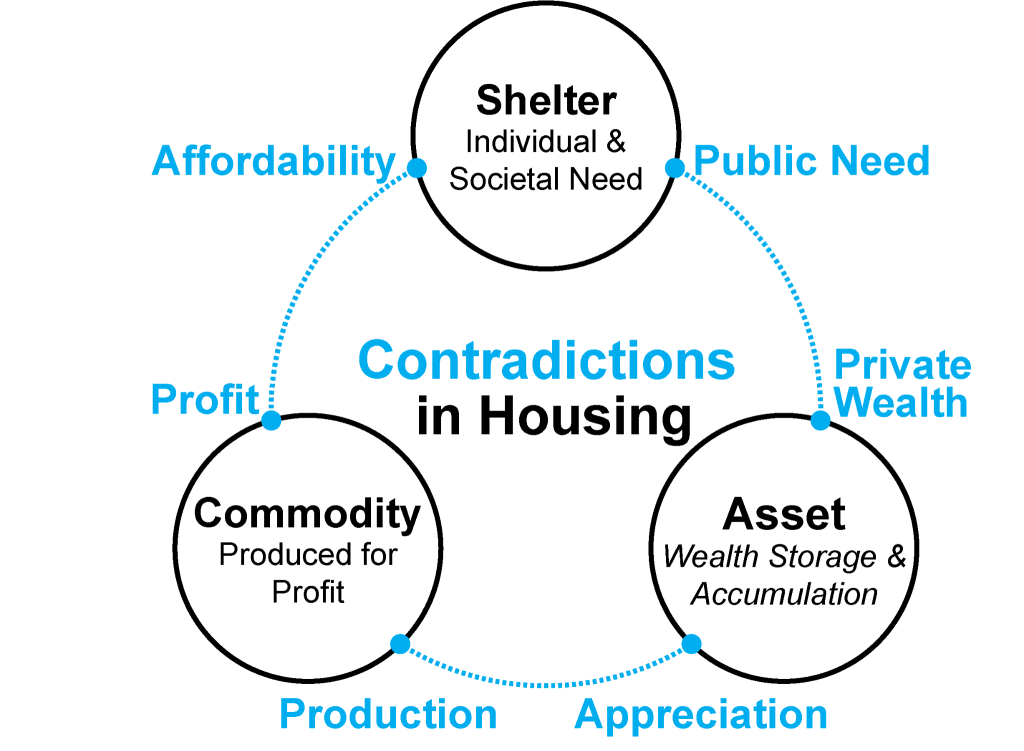
The housing crisis grew out of an inherent contradiction in how housing operates. For tenants and workers, it is shelter: the place people live, raise families, and recover from work. For developers, contractors, and labor, it is a commodity: something built, bought, and sold through the market. For owners, lenders, investors, and towns, it is an asset: a source of rent, wealth, credit, and tax revenue.
Clearly, these roles do not fit together neatly. Shelter requires affordability and stability. Commodity production requires profit. Asset ownership depends on rising rents, rising land values, and protected resale prices.
The same system that asks housing to become affordable also demands that it stay expensive. High prices generate rent, support land values, secure loans, and protect local tax bases. The crisis we see today is the logical outcome of a system expected to provide affordable shelter, produce profit, preserve wealth, secure debt, reward investment, and sustain municipal finance.
Supply-Side Limitations
Private development responds first to profit, not need.
My work as a designer focused on multifamily housing has taught me that projects only move forward when expected rents or sale prices can cover land, construction costs, financing, and profit. Private development can add homes and ease pressure, but when rents fall, prices weaken, or returns shrink, capital pulls back.
The market does not keep building just because working people need homes.
The abundance movement wants to recreate the rate of residential construction we saw in the postwar era. However, the postwar boom cannot be separated from the massive federal subsidies that supported its construction. We do not have the modern suburb without the GI Bill, Federal Housing Administration-backed insurance, and the creation of the interstate highway system. Since the postwar boom, and subsequent pullback of government support, housing construction has sporadically materialized as a declining series of booms and busts shaped by recessions, credit conditions, land prices, and construction costs.
The role of states and cities rise and fall within that larger cycle, while their relative position depends on material conditions like land, labor costs, infrastructure, and regional growth pressure.

Massachusetts can reform zoning and strengthen public policy, but it cannot replicate the building rate of a state like Florida without the available land and market conditions that make that scale of private construction possible. Massachusetts has set a goal of 220,000 new homes by 2035, but so far it has not built the public institutions needed to build, preserve, and keep that housing affordable. Unsurprisingly, we aren’t on track.
What Needs to Be Done?
All three sides of the housing contradiction must urgently be confronted.
Massachusetts, and the Healey administration, must protect housing as shelter, build and repair housing beyond the limits of private profit, and weaken the power of landlords, banks, investors, and wealthy towns to benefit from scarcity. More homes are necessary, but new housing becomes an affordability strategy only when public power determines where it is built, who controls it, and whether it stays affordable.
The blueprint forward is simple. Housing must be defended as shelter. In both gentrifying Boston-area neighborhoods and Gateway Cities across the state, the goal must be reinvestment without displacement. That means rent control, eviction protections, and prioritizing affordable housing.
Second, housing production must become a public responsibility. When expected returns fall, the market slows, even if people still need housing. Massachusetts needs public financing, infrastructure investment, and a state social housing authority capable of building and preserving homes directly.
Legislation should be passed mandating that municipalities allow apartments, remove parking minimums, and allow smaller residential lots that can accommodate smaller homes. Exclusive suburbs like Milton and Wellesley should also have to use public land for social housing and meet enforceable regional housing obligations. Communities that hoard access to jobs, transit, schools, and high-value land should not be enabled to push all housing construction into working-class neighborhoods.
These are not separate crises. Displacement in high-rent neighborhoods, abandonment in older industrial cities, and exclusion in wealthy suburbs are different expressions of the same housing contradiction.
The housing crisis cannot truly be solved without federal action, but Massachusetts cannot wait for Washington to move first. If scarcity is protected through law, finance, and land ownership, then those are the forces we have to confront here.
This will not be easy, but there is no other option. Massachusetts must protect tenants, build social housing, and challenge the system that organizes housing around scarcity. Despite the recent loss in the Massachusetts Supreme Court, the need to push for rent control has not ended.
Boston DSA Housing Working Group Co-chair Tim Scalona addressed the problem clearly:
As rents explode and few affordable housing opportunities exist without a years-long waitlist, tenants risk an eviction notice after each health emergency or job loss.
The task now is to fight for an equitable future, building by building, city by city, and law by law.
B. Greer is the Housing Justice Campaign Lead for Boston DSA and a senior designer focused on multifamily housing. He is currently working on the social housing proposal in Cambridge alongside CHJC.
The post OPINION: Healey’s Abundance Relies on Institutions Keeping Us in Scarcity appeared first on Working Mass.
“}]]