[[{“value”:”

By: Julia Z & Jake S
WORCESTER – Students have returned to Worcester Polytechnic Institute (WPI). Freshmen are being shuttled through new student orientation, professors are dusting off their syllabi, and returning students have long soaked in their remaining days of freedom. Many new students were no doubt won over by WPI’s aggressive promotion of its cutting-edge Robotics Engineering, Computer Science, and AI undergraduate programs along with its highly-celebrated R1 Research University status. Many are surely excited for the “project-based learning” described by eager campus tour guides, ready to sell them a vision of high-tech projects on a charming New England campus.
But a university campus is much more than its students, teachers, and overpaid administrators. WPI may claim non-profit status on its tax filings, but in order to compete in a cutthroat higher education industry, it still carries all the fixtures of a corporate enterprise — in many ways, becoming more a landlord/buffet/hedge fund/private police department conglomerate that offers college degrees on the side — including a massive staff force to keep the lights on, the students learning, and the tuition dollars rolling in.
So who are the faces that keep those lights on? Who does everything from preparing curriculum, to the research that won WPI its R1 status, to taking out the trash and setting the tables for big donor wine-and-dine sessions? And, more importantly, why are they increasingly becoming self-organized into trade unions to represent them against the interests of WPI’s endowment managers?
Working Mass sat down with representatives of three organized labor unions at WPI, plus the campus chapter of the American Association of University Professors (AAUP), to talk about the importance of their work, their organizations, and their conflicts with the bosses on campus.
Trades, Groundskeeping, and Custodial Staff

Service Employees International Union (SEIU) 32BJ
SEIU 32BJ is the international union representing facilities workers at WPI. Without their labor, repairs and maintenance on buildings would go unaddressed, trash would pile up in every classroom and office, and the grass on the Quad wouldn’t get cut — in other words, the campus itself would probably become an overgrown ruin. Every few years, by being organized in their union, facilities staff negotiate a contract with WPI to lay out fair wages, decent benefits, and dignified working conditions. Between every contract cycle, the contract needs to be enforced; the staff, through their union, sometimes find themselves continuing to battle with WPI’s administration to follow the terms of the agreement that both parties have already signed. Mark, a union steward elected by fellow custodians to address such problems on the job, told us about a recent fight, and how the union united his coworkers to push WPI toward a fair resolution that protected their jobs and made their lives easier.
About a year ago, the administration brought in consultants from Core America to evaluate the campus practices, supposedly as a checkup to make sure everything was properly staffed and maintained. Core America went to work to cut good union jobs and clamp down on upkeep costs. Part of what they developed was a proposal for communal trash bins in office buildings: rather than entering individual offices to pick up trash and recycling, office staff themselves would take on the work of custodians and deposit their trash in a larger, central bin. Less time spent gathering trash meant WPI could try to get away with paying fewer custodians to do it. The plan would cut five jobs and open the door to more “reorganizations” (i.e., more cuts).
As Mark said, nobody thought to talk to custodians themselves about the change. Not only was WPI trying to skip past a contractual obligation to negotiate over these changes with the people who do the work, it wouldn’t even have worked out the way they wanted.
“They don’t know anything about our jobs,” Mark said, of the administration and their outside consultants. “If you had office staff doing this, I’d be spending more time getting everything into the right bin than I would have spent just walking through their offices anyway. President Wang used to work at a school that tried this idea out, and that’s exactly what happened.”
Union representatives called a meeting with management and were quick to demand the plan be reversed. Union members took collective action by delivering a petition to back up what their reps were saying, and WPI backed down. Core America’s recommendation wouldn’t go through. Mark reflected on the outcome:
We got them to open those five positions back up. Did you know they don’t approve purchases in May until the fiscal year ends? At certain points in the year, we have to be really careful with the supplies we have left. Students pay tens of thousands a year to go here, and management has tens of thousands to spend on these consultants, but they want to cut our jobs and make us ration toilet paper?
WPI estimates the annual cost of attendance while living on campus — which is required of first- and second-years — to be just shy of $85,000. The total evaluation of its endowment sits at well over half a billion dollars.
According to Propublica, in the fiscal year ending June 2025, WPI’s Chief Finance Officer — who reportedly interfaced with Core America consultants — was paid roughly $600,000, while the school’s President took home just over $1 million total.
Resident Advisors

United Auto Workers (UAW) Local 2322
Resident Advisors (RAs), Residential Mentors (RMs), Community Support Assistants (CSAs), and Community Development Mentors (CDMs) come together to form a union affiliated with United Auto Workers Local 2322. Student workers in any of these four positions perform key roles in keeping students safe, submitting requests for maintenance and repairs, and building community amongst undergraduate students. Without their labor, the dorms would be less safe, less maintained, and much more lonely places to live.
We met with Zoey and Dom, two union stewards for this group of workers, which voted to unionize in 2024 and won its first contract with WPI the following year.
One core reason the Res Advisor Union (RAU) formed was to challenge constant changes to job descriptions imposed by WPI. In fact, WPI only had a single Res Advisor role, but very soon after RAs won their union election, the administration proposed breaking the job into its current roles, removing most RAs from on-campus housing. Admin claimed this would lighten the workloads of RAs, but Zoey and Dom know it was another cost-cutting measure. Most of the new roles would receive no meal plans, no housing, and less pay. Moreover, RMs would be charged with developing a meaningful relationship with 75 or even 85 students at a time, where in their old role, RAs were only expected to handle around 35.
“This seemed to be the personal project of the Dean of Undergraduate Students,” Zoey told us, “but nobody wanted to actually engage with us to figure out a solution that would actually work.”
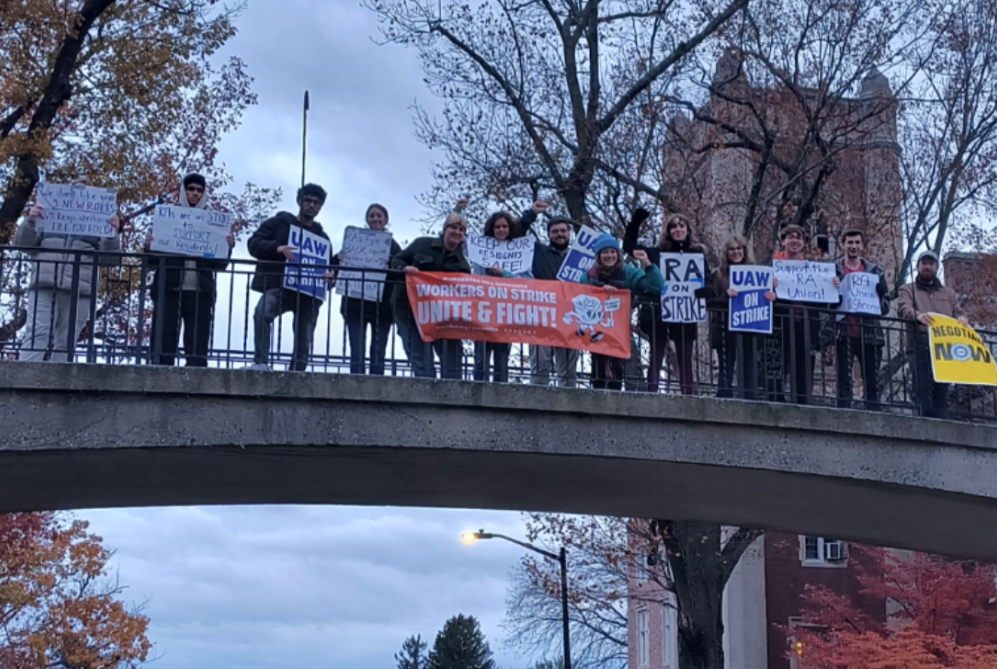
During intense contract negotiations, RAs went on strike from October 31 to December 15, 2025, after which the RAU won a decent contract with WPI that includes just-cause firing, increased pay, housing vouchers, meal plans, and workload caps. And while many of the job description changes were ultimately accepted, they’ll be implemented gradually over a 2 to 3 year phase-in period with a joint Union-Management Committee to oversee the transition. If the new roles aren’t working for Res Advisors themselves, the union will return to the negotiating table in 2028 with an opening to fight again for a better system.
Graduate Student Workers
United Auto Workers (UAW) Local 2322
Several hundred graduate student workers are organized under the WPI Graduate Workers Union, WPI-GWU, a UAW Local 2322 affiliate. Most doctoral students, and many master’s students, often work as Research Assistants (RAs) or Teaching Assistants (TAs), with others working as administrative staff while pursuing their graduate degree. As a teaching and research institution, the value of this work is obvious. Without TAs, grades wouldn’t be submitted; without RAs, WPI would attract no grant funding; without administrative staffers, very little work could get done at all. Although faculty generally direct teaching and research, graduate workers perform an enormous share of the day-to-day work: office hours; proctoring exams; grading student work; running experiments; and applying for research funds.
Stephen is a doctoral student in Biomedical Engineering, a co-chair of WPI-GWU, and an officer in Local 2322, which not only represents grads and res advisors at WPI, but thousands of academic and non-academic workers across New England, including similar workers at UMass Amherst and the University of Vermont.
The GWU won its first contract in 2023 after several months of tough negotiations. Prior to the contract, grad workers could barely afford to live in Worcester, and a litany of safety problems plagued their research labs. Stephen told us that some of his colleagues were forced to live on food stamps and simply couldn’t make rent. The ambiguity of their student-worker status even led to delays and complications in receiving worker’s compensation for lab injuries.
Their first contract changed everything. Stipend and hourly pay increased as much as 20%; graduate workers were guaranteed paid time off for the first time; WPI now covers the cost of many grad workers’ health insurance, and they now enjoy clear definitions of what’s expected of them at work. Workload caps, just-cause firings, and even new protections and benefits for international students were enshrined in the agreement.
Teaching and Research Faculty

American Association of University Professors (AAUP)
Professor Dan DiMassa is Vice President of WPI’s chapter of the American Association of University Professors (AAUP). At WPI, the AAUP doesn’t function like a traditional labor union, but still represents the organized interests of full- and part-time faculty. Despite the reality of a totally unequal power imbalance between faculty and the university administration that holds hiring and firing authority over them, labor law treats faculty as “managers,” and restricts their rights to organize unions at private institutions like WPI.
According to Professor DiMassa, the AAUP chapter at WPI formed in 2018 to deal with the administration’s attempt to rewrite parts of the faculty handbook. Their changes would have undermined academic freedom, putting the right to adjudicate disputes over academic integrity into the hands of trustees and administrators. Since then, the AAUP has also been forced to confront management over COVID-era cuts to faculty retirement benefits, which have only been partially reversed.
At WPI, the AAUP chapter often works through the faculty governance system, which is the main mechanism through which faculty can have a say in the development of university policies. Through this channel, despite lacking legal rights to negotiate a union contract, faculty organized under the AAUP have won new tenure-track jobs and enfranchised a new category of teaching faculty. Faculty governance isn’t a perfect way for professors to get what they need, but because they’re organized and can unite in collective action, their conditions stand a chance at improving.
Dan told us that the AAUP truly sees the interests of faculty and students as aligned. Both share a common investment in the core educational functions of a university: teaching and research. For the whole system to work, students and faculty alike need to build and maintain an environment of academic freedom where their thoughts can be tested and challenged. Robust faculty governance — capable of struggling against the power of professional university administrators charged with driving up revenue while cutting down on costs — plays an important role in that process.
Without its workforce of wage labor, WPI would cease to function, just like any other private enterprise under capitalism. And just like at any other workplace, it’s when workers organize for collective action in their own interests that they can challenge the boss to improve their lives, their workplace, and the world around them. Workers keep the world running, and the working class deserves to run the world!
If you want to hear more from Resident Advisors and graduate student workers about their work, their lives, and their labor unions, head to working-mass.com and type “WPI” in the search box!
On Wednesday, November 11 at 5:00pm, WPI YDSA — the campus section of Central Mass and Worcester DSA — will facilitate a town hall featuring members of each of the worker organizations we interviewed in this article!
Come hear about upcoming contract negotiations of the graduate student workers and facilities staff, and learn more about what it means to be in a union as a part of the working class!
Julia Z and Jake S are members of Central Massachusetts & Worcester DSA and contributing writers for Working Mass.
The post Stiffing Workers, Rationing Toilet Paper: Who Really Makes WPI Run? appeared first on Working Mass.
“}]]