
[[{“value”:”

By: Andrew S
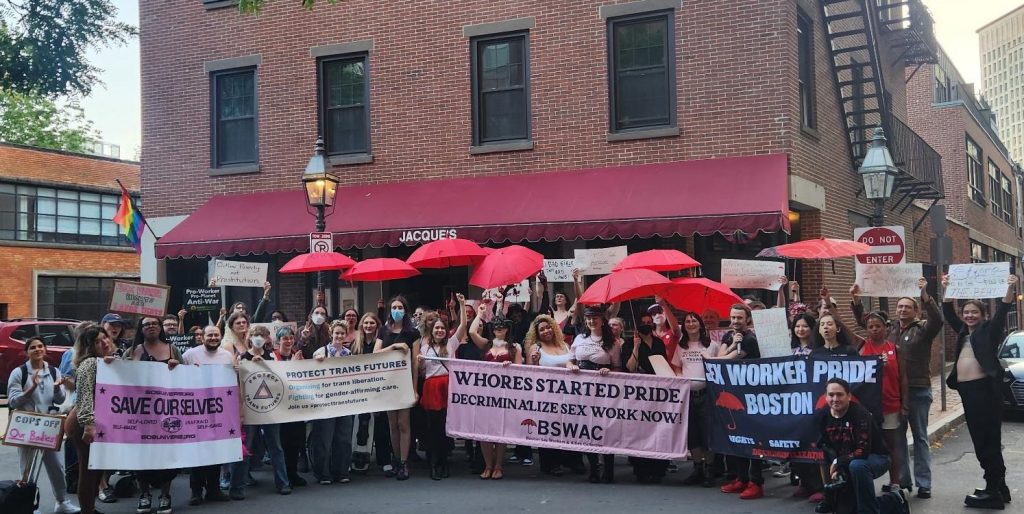
BOSTON COMMON – On September 14, sex workers and allies gathered at Brewer Fountain under a canopy of red umbrellas for Boston’s historic first March for Sex Worker Pride. Led by organizers Rita Romero from Red Light Disco, Amanda Rodriguez from FemMenThem, and Jessica Van Meir from Boston Sex Workers and Allies Collective (BSWAC), the march both centered the public celebration of sex worker pride and the ongoing fight for decriminalization.
Several sex workers, community organizers, and local politicians spoke to a crowd about the importance of the event before participants marched from the Common to Jacques’ Cabaret, the oldest continuously operating gay bar in the city.
Speakers at the rally spoke on decriminalization, the importance of protecting bodily autonomy, and the contributions sex workers have made to the feminist and queer rights movements. The march was the first in Boston history, creating an opportunity to publicly recognize sex workers and their allies. Save Our Selves (SOS), Sex Worker Pride Boston, and Protect Trans Futures were all crucial supporters of the event.
For some participants like Savannah Sly, the march marked a huge milestone:
I have been a sex worker since 2003, and I am so ecstatic to see sex workers and allies visibly marching through Boston and demanding our rights be respected. I wish something like this existed when I was eighteen and was first getting started.
Members of Democratic Socialists of America (DSA) and the Communist Party, USA (CPUSA) in attendance supported the same. Rat, co-chair of Southern New Hampshire CPUSA chapter, said:
This is another step toward destigmatization, decriminalization, and collective liberation, and to be recognized for who we are in public.

Decriminalization vs. The Nordic Model
The question of decriminalization has long been a battleground of policy for sex workers. One side favors the Nordic Model (also known as “end-demand”), where prostitution is a phenomenon manufactured from societal gender inequality, understanding buyers in the sex trade as the main culprit. Nordic Model organizations seek to illegalize commercial sex trade from the consumer side by targeting “Johns,” or customers of sex workers who are customarily presumed to be men. Nordic Model supporters believe that if the consumption of the commercial sex trade is made illegal, trafficking in the trade and the exploitation within the industry will effectively diminish.
But advocates for full sex work decriminalization actively see the Nordic Model as a dangerous misstep that leads to more restriction on sex workers. Case studies of legalization have typically resulted in more restrictions of sex workers than protections, as the government requires sex workers to register within rigid regulations. The Nordic Model has likewise proven to restrict health care access in places like Canada, greatly increasing the number of health issues that sex workers there suffered as a result.
Organizations such as the ACLU and Human Rights Watch have advocated for full decriminalization of sex work.
Protection of sex workers’ right to bodily autonomy was a center pillar for many in attendance at Boston’s first Sex Worker Pride March. Beyond keeping them safe from wrongful discrimination or safety in their profession, autonomy plays an inevitable role in sex worker earnings, too. Zachary Flynn, a sex worker in the area, spoke on his own experience:
In late-stage capitalism, autonomy is important. If you would rather judge someone for sex work than pay them a livable wage, then what else do you expect us to do? I work three to four jobs on top of sex work, and that is barely keeping me afloat.
Zachary continued, speaking on how sex work builds wealth through labor:
I think the fact that even with sex work being one of three to four jobs someone can have and even then not being able to support themselves financially says a lot on its own, but not everyone’s story with sex work is strictly about survival. It’s a chosen (and needed) profession for a fair amount of society. The point of the march is autonomy. All forms of work are selling your mind or body through means of labor, so why is it different in this context? If you have ever watched or rented porn, visited a strip club or advocated for women/queer rights, that means you support sex work, whether you realize it or not.

From Origins to Pride
Carol Leigh was the first to coin the term “sex work” in the 1980s to provide a term that described work different from prositution. According to Mary Carol of the Boston Sex Workers and Allies Collective (BSWAC), an important part of that was the emphasis on work and labor.
BSWAC organized around the community around this foundational concept in the run-up to the Pride March. On September 7, BSWAC hosted a screening and panel on Working Girls (1986), independent filmmaker Lizzie Borden’s movie about a day in the life of a woman working in a brothel in New York City. An overbearing manager forces her to stay beyond her hours, while displaying glimpses of interaction between workers and clients throughout the entire day. Working Girls is a representation of sex workers and their connection to labor in the view of Mary Carol.
The Pride March also took the time to remember what sex workers have contributed to and suffered historically. The red umbrellas ubiquitous across the march were not coincidence, but rather the universal symbol of solidarity that has called attention to poor working conditions faced by sex workers since 2001. Further, sex workers’ contributions far outdate the symbol. Sly stated:
Sex workers helped start Pride. Sex workers are in the canaries in the coal mine for how people are treated. They are at the forefront at the advancement of human rights and bringing home the bacon for their communities at the same time. Pride is sex workers claiming their own unique space and being the focus for collective liberation.
Many steps remain to make in order for sex worker pride to be fully enjoyed.
Rat claimed that more needs to be done legislatively and culturally: “we need to challenge elected officials on their decriminalization stance, and we need people to speak up for sex workers even when they’re not in the room.” BSWAC’s Legislative Priorities include legislation for full decriminalization, safe reporting, and mechanisms to protect workers from sexual assault by cops.
Andrew S is a member of Boston DSA and associate editor of Working Mass.
The post Red Umbrellas: First Sex Worker Pride March Organized in Boston History appeared first on Working Mass.
“}]]