
[[{“value”:”

By: Matt Wolfinger
BOSTON – The verdict is in from Bay State voters: public defenders in Massachusetts can finally unionize.
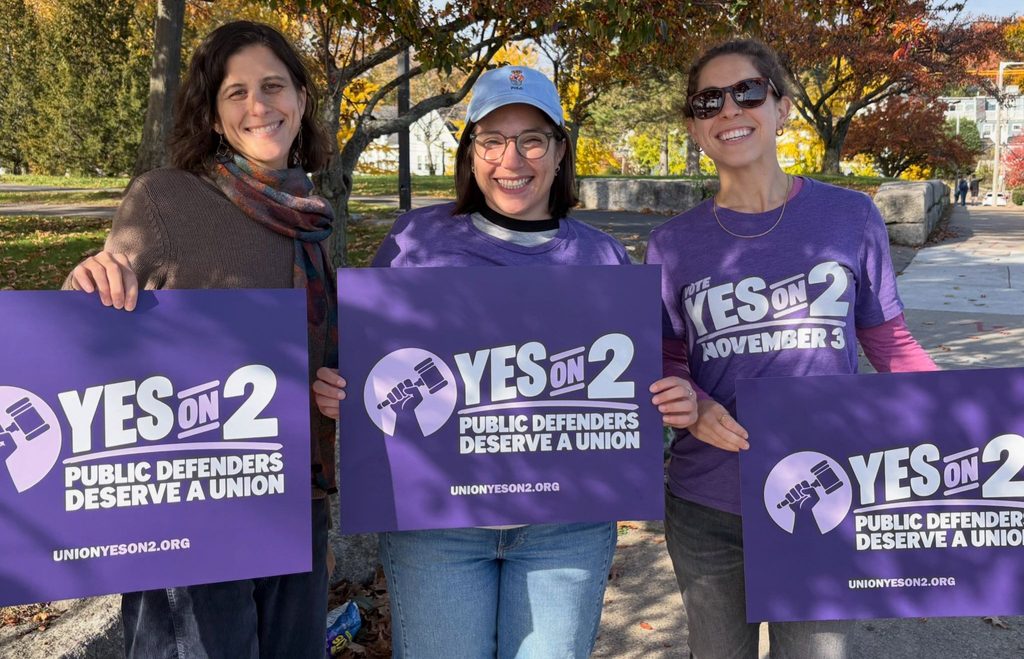
Since 1979, public defenders in Massachusetts have been fighting for the right to unionize. After decades of asking elected officials to amend the statute in the state constitution that bars them from unionizing with no success, workers with the Committee for Public Counsel Services (CPCS) put their fate in the hands of voters by securing a spot on the 2026 election ballot. Question 2 ultimately passed November 3, with 64 percent of voters in favor. Massachusetts Democrats like Congresswoman Ayanna Pressley, Senator Ed Markey, and Boston Mayor Michelle Wu endorsed the measure leading up to the election.
When someone accused of a crime can’t afford legal representation, entitled to all per the 6th Amendment, public defenders take the case – serving as the last line of defense between the state and the working class. Reliant on government funding and crushed under the weight of high caseloads, public defenders see little pay in return. Ballot Question 2 allows these 500 public defenders and many social workers, paralegals, interpreters and investigators at CPCS to collectively bargain. Previously, CPCS was one of the few state agencies whose employees could not unionize, as their name was left off the initial law permitting public sector unions in Massachusetts.
More than 90 percent of state employees in the Commonwealth have unionized.
The Right to a Union Does Not Mean the Union
Crucially, the measure doesn’t automatically form a union, but gives workers the right to create one. As an independent entity operating within the state’s judicial branch, CPCS relies on government funding. Once the union and CPCS management agree on a contract, it would be sent to the Governor’s office and, once approved, be funded by the state legislature. The committee that helped get Question 2 on the ballot received most of its over $1 million in funding from the National Association of Government Employees (NAGE) and Service Employees International Union (SEIU) Local 888, who’ve both expressed support for the measure. The committee helped collect more than 86,000 signatures to secure a spot on the ballot.
SEIU has worked alongside CPCS employees for decades supporting their efforts. Still in its early stages, the workers plan to organize with SEIU Local 888.
“We look forward to partnering and forging a long lasting partnership with CPCS,” said SEIU Local 888 President Tom McKeever in a public statement. “Security, stability and predictability through a collective bargaining agreement for these state employees will create less turn over, retain the most talented and provide the best services to the most vulnerable.” SEIU Local 888 expressed interest in an interview but did not respond in time for publication.
Indigent defendants (whose income level is below a certain threshold) are provided representation from CPCS defenders, social workers, and other employees who specialize in advocating for members of underserved communities.
The exact requirements can vary by state, but in Massachusetts, one’s income cannot exceed more than 125 percent of the Federal Poverty Line ($19,950/year or less for a family of one).
Part of 1963’s landmark Supreme Court case, Gideon vs. Wainwright, recommended that each state set up their own system to provide legal representation to all under the 6th Amendment. The 6th Amendment Center explains that CPCS is “responsible for funding and administering all adult and juvenile trial-level indigent defense representation in [Massachusetts].”
There are two kinds of CPCS attorneys: one is the private counsel division, consisting of private attorneys who subcontract with the state and are paid by the hour (bar advocates). The other is the public defender division, which maintains a full-time staff of attorneys. The CPCS workers employed by the state represent roughly 20 percent of indigent defendants while its bar advocates handle the remaining 80 percent. Since independent contractors can’t unionize, the latter are absent from the ballot.
Bar advocates made headlines last year after engaging in a weeks-long work stoppage to demand better wages, refusing to take on new cases while continuing to work on their existing ones. This led to hundreds of cases being dropped as the remaining CPCS employees, already dealing with insanely high caseloads, were unable to shoulder all of the work that had been pushed onto them.
If a client is left without representation for more than 45 days, the case is dropped per state protocol. The same goes for those in police custody, who must be released after seven days if they don’t receive representation.
Conflict of interest policy plays a significant role in what happened, as it reduces the amount of cases public defenders can take on. For instance, one attorney can’t represent two people whose interests are in conflict with one another, even if their cases are unrelated.
CPCS has committed to revising these policies, but doesn’t expect it to do much good since there are still firm ethical guidelines they must adhere to. The numbers just weren’t there to let CPCS absorb every case thrown over to them during the stoppage.
The striking bar advocates asked for a raise of $35/hour. Instead, they received two $10/hour wage increases – one last year, and another this August – amounting to $85/hour. This is still far below other states in New England, according to recent data from the Massachusetts Office of Inspector General (OIG). But since independent contractors aren’t employees, they pay for things like benefits and malpractice insurance out-of-pocket. Some bar advocates reported last year that their final takehome pay was really closer to $20/hour.

The decision to afford public defenders and bar advocates the pay and conditions they deserve will ultimately be in the hands of CPCS management and the legislators on Beacon Hill. Making public defenders state employees does come with one catch – public sector unions in the Bay State can’t go on strike, so by forming a union they forfeit the right exercised by bar advocates.
This incident has been cited by critics as proof that passing Question 2 would somehow make things worse, placing the blame on the workers who had to twist the arm of their employer to be paid an increased wage that’s still far below every other state in New England. The stoppage resulted in a wage increase for bar advocates and additional funding for CPCS to hire 320 new public defenders by September 30, 2027.
Daniel Werner, a staff public defender with CPCS for more than 14 years and organizer with the “Yes on 2” initiative, told Working Mass that because of that funding, the number of attorneys at his office has “more than doubled” in the last year, from roughly 18 attorneys to 38.
“We’ve had around 20 people in this most recent class one month ago, on top of 10 new people recently before that,” said Werner. “So it’s kind of crazy. I remember when the Malden office had eight lawyers, and now it has 38. It’s a huge expansion.”
This growth has helped keep caseloads under control, but the rapid hiring rates have introduced their own set of issues. Currently, a lot of time and resources are spent interviewing and training waves of new employees.
But without the means to retain these employees through competitive wages and benefits, CPCS has been plagued with high turnover rates, as many attorneys quickly burn out and migrate to jobs with better benefits and pay. Werner says a contract would help remedy this issue by ensuring their wages match those of nearby states and keep up with inflation.
“People do this work for a couple years, then they marry and want to have kids, but they feel like they can’t plan their future,” said Werner. “So we do get turnover, and because of that, we have a high supervision ratio and a large training department because we’re constantly cycling people through.”
As rewarding as the work may be, fields with more liveable wages in the current conjuncture become increasingly necessary to pursue for lawyers saddled with student loan debt and struggling to stay afloat. A CPCS representative told Working Mass that the current starting salary is $75,000 for a non-barred, recent grad and $80,598 for a barred attorney with no experience. Data shared by CPCS upon request shows a gradual increase in attorney pay over the last decade.

Beyond Public Defenders
By their own admission, the compensation offered by CPCS is still below the competitive standard that could lower the high rates of turnover. Public defenders at CPCS receive the most attention in the press, but they’re only one part of the story. Social workers in the public defender office like Jeff Whiteside, who’s been there for more than a decade, haven’t benefitted from the waves of new hires at the same rate as public defenders.
Whiteside and Werner both spoke to Working Mass on behalf of themselves. All opinions expressed do not speak for CPCS as an agency.
“I don’t think it was intentional,” Whiteside told Working Mass. He continued:
But the focus was on hiring attorneys, and not necessarily putting in the infrastructure as far as support staff like social workers, investigators, interpreters, in place at the same clip. So it created a very high social work to attorney ratio that was way out of alignment from what the ratios should be.
The ideal for an office, Whiteside explained, would be an attorney-to-social worker ratio of 10 to 1. But at the moment, he said it’s closer to 25 attorneys for every social worker. This has spread the limited number of staff who aren’t public defenders thin as they struggle to provide the best possible representation for their clients.
Whiteside works according to a “holistic defense model:” going to jails, prisons and courts to ensure the full story of their clients is properly told and they remain humanized throughout their journey through the legal system. Attorneys do not necessarily take that approach consistently:
They basically just go buy a police report, which many times in our experience isn’t, you know, necessarily accurate.
Social workers also connect clients with social services to assist with mental health and substance issues to meet their needs and develop comprehensive reentry plans. “We’re coming in contact with people at, many times, the most vulnerable and hardest time of their life,” said Whiteside. “More times than not, our clients really appreciate that they have someone in their corner that actually wants to get to know them as a person.”
Can a Union Improve Service to the People?
A proper union contract isn’t just about the money for CPCS employees. Rather, proper staffing and more room to speak their minds about working conditions would allow them to give their full attention to helping members of the Commonwealth’s most underserved communities.
CPCS and the OIG have taken each other to court after an OIG report released in June alleged the public defense system in Massachusetts “is broken, expensive, and is resistant to oversight.” The report named CPCS directly, claiming its attorneys aren’t taking on enough cases compared to nearby states and recommended raising the limit on the number of hours bar advocates can take on per year – relying more on independent contractors (who can’t unionize and earn less for the same work) than the staff attorneys to shoulder caseloads.
CPCS countered with a lawsuit of their own and a 439-page response to the OIG’s claims, admitting some aspects need work while committing to improvements. They disputed the OIG’s claim of a broken system, saying it “does not reflect the work of the people who built one of the nation’s most respected public defense systems.” They also allege that the OIG misrepresented their report’s own data, repeatedly pinning the responsibility on CPCS for issues they don’t have control over.
The OIG argued that CPCS dropped the ball during last year’s work stoppage, and that its staff attorneys didn’t take on as much work as they could have. Between July and December 2025, the OIG’s report notes that 1,689 cases were dismissed and 213 defendants released without bail; they acknowledge that most of these cases have since been refiled by district attorneys and most defendants redetained.
The lack of staff to account for the aforementioned conflict of interest policy barred CPCS from taking on every case, even if they wanted to. Those 320 new hires will give CPCS the numbers to ensure this won’t happen again in the event of another stoppage, but paying these employees decent, competitive wages will keep their numbers steady and decrease turnover.
CPCS acknowledges their data keeping practices can be improved, as the lack of data gave the impression that attorneys weren’t taking on as much work as they could, stating that “staff attorneys took on substantially more work once the shortage hit, and how much more they could take on was set by constitutional and ethical limits.”
Werner has observed that things like discipline, promotions and personnel decisions are largely based on personal relationships, so more rigorous and transparent data collection could result in more equitable outcomes for employees.
“One of the things that the Office of Inspector General report noted is that [CPCS] isn’t really collecting any data,” said Werner. “So it’d make the agency more efficient and make personnel decisions more fair … based on objective criteria rather than personal relationships.”
The unionization process moving forward may be “somewhat convoluted,” according to a report from Evan Horowitz at Tufts University’s Center for State Policy Analysis. “Salaries for CPCS lawyers are constrained by a statute requiring pay comparable to that of attorneys in district attorneys’ offices,” wrote Horowitz. “A bargaining agreement would have to work within that rule—or require a change in state law.”
But organizers at CPCS are up to the challenge, maintaining the momentum that helped them get Question 2 across the finish line. Organizers like Werner say they don’t intend to waste any time, aiming to “move to a card count pretty quickly.”
The workers at CPCS play a critical role in our for-profit legal system. While billionaires in the United States are let off the hook for their crimes with a fine and a slap on the wrist, working class people have found themselves in the crosshairs of the very system supposedly meant to protect them. The clause in 13th Amendment that maintains legalized slavery for those convicted of a crime enslaves a “workforce” of nearly 2 million incarcerated people who earn pennies for their labor, all in service of the prison industrial complex.
It’s a system built with the intent to punish, not reform. After serving their sentence and being released from prison, formerly incarcerated people in the U.S. reoffend within 5 years (70% recidivism rate) at a much higher rate compared to countries like Norway (20%) who prioritize the reformation of incarcerated people and provide more comprehensive reentry plans. This is not a reflection of their character, but rather a scathing condemnation of our justice system’s inability or outright refusal to view formerly incarcerated people as human beings, provide reparations and address the deprivation of material conditions responsible for crime.
Public defenders, social workers and the hundreds of others at CPCS see this humanity plain as day and serve as their advocates in a legal system stacked against the most disadvantaged. After fighting for the rights and fair treatment of their clients for decades, the time has come for these workers to do the same for themselves.
Whiteside told Working Mass he’s confident they have more than enough employees on board to sign authorization cards and move to a vote. They’re relieved to see Question 2 passed, but say there’s plenty more work to do.
Matt Wolfinger is a data journalist and contributing writer to Working Mass.
The post Public Defenders in Massachusetts Can Finally Unionize, But Organizers Say Work Remains appeared first on Working Mass.
“}]]