[[{“value”:”

By: Chris Brady
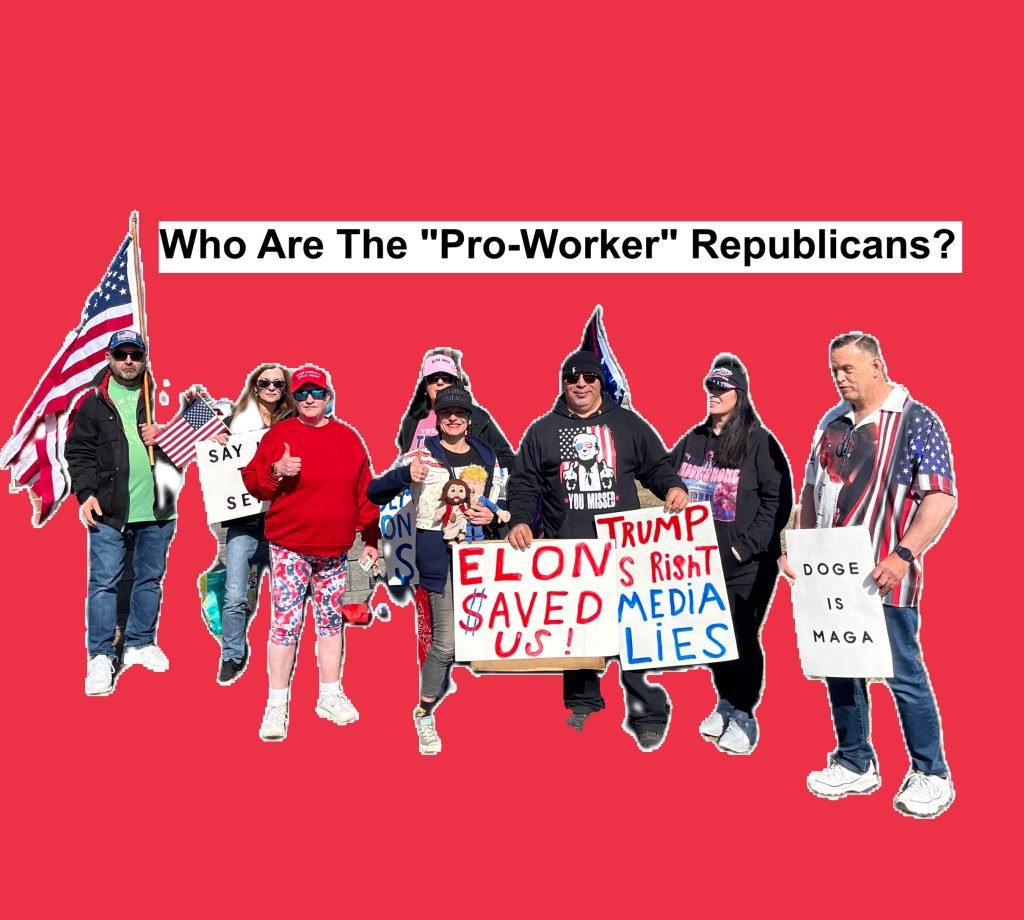
Teamsters’ International President and Medford native Sean O’Brien took the stage at the 2024 Republican National Convention, upending decades of precedent in organized labor’s reliable standing as a Democratic bloc. O’Brien’s appearance wasn’t shocking so much as symptomatic. Labor is in political freefall. Workers have correctly identified that Democratic politics have left them behind; a new populist right has fomented an ideological pitch to try and fill the absence. This new political movement, constituted by labor bureaucrats, pseudo-populist politicians, and disaffected working class voters is increasingly shaping the labor movement with a new right-wing force, animated and with collaboration of a wing of labor leaders and strategists. Although O’Brien frustrates principled organizers everywhere with politics and his love for podcasting more than doing work, the significance of his 2024 speech was the open display of the forces which propelled the labor leader to try to court a new audience.

Meeting of the minds. (Credit: Mediaite.com)
Oren Cass’s Ideology
The intellectual base behind labor’s rightward shift is being spearheaded by a different Massachusetts native: Oren Cass. Cass crystallized his maverick identity after working on Mitt Romney’s failed 2012 presidential campaign.
According to Professor of Labor Studies at UCLA Kit Smemo, Cass lamented following the loss that:
“The Republican Party’s ‘blind faith in free markets’ left it unable to win elections, much less address the gnawing social (and moral) crises left by decades of austerity, deregulation, and privatization.”
This sentiment may seem ludicrous coming from a Republican, as even most Democrats will not verbalize anything close to the critique of neoliberal doctrine as Cass has.
But the GOP is no longer Romney’s party. National politics has struggled to meet the collective shedding of the neoliberal paradigm, and in Washington, D.C., where Matt Yglesias, Noah Smith, and an army of upper-middle class striving 26 year-old Hill staffers excrete propaganda that somehow evolves into law – establishment forces have left a vacuum for politics that is interested in workers, at least on the surface.

Matt Yglesias, the chopped man and hot-take centrist whose readership includes most Democratic establishment players. (Credit: Current Affairs)
This realization led Cass to found American Compass, a think-tank that defies conventional GOP orthodoxy and attempts to articulate a Republican worker agenda fit for the Trump moment. Its policies combine a family-centered conservatism with a seemingly genuine assessment of the economic crises workers face in the United States. Acolytes include Vice President J.D. Vance, Senators Hawley (R-MO) and Cotton (R-MO), and Secretary of State Marco Rubio. Cass has even appeared on Sean O’Brien’s podcast. Compass advocates for a focus on the nuclear family, deportations, regulation of Big Tech, and, incredulously, is critical of the financialization of the United States economy by Wall Street. Of particular emphasis, however, is Compass’s self-identified advocacy for labor and workers.
According to their policy page:
“Organized labor has traditionally been the mechanism that gives workers an institution of solidarity, power in the market, and representation in the workplace. Strong worker representation can make America stronger.”
In 2021, Cass gave a lecture titled “Why National Conservatism Needs Worker Power.” This rhetoric is a far cry from the more familiar Republican establishment lines, drunk off of Koch funding, pushing right-to-work laws and demanding that greater shares of surplus value fall to Capital. While a Republican operative ostensibly supporting the labor movement may reflexively seem refreshing, if not confusing, the actual policies being proposed by the American Compass labor desk are different than either the mainstream of labor or the rank-and-file movement. For example, Compass is emphatically critical of the National Labor Relations Act, which resulted in the creation of the National Labor Relations Board (NLRB), due to its institutionalization of bargaining power monopolies by labor unions instead of its suppression of worker power. Similarly, Compass has expressed skepticism of the DSA-endorsed PRO-Act, which would increase worker organizing through these channels.
Instead of the current system of labor, Compass prefers non-union “works councils” in European Union style, where although workers may not earn collective bargaining power, they at least offer new, more bureaucratic channels to communicate with management.
The Role of David Rolf
This concept, surprisingly, does not stem from some Jack Welsh union-busting fever dream, but in part from David Rolf, former President of SEIU 775 and member of the American Compass Board of Advisors. Rolf has spoken out extensively in support of ‘labor movement innovation,’ including while teaming up with libertarians.
What does David Rolf believe in? We just don’t really know – which makes him a great token labor leader for Compass.
American Compass is staunchly opposed to labor unions acting politically.Citing a survey they conducted themselves, Compass claims that workers would prefer their unions to exist solely to improve their working conditions, siloed away from politics, and that the progressive projects pursued by leadership are actually unpopular with rank-and-file workers. Predictably, Compass is opposed to labor’s work stoppage tactic, calling strikes “unproductive,” in the sense that withholding labor is inefficient for the economy. This analysis counters prolific labor activist Jane McAlevey – and all historic labor scholarship and praxis – that indicates that strikes are the most effective tools the working class has.
Smemo articulates that Compass’s role is to coerce a conservative-friendly compromise between capital and labor. “[Cass] sees this as a way to harmonize business interests and profitability with workers’ demands for more pay. But of course, in a very conservative sense, the strategy has to be calibrated to what ultimately is going to keep workers in line. How do you increase worker power without empowering workers?”
The danger, here, with this sort of political project is that it threatens to take the teeth out of the labor movement. If Cass had it his way: unions are no longer political, no longer strike, and increasingly sympathetic to nativism and nationalism. Instead, Cass wants labor to work out better wages with management through legal maneuvering and arbitration. That’s certainly a nice thought, but in practice it’s how you de-fang one of the few institutions that actually fights for working people. Unions didn’t win the 8-hour workday from bureaucratic dexterity.
With a sizable coalition of Congress bought into the mission, the concepts American Compass espouses are no longer just words on a policy proposal. They’re real threats, and they’re infiltrating the labor movement.
The Rank-and-File Alternative
In Philadelphia, well outside of D.C.’s theoretical fetishization of working people and in the real world, a more traditional labor leader is utilizing tried and true class politics. Richard Hooker Jr. is running against Sean O’Brien for the Presidency of the International Brotherhood of Teamsters, currently serving as the Secretary-Treasurer of Teamsters Local 623.
Hooker’s assessment of O’Brien’s leadership was grim. He cited the federal gutting of collective bargaining rights, NLRB, and OSHA, blaming the Trump administration that O’Brien has courted.
“That does not sound like a party who cares about workers. And unfortunately, our general president has aligned with that party.”
Hooker is running on a slate aimed at making the Teamsters more democratically structured.
“Once you create that more democratic union, you’re going to get members to fight more against the company and that’s what we need. We need our members to fight more against the employer class, the ruling class.”
Hooker uses class-war language, not mutually beneficial worker-employer MBA speak, because that’s what his membership responds to. This is in stark contrast to O’Brien’s argument for labor leaders to meet the most reactionary segments of their membership, and consequently to the concepts proposed by American Compass. Hooker maintains that unions are political organizations, that workers come to union leadership to solve political problems regarding ICE, safety, and affordability.
As for ending the option to strike, Hooker was incredulous:
“Eliminating strikes? That’s crazy. Why be in a union if you can’t withhold your labor? If the company is going to continue to exploit you and not give you what you demand and deserve. Look what happened back in Haymarket in 1886.”

Richard Hooker Jr. (center) campaigning with Teamsters at UPS. (Credit: Richard Hooker Jr.)
American Compass As A Prevention, Not A Solution
Governor Mitt Romney signed the Massachusetts Health Care Reform Bill into law in 2006, creating the foundation for what would soon become the Affordable Care Act. The move may seem odd – why would Mitt Romney choose to pursue healthcare reform as a signature policy achievement? After its passing, Romney declared it as the end of the “single-payer canard.” Whatever the merits of the bill, it effectively closed-off any potential for more radical universal healthcare reforms.
The Romneycare bill was successful in making the healthcare system a little bit less depraved, but it failed to address even most of the problems associated with the quasi-privatized healthcare system. It did, however, take out all of the momentum behind a statewide push for universal healthcare. In essence, Romney’s calculus was in part to sacrifice some healthcare concessions in order to protect the market system from the potential of a future universal healthcare plan.
American Compass likely serves a similar purpose. Workers are converting to more radical politics – DSA has eclipsed 100,000 members – and the labor movement has made moderate gains in organizing and militancy in recent years. Compass is not a solution for the economic plight of workers, but a mechanism to contain and diffuse political pressure that workers are building.
Oren Cass has correctly identified where the winds are blowing, and that conservatives didn’t have an answer to meet a moment where workers are learning to wield their power. The solution, like for his former boss Romney, is to develop policies with the aesthetics of populism and worker advocacy, while in reality accomplishing anything but that. If successful, capital will be able to stave off a labor movement on the offensive, just like they beat us on healthcare two decades ago.
Smemo said:
“There’s been rising labor militancy and organizing. Workers are not simply accepting this intolerable inequality lying down. I think Cass has recognized that you can try to obfuscate, you can try to misdirect attention, but ultimately, it’s going to be something you have to reckon with. And it’s going to require some preemptive moves in the hopes that this can prevent far-reaching labor militancy and insurgency.”
Chris Brady is a member of Boston DSA and an editor of Working Mass.
The post Who Are The ‘Pro-Worker’ Republicans? appeared first on Working Mass.
“}]]