[[{“value”:”

By: Vanessa B
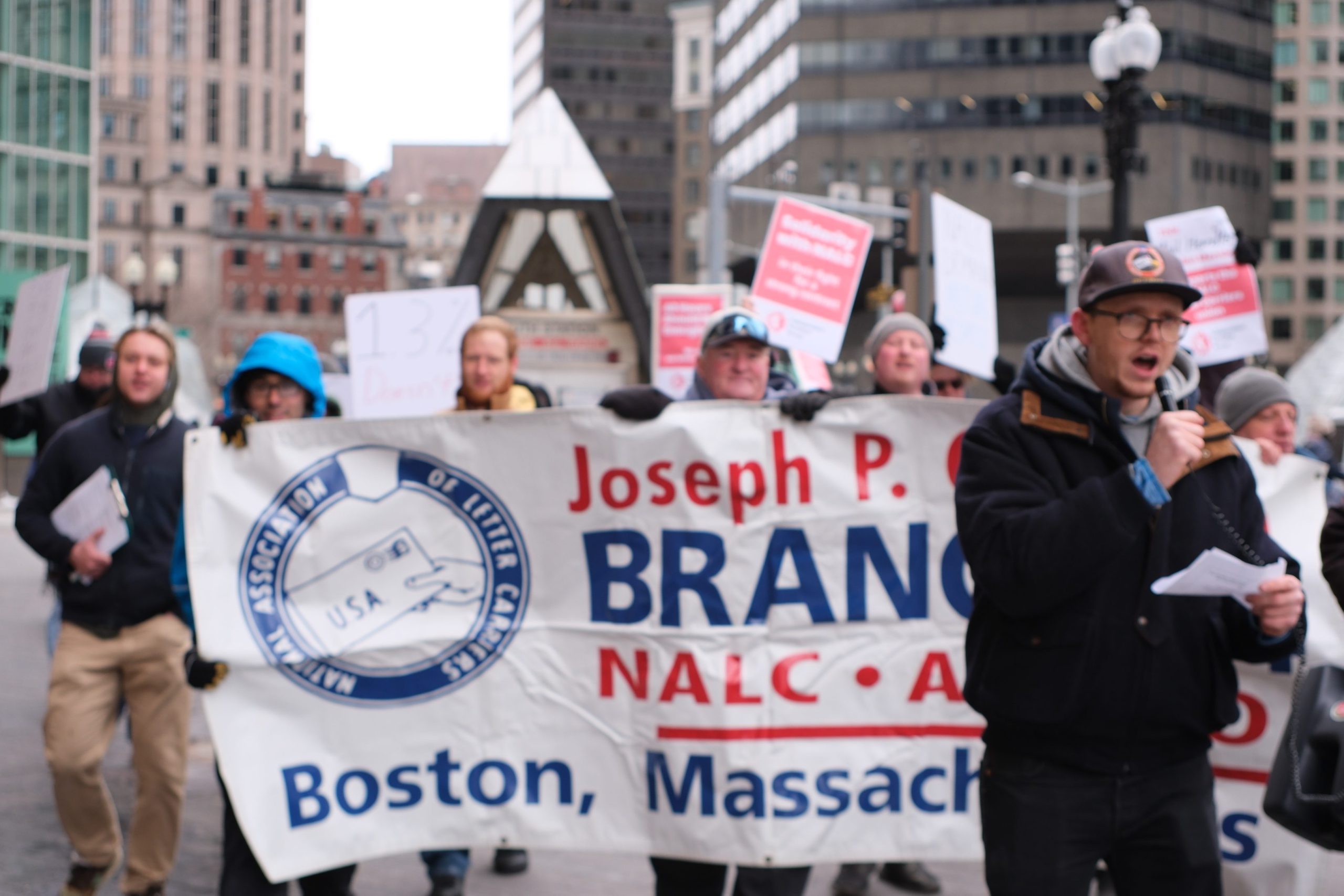
BOSTON – On Sunday, February 22, postal workers gathered for a rally in front of South Station. Agitated by growing managerial bloat and stagnant starting wages, postal workers affiliated with the National Association of Letter Carriers (NALC) are looking to win a contract in 2026 that will make the postal service a sustainable place to work for years to come.
In speeches, workers repeated the call for “30/30”, demanding a $30 starting wage and a ratio of 30 workers to 1 manager.
“If this job is going to survive, if we’re going to recruit and keep people, $30 an hour should be the floor, not the ceiling,” said a rally speaker. “The cost of living didn’t freeze in 2006; housing didn’t freeze, gas didn’t freeze, groceries didn’t freeze. The only thing that froze was us on the streets, and our starting wage.”
Rally speakers outlined a list of demands, such as an all-career workforce, as well as shorter timeframes for moving up the pay scale and overall pay scale reforms, which postal workers hope will help increase retention rates for newly hired letter carriers.
The fight illustrates an upsurge in letter carrier rank-and-file organizing locally – but why? What brings rank-and-file postal workers together amidst a bad contract, tensions within the union over its bargaining process’s (dis)empowerment of members, and a hostile federal environment?

2024 NALC Conference Opens the Door to Democratic Reforms
Rank-and-file worker organizing has been steadily accumulating into a nascent reform movement within NALC. Workers brought proposals for constitutional reforms to bargaining to the national NALC conference in 2024, aiming to increase transparency around the process.
Prior to a national NALC convention in 2024, NALC’s constitution empowered just one person to negotiate contracts between the union and USPS: NALC’s national president, Bryan Renfroe. Much of the ire about the lackluster contract campaign that emerged in 2025, following the 2024 conference debates, has been directed at Renfroe.
The anger of many rank-and-file members towards their union president over the contract stems from the ways in which 2024 reforms did not go far enough. At the NALC Conference, membership won some bargaining reforms. For example, rather than solely having closed-door meetings between the union’s president and management, there will be an appointed group of worker leaders from across the country invited to give input on bargaining.
Despite improvements, members of NALC still have not won a fully transparent open bargaining process.
According to Read Wilder, a young letter carrier and shop steward in Cambridge, the lack of transparency, slow negotiations, and a disappointing contract last year have all led to an upsurge in rank and file organizing amongst postal workers in the greater Boston area.
“The same activists who got open bargaining passed are also looking for a better contract campaign this time around,” Wilder said.

2025 Contract: Too Little, Too Late, Say No
Adding to the urgency organizers feel around the 2026 contract fight is a widely-held feeling that the recently settled 2025 contract was ‘too little, too late’ for many. The contract was voted down by members following a nationwide vote no campaign. The final vote tally: 63,680 no votes to 26,304 in favor.
The contract went to arbitration before a judge, where a deal was reached between the postal service and NALC virtually identical to the one that was rejected by membership. Despite leadership’s promises to “fight like hell,” NALC wrapped up arbitration with the US Postal Service after just two days spent in mediation.
NALC’s 2026 contract fight comes only a year after the previous contract was settled in March 2025. Letter carriers went on working under an expired contract for 700 days. Boston postal worker Harman said:
I was on the phone with my steward when he found out that we got a new contract. It was pouring rain. We were both working a 12-hour that day, but finding out that we got the same contract that we voted down was just like a punch in the gut… It killed any morale, finding out that they took 700 days to negotiate, but only a few days in arbitration to give us the same thing we said no to.

The Movement of Building a Fighting NALC (BFN)
For those committed to building a rank-and-file reform movement within NALC, the focus isn’t toppling the establishment overnight. Their priorities lie in strengthening locals and empowering union members to take ownership of their union, their work, and their contract fights.
In a July statement, NALC reform caucus BFN stated that:
Build a Fighting NALC (BFN) aims to build a national rank and file reform movement to transform NALC into a democratic, fighting union that engages with and mobilizes the membership to fight for better wages, working conditions, and a high quality public postal service.
BFN organizer Derek Liehmon, a Boston-based postal worker, said that he hopes the caucus will “give people an opportunity to learn how to do union democracy.” He continued:
BFN is not doing something because one person or some leader who’s three or four levels of bureaucracy above the rank and file, decides we’re doing it. We vote on stuff, we decide together.
Establishing union democracy internally has involved electing leadership for the caucus, and drafting a constitution for the reform group to follow. Liehmon said the group has looked to other reform caucuses, such as UAW’s Unite All Workers for Democracy (UAWD) and Teamsters for a Democratic Union (TDU), for guidance as they start the process of reforming the letter carriers’ union from within.
“We are trying to apply the last 50 years of reform caucus history in our context, and this is something that really hasn’t existed in the postal unions. From my understanding there aren’t reform caucuses in the other ones,” said Liehmon.

Growing concern about the future of USPS
While union leadership are under increased pressure from members to win a stronger contract this time around, questions remain about the USPS’s ability to remain afloat financially. In their financial report for fiscal year 2025, USPS reported a loss of $9 billion.
At a House subcommittee meeting about the financial future of the USPS, Postmaster General David Steiner testified that the USPS may not be able to provide the current level of service a year from now. Steiner cited decreased usage of the service and high labor costs as factors in the current crisis, and asked that Congress increase the service’s borrowing authority while they “determine what the Postal Service should do to best serve the American public.” Rather than a government that wants the massive funding the USPS requires to fully succeed as a public service, the USPS faces a government deeply invested in its disinvestment.
According to the Office of the Inspector General, USPS spent over $800 million from 2022-2024 on grievances, which are typically related to violations of the collective bargaining agreements between unions and employers.
In a statement published on NALC’s website, the union agreed with the Postmaster’s call for Congress to extend USPS’s borrowing limit, but pushed back on Steiner’s suggestions related to the workers who deliver the mail.
“We will fiercely fight limiting letter carriers’ workers’ compensation benefits in any way or increasing usage of non-career employees in our craft as some in the hearing suggested. Even suggesting such foolish actions are insulting to America’s hardworking letter carriers,” said NALC president Renfroe.
Liehmon told Working Mass:
If you listen to how Renfroe and the union admin talk, they’re really worried that pushing management too hard is going to destabilize the Post Office, that pushing too aggressively is going to create a target for our union and for the postal service, that trump is going to DOGE us. But he might just do it anyway. What happens when they do to us what they’ve done to everybody else?
“The answer to this is not austerity or lower wages,” Liehmon said. “It’s a political decision. Where do we want to spend our money? Do we want to spend it on this public service that mostly funds itself, or do we want to spend money on the military? We (NALC) have to be left wing, and have left wing politics because at the end of the day, it’s a political question.”
That political question may be solved beyond the shopfloor of the Post Office, but NALC faces its own political decision in engaging the question. NALC can work within the broader labor and reform movements to create the political conditions needed for its needed survival. But without leadership from below, there’s no guarantee.
The future of NALC, in other words, relies on the workers. As always.
Vanessa B is a member of Boston DSA and contributor to Working Mass.
The post Postal Workers Demand 30/30 Amidst Organizing Surge Among Rank-and-File Letter Carriers appeared first on Working Mass.
“}]]