[[{“value”:”

By: Travis Wayne
SOMERVILLE – Somerville and its new mayor face a test from organized labor as the city’s executive sits across from a burgeoning municipal workers’ union: Somerville Workers United (SWU) – AFSCME 93, whose members are joining a union representing 45,000 state, county, and municipal workers across New England.
The new city workers’ union, which seeks to represent around 220 non-union workers in the city including both the bulk of the city’s administrative staff and positions of lowest compensation, hovers near the 50% threshold of cards needed to formally request voluntary recognition from the mayor.
The union crosses the threshold after taking the unusual organizing decision to announce their intent to unionize to the public before reaching a 50% majority — which led only to more support, both externally and internally. Compensation and rising austerity in the city government were common themes in conversations between city workers and Working Mass.

Rising Anxiety and Opaque Compensation
Multiple non-union employees that Working Mass spoke with shared that feelings of destabilization in their jobs began in late 2024, but were exacerbated in 2025. Non-unionized city workers have felt increasingly unstable as Greater Boston continues to lose tens of thousands of jobs – a trend that has only worsened.
ICE’s early descent on Somerville did not help in making workers feel safe.
As workers’ vulnerability increased, the need to protect their employment collectively did, too. Individuals’ requests and questions regarding stability and compensation were often punted under former Mayor Ballantyne’s administration. Workers were asked to wait for a Compensation Plan to be released in 2025, the summer before the city elections. But upon its release, the Plan did little except unlock deep dissatisfaction in much of the non-union workforce. According to Josh, one city worker and SWU organizer:
While the base rate was increased for the the lowest-paid employees, the top line pay for directors also increased – and the way they paid for this was a giant step and grade system in the middle for the vast majority of non-union employees.
The sheer complexity of the Plan makes its meaning entirely opaque to many employees looking for critical information on their own employment terms. Many employees have no idea what step and grade to expect at any given time. In effect, the policies are obscured by a wall of legalese that increase barriers to entry for workers just trying to put food on their tables.
Luis, a strategic planner with the city, also added that the Compensation Plan didn’t include any mention of gender parity or Cost of Living Adjustment (COLA) increases – even as gas soars and rent rises. Layoffs also remained firmly on the table.
There was another layer, too, which fundamentally impacted the nature of the labor done in the workplace. Non-union city workers had seen their job descriptions slowly divorced from requested responsibilities and compensation. “All non-union employees were doing other duties, one-off pet projects of the mayor or whoever the city manager was at the time,” said Josh. Directors can press rank-and-file workers for assignments entirely outside their job realm and hold them accountable for that work and workers shared between departments. As Luis indicated:
It’s very difficult to figure out what to do when no one can come to agreement on what my job actually is… and we do what they need us to do at any given time.

New Austerity Suffocates City Workers Further
Mayor Jake Wilson has stated values that are aligned with many of the same priorities as Somerville workers. He supports the development of social housing and calls for the city to be a “guinea pig” in the fight against displacement. And when Mayor Wilson reported in the Cambridge Day that administrative restructuring has occupied much of his effort since taking office, he said “we’re building a team” as his biggest accomplishment of his first one hundred days in office.
Many workers have been made to feel they are decidedly not inside that team.
First, city workers already anxious about their employment since 2025 heard silence from the mayor. According to multiple sources, Mayor Wilson did not contact or introduce himself in any way to the workforce, not even an email. “To this day, we haven’t been properly introduced to the Cabinet of the new Mayor’s Office,” said Luis, shaking his head. Other workers that spoke to Working Mass confirmed that they also had not seen the mayor once.
Then, the mayor fired Arts Council Director Greg Jenkins. The same “departmental reorganization” that created the Cabinet never introduced to workers was enough to end someone’s career after 25 years. In that case, multiple sources speculated to Working Mass that the mayor showed up in-person to introduce himself to workers (one of the only times reported) to assuage their anxieties after their direct manager’s abrupt firing.
But larger concerns than just the remoteness of the mayor were top of workers’ minds: namely, cuts. One SWU organizer shared with Working Mass that every department is expected by the administration to cut a position from their department, as of the end of April 2026. This is after they fired a staff person working in housing, an “active and essential organizer,” in late April 2026. Workers expressed the broader feeling the cuts underscored: that their labor was not valued, with dire consequences to residents. Josh said:
The nature of our job is policy implementing for the public good. It’s a real problem we have no voice in crafting the policies we are charged with implementing.
For example, the city’s portfolio of complex permits is overseen by just three staff members charged with the enforcement of all zone ordinances and inspection in Somerville. In just one department, then, an austerity pattern towards staff from the Mayor’s Office can decrease access to direly-need services for tenants and protection from abusive landlords. Luis summarized the effect of the cuts on the already-squeezed staff:
You start to think of yourself as a number. The perception of how the administration treats us is just as a number in this work: a producer of outputs. People are still passionate about the work.
In lieu of investing in the workers who actually hold relationships with residents and can serve their needs most effectively, the Wilson administration has been characterized so far by what two workers called “a tech bro approach.”
In the Cambridge Day, the mayor underscored a “performance measurement tool” that turns many of the key calculations workers make in policy implementation into an automated dashboard for metric tracking. The mayor is also forcing workers back to work in person, following the same pattern as corporations after the pandemic.
Meanwhile, the labor movement in Somerville beyond City Hall also signaled dissent to the austerity of the new administration impacting non-union city workers. According to the Somerville Educators’ Union (SEU), the mayor aims to take funds from Somerville schools:
Mayor Jake Wilson has asked the district to prepare for up to $1 million in reduced funding, which is well below level-service. This is to account for the projected $5.3 million deficit in the City’s budget.
The mayor has asked for these cuts despite, as the teachers’ union pointed out, the fact that the City of Somerville holds 23.8 million in “Free Cash” and $15 million in a Stabilization Fund. Those funds not only can be utilized to float education, but also support city workers.

Organizing the Union of the Formerly Non-Union
Within the city government, around 220 non-union employees make up the workforce that SWU seeks recognition to represent. The organizing drive took off across multiple non-union departments after the Compensation Plan’s release, but especially revved up as workers felt the need to ensure their own jobs’ stability as the city administration changed.
The Office of Sustainability and Environment was among the first centers of agitation. According to SWU organizers, department workers’ direct feedback was met with coldness by their director, leading to further dissatisfaction exacerbated by micromanagement that followed. Any projects that needed directorial approval were stonewalled and access limited.
The Office of Sustainability workers were the first to sign union cards, with three members of the original Organizing Committee (OC) from that department, because of both that stonewalling and another key factor: the employees’ own deep experiences. Workers in the office included a federal employee purged from the Environmental Protection Agency and a former member of the American Federation of Government Employees (AFGE), equipped with union experience, while another employee was a community organizer hired to work in community development for the city due to their organizing background.
Other departments proved more challenging to reach and build solidarity with, because they were more remote, more autonomous, and better-managed by their director than others.
Non-union workers share a workplace – tasks, relations, ideas – with unionized colleagues. Thus, even in departments without workers with labor or organizing experience, workers had exposure to the major differences between their contracts and those of union workers. The Somerville Municipal Employees Union (SMEU) was unaffected by the Compensation Plan and, when union employees saw benefits won, non-union workers also observed increases due to the city’s requirement for parity. The difference became stark.
City workers first sought to organize into one of the city government’s existing unions that inspired so many of their ranks. Ultimately, that choice seemed less possible over time for workers’ needs, according to Josh. Despite SMEU President Ed Halloran’s support, the reception of SMEU membership to their coworkers’ unionization was frostier than they hoped. Controversy between other parts of the Somerville labor movement and SMEU around the reinstatement of one union member that led to the 2024 resignation of library workers was also not encouraging.
We started having these amorphous conversations… those of us who were former municipal workers began reaching out to SMEU, the Steelworkers, UAW, and eventually AFSCME 93… their expertise with the public union process was on display in a way the others in a technical space weren’t… and many felt SMEU would not yield in their challenges, and the time it would take to activate leadership would be too long for workers.
In the end, 75% of the nascent union chose to affiliate with AFSCME 93.

Going Public
Somerville Workers United (SWU)’s demands are, in the end, simple.
“We need a seat at the table,” Josh told Working Mass. “We need clear policies and procedures in the handbook, like overtime, flexibility, offboarding, steps and grades made transparent, position reclassification.”
The union chose to go public on March 10, before reaching the 50% threshold, largely because one obstacle they encountered was hesitancy from their coworkers to join in any clandestine effort. In a city where so many unions bargain with the city, some non-union city workers felt uncomfortable organizing with Somerville Workers United till the union was open about its work.
According to SWU organizers, the strategy of going public early was successful. Going public allowed the union to speak to more and more of their non-union coworkers openly. Questions of dignity, compensation, and stability unfolded in conversations from City Hall to the most remote corner, with organizers conducting one-on-ones department by department.
The mayor’s office did not interfere or in any way communicate its notice of the new union. On April 10, 2026, SWU had reached 70 union cards signed out of around 220. The union held a series of socials for workers and their allies in labor and beyond: a St. Patrick’s Day social at the Burren, building-level tabling at the Annex and City Hall, a potluck picnic in Winter Hill, an art build at Aeronaut Brewery. Workers signing on steadily grew, till by the end of the month, the union hovered near the 50% threshold needed for climactic action.
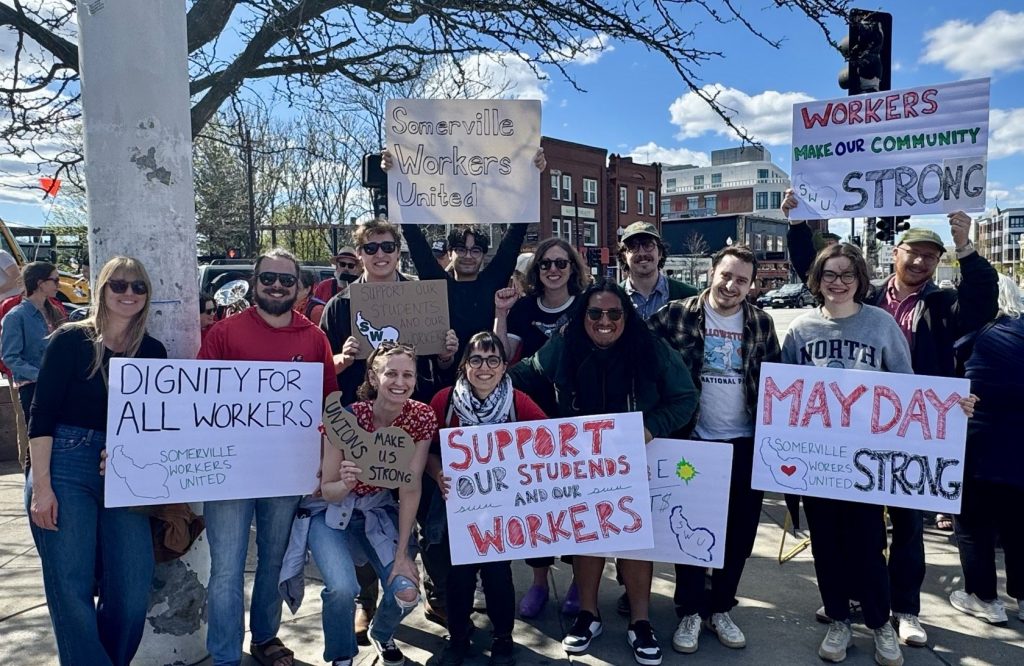
On May Day, as workers rallied in socials and events across Greater Boston, SWU coordinated with the Somerville Educators Union on their rally to “demonstrate solidarity across public sector workers in the face of looming budget cuts” in their final stretch push for recognition from the city government. The action signals an important shift from seeking recognition as a union to acting as one, as part of and connected to the fight for recognition – in this case, representing workers’ interests in unity with Somerville’s teachers’ union facing the city to reject the notion of a zero-sum game between schools and services.
“To some extent, to be the union is the point,” Josh said. SWU has certainly become the union. It’s up to the mayor whether he will recognize the workers as the union they already have become, or not.
Travis Wayne is a union organizer in Somerville and the managing editor of Working Mass.

The post Somerville City Workers, Facing Opaque Pay and Austerity, Unionize with AFSCME 93 appeared first on Working Mass.
“}]]