
[[{“value”:”

By: Frederick Reiber
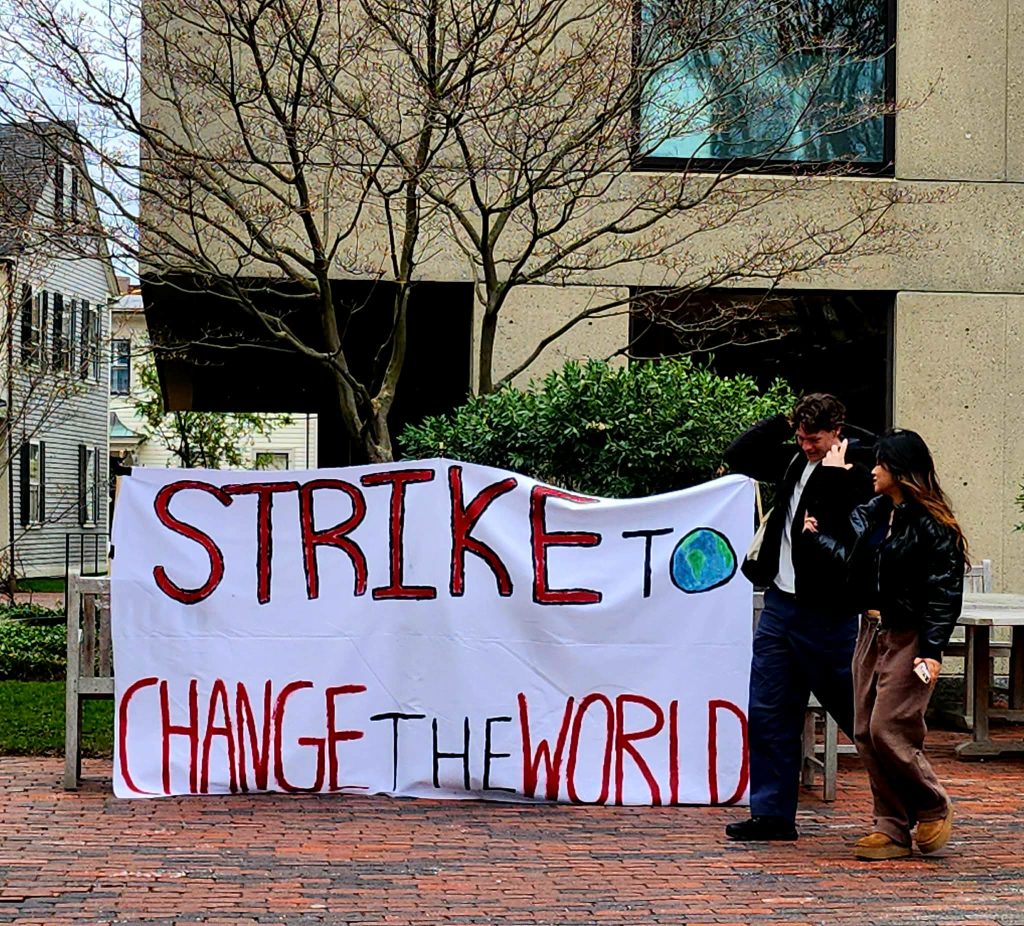
CAMBRIDGE — Harvard students are in their reading period in advance of finals as Harvard’s graduate union representing workers in around sixty programs of departments across the university surge to the end of their third week on a historic strike at the world’s richest university. Seeking to continue escalating pressure following a 79% turn out with 96% of its membership in favor of militant strike action for the union’s demands in April, workers have escalated to withholding teaching and research, disrupting end of semester activities, and slowing operations.
The Harvard Graduate Student Union (HGSU) – UAW Local 5118 strikes as other unions on campus have so far chosen other strategic routes in negotiations, despite the potential for contract alignment, but anger over workplaces issues in the rank-and-file movements is increasing across campus and its surrounding communities. The university focused entirely on attacks from above increasingly faces dissent from below.
And since workers make Harvard run, ultimately, the workers’ threat demands the university’s attention.
Demands for Dignity and Against ICE
HGSU has been bargaining for a total of 14 months, with only two tentative agreements—one on access to space for office hours and another on holidays, personal days, and vacation. Harvard has refused to bargain over issues including access to ADA-compliant spaces, union representation in cases of intellectual property disputes, rights to healthcare, and academic freedom. The university has also denied workers the right to open bargaining, recognizing the potential for increased worker power when negotiations are not done behind closed doors.
The current campaign has coalesced around four primary demands:
First is the creation of an independent process for addressing workplace harassment, discrimination, and bullying. Union data estimates that at least one in five student workers experiences some form of harassment as researchers and teachers, while Harvard currently controls the only formal channels for reporting and resolving those cases. Graduate workers are calling for access to a neutral, third-party system, with the ability to appeal to an independent arbitration with the authority to issue binding remedies.
Workers spoke to the need for Real Recourse. In anonymous testimony published by HGSU, one student worker reported:
“I was repeatedly told I didn’t have a good Title IX case because I had a previous relationship with my harasser and because I was not assaulted. Though they suggested I could get help from CAMHS, there was no action taken to address my concerns or protect future victims… The person who harassed me did end up assaulting someone else about a year after I went to the Title IX office. If the university had acted on my concerns when I brought them, they could have prevented an assault. The way that the university failed me and the other members of my department in this process is incredibly frustrating… If I had had union representation to support me as I navigated the process, I believe I could have stood up for myself better.”

Second is the implementation of a “fair share fee.” This clause would require all workers covered by the contract to contribute to the costs of union representation, regardless of membership status. Doing so helps to spread the substantial costs of organizing and contract enforcement more equitably, helping to sustain the union’s operations. Such fees are common in states without anti-labor right-to-work laws, including Massachusetts.
Workers are also demanding wage increases, setting a baseline of $55,000 for all graduate student employees. RAs and TFs at peer schools such as MIT, Stanford, and Princeton make far more while boasting smaller endowments than a university located in the country’s most expensive city. In addition to a higher base pay, workers are calling for a Cost of Living Adjustment (COLA) which ties annual raises to inflation, ensuring wages keep pace with rising expenses over the life of the contract. Similar clauses have been won at other universities. Organizers demand a living wage with COLA adjustment that reflects the realities of living and working in Boston’s high-cost environment while addressing longstanding pay disparities. Right now, research-based positions earn roughly $40,830, compared to about $26,300 over ten months for graduate workers in teaching roles—a gap the union argues is unjustified given the university’s reliance on both forms of labor.
Harvard heavily discourages and often forbids other forms of employment. Nonetheless, during bargaining with HGSU, university representatives called the living wage demand “unreasonable.” Harvard indicated in bargaining that its top priority is growing its endowment, even as the university during the same November 7, 2025 session rejected the union’s requests to bargain for paid family leave, healthcare during leaves, and full compensation for RAs and TFs whose appointments cancel last minute, necessary for financial stability for the most vulnerable student workers.
Harvard University has an endowment of $56.9 billion.
Finally, the union is demanding stronger protections for international student workers, with organizers pointing to an increasingly hostile national climate, including intensifying immigration enforcement and right-wing political attacks, which leave non-citizen workers vulnerable. Crucially, the union is fighting back against a university that has bowed to the Trump administration’s anti-immigrant culture war demands. Of course, that also means that HGSU’s inclusion of the fight against ICE in its organizing forces Harvard University into the position of raising the stakes of its choice to hold its head down and hope the White House stops beating its crimson walls.
The demand to protect immigrant workers has, in many ways, crystallized into the nexus of the union’s fight. In June 2025, HGSU introduced into contract negotiations a call for Harvard to safeguard I-9 forms, fund legal counsel, and prevent ICE agents from entering spaces without a valid judicial warrant. Some students pointed out the University of California has held these policies for a decade.

The Structural Challenges of Organizing in Academia
Organizing at a university presents many unique challenges. Workers contend with an uncertain legal landscape, as the current National Labor Relations Board has a Republican majority, which may revoke graduate students’ dual status as students and laborers. In order to help avoid such an outcome, graduate worker unions across the country have pulled numerous unfair labor practice charges in an attempt to limit such a ruling.
One effect of this is that workers at Harvard are now on what is considered—in legal terminology—an “economic” strike. Unlike an unfair labor practice (ULP) strike, which provides legal protections around employee replacement, economic strikes have no such protections allowing employers to—theoretically—higher permanent replacements for striking workers. While such action is unlikely, the inability to use ULPs can negatively impact organizing and outcomes.
Challenges also appear at the community level, with workers needing to overcome a highly dispersed workplace, with social connections often centered around the academic department. These siloes compound the experiences of academic workers as isolated and overextended, needing to balance multiple responsibilities, and challenges around how the broader ivory tower and surrounding communities view academic work. Indeed, Harvard has attempted to weaponize these characteristics. The university forcefully removed more than 800 student workers from the union, refusing to recognize their employment status, during a series of restructurings and reclassifications that multiple staff in multiple unions described to Working Mass as latent attacks by the university on its own workers in July 2025. These included also capitulation to federal demands including the closure of offices serving communities of color on campus, which HGSU bargaining committee member Denish K. Jaswal pointed out to the Crimson.
The answer to overcoming structural obstacles for HGSU organizers was an organizing model focused on developing strong inter-personal relationships through one-on-one conversations. As grad worker Marley Hornewer explained:
It’s a lot more one-on-one conversation than in any other organizing I’ve done before. [You need to be] really accepting of the fact that organizing takes time […] folks have so much else that they’re doing that responding to a text or getting coffee with you isn’t necessarily a priority, but when it happens […] it feels so powerful to people to see themselves as a worker.
Jessica Van Meir, a TF at the Harvard Kennedy School, emphasized the ways in which organizing and the strike has transformed rank-and-file grad workers, whose anger at the university on behalf of every demand increases with each day of evidence from Harvard of its own obfuscation:
The outpouring of participation in the strike and refusal to cave to the administration’s scaremongering demonstrates that graduate student workers understand our importance to the university. Harvard can easily end the strike and restore business as usual by offering us a living wage, independent arbitration for harassment and discrimination cases, and protections from ICE coming on campus without a judicial warrant. But until then, no teaching, no grading, no research assistant work. How embarrassing to have to explain that to the parents who are forking over their retirement savings for their children’s education. The choice is Harvard’s.

Creative Strategies for a Community Organization
Harvard workers have deployed numerous creative and community-based strategies for the purposes of solidarity. For instance, striking workers have been blocking deliveries, a tactic in which workers will form a picket line outside of university docking sites. Drivers attempting to deliver Harvard’s packages from unionized or pro-labor workplaces like UPS or USPS will refuse to cross a picket-line, either through previously established union contracts or out of solidarity for the workers, which disrupts university operations and pressures administrators to come to the table.
HGSU has also run a number of teach-ins, covering topics like labor history, socialist activism at Harvard, and an intro to agency or “fair-share” fees. One was an Undergraduate Strike School on April 24. Workers have also launched a number of community events focused on bringing in both academic and local communities into their struggle.
One of the largest events was the first week community rally, hosted on April 23rd at the Science Center Plaza, the day before the Undergraduate Strike School. A wide range of speakers representing labor unity spoke, including current HGSU president sara speller as well as brother and sister unions at Harvard including Harvard Academic Workers (HAW) and SEIU 32BJ and UNITE-HERE Local 26. The unions were also joined by organizers from the Harvard Temporary Protected Status (TPS) Coalition and undergraduates from the Student Labor Action Movement (SLAM).

The event also featured a number of local and state politicians including Massachusetts State House Rep Mike Connolly, DSA-endorsed Cambridge City Councilor Jivan Sobrinho-Wheeler, as well as challenger for incumbent Marjorie Decker’s seat and former HGSU president Evan MacKay. City Councilor Sobrinho-Wheeler said, during his speech:
I’m glad to stand here and deliver the message… if Harvard wants Cambridge to have its back, its gotta have the back of its workers.
Various other university communities have also thrown support behind the striking graduate workers. Earlier this week, around 200 first year Harvard Law School students signed letters urging their professors to press the University to come to the table with the union. Faculty—albeit at significantly smaller numbers—have also signaled their support to the striking graduate workers, agreeing not to replace or retaliate against workers on strike.

Diverging Strategies in a Shared Fight
Harvard’s graduate workers are not alone in facing an expired contract, or the brunt of the Harvard administration. Other Harvard bargaining units are also embroiled in contract fights, but have taken different tacts to striking. While multiple bargaining units are affiliated with the United Auto Workers (UAW) that have pioneered the strategy of coordinating unions to strike when bargaining happens at the same time and now lead the charge for contract alignment on May Day 2028, strategic contract alignment has not been on the table at Harvard.
The Harvard Union of Clerical and Technical Workers (HUCTW), the largest union on campus representing over 5000 administrative workers essential to the university’s operations whose members often work closely alongside HGSU members, is scheduled to vote on May 12–13 on a modest agreement that would grant most members a $2,300 raise and expire after one year. The union has proposed this contract to membership after Harvard’s central fundraising office laid off a dozen HUCTW union members and announced mass summer layoffs likely to decimate HUCTW’s ranks. David Deming later confirmed the intent to target union workers in an open forum, where the Dean of Harvard College called essential labor work that “you would never really know or care about.” In one email obtained by Working Mass, HUCTW organizer Bill Jaeger intervened to ask members to vote yes on the proposed contract, while the HUCTW Rank-and-File Movement, focusing on building up the leadership of rank-and-file members over the union, publicly urged membership to remember “we can’t eat prestige” and instead vote no on May 6, 2026.
HUCTW has urged members to turn down work that managers ask them to perform that would normally be done by grad workers – crossing the picket line – but indicated members should continue to do “their own jobs as usual.” When asked about HUCTW, multiple organizers with HGSU declined to comment about their relationship with the other union.
Harvard custodians with 32BJ SEIU ratified a 4-year contract in March that union leaders called the “biggest wage increase in decades:” a 4% hourly raise by 2029. While Harvard dining hall workers went on strike in 2016, their 500 rank-and-file workers affiliated with UNITE HERE Local 26 have not yet chosen that route even as their negotiations have dragged into. Most controversially, members of the Harvard Academic Workers (HAW) – UAW —a unit of non-tenure-track researchers and instructors that has been bargaining for 18 months—recently decided not to strike. In a controversial move, HAW’s bargaining committee overrode the vote of membership after citing concerns on sufficient votes for strike authorization and uncertainty about support from the union international. This decision was made by a bargaining committee made up of rank-and-file members after consultation with UAW staff.
The union also recently filed a Unfair Labor Practice (ULP) against Harvard.
At the same time, workers within HGSU praised the academic workers’ commitment to solidarity and struggle. One worker said:
I do feel a lot of solidarity from them. We’re fighting for a lot of the same things … and continuing to work together towards a more just academic environment generally.
Whatever the tactical differences, these parallel struggles underscore the broader potential for cross-union solidarity and coordinated fights that can reshape power across the university. Further, every single union shares an employer – one seemingly intent on facing, and then offsetting, the wrath of the federal administration onto its staff.

Higher Education, Labor, and Struggle
Higher education is not a refuge from conflict, but a site of struggle. As Harvard PhD candidate Laura Chen put it:
Every morning when we do delivery pickets and get to cheer for the Teamsters as they turn their trucks around for us, it’s incredible. It’s so fun. And getting to explain to various burly truck drivers why we’re with the UAW – delightful.
These moments capture something larger than a single strike. They show how academic workers are linking up with a broader labor movement, building relationships that extend beyond the university.
At a moment when higher education is defined by precarity, political attacks, and deepening inequality, these contract fights are about more than pay or procedure – they are battles over the basic necessities of life and worker humanity. What is unfolding in higher education organizing is not an isolated conflict, but part of a wider struggle over power and dignity.
Readers can support grad workers by joining them on the picket line, held each day, or contributing to the union hardship fund.
Frederick Reiber is a contributing writer to Working Mass.
The post Harvard Faces Grad Workers’ Strike as Discontent with the University Rises From Below appeared first on Working Mass.
“}]]