
[[{“value”:”

By: Matt Wolfinger
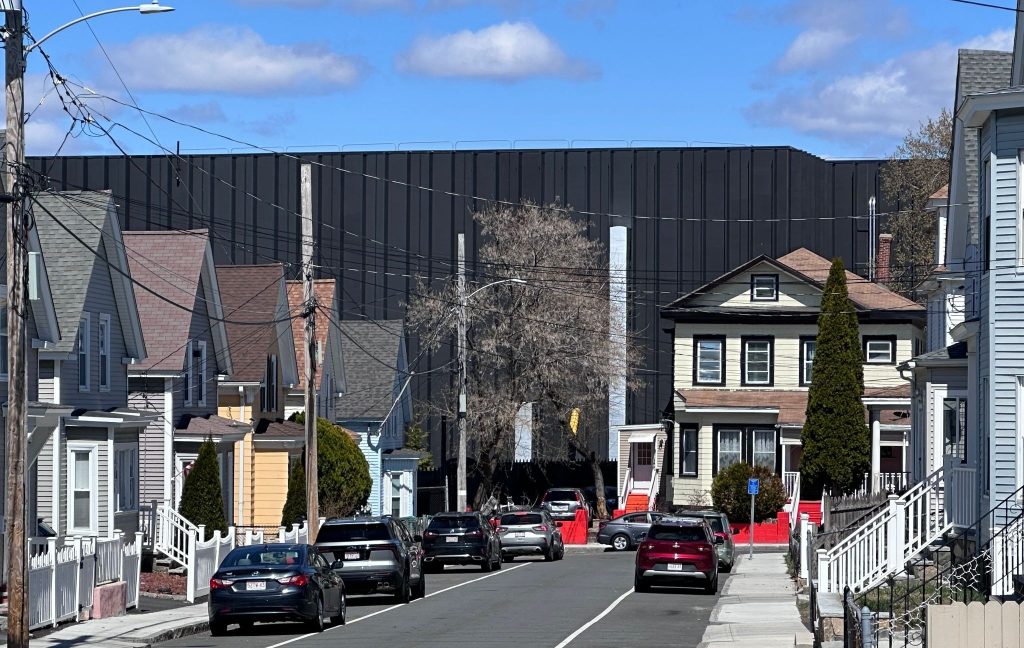
LOWELL – In the Sacred Heart neighborhood, a massive black box looms over the surrounding homes. The building, called ‘the Dungeon’ by some locals, is the largest data center in Massachusetts.
Lowell residents have been living in the shadow of Markley Group’s 352,000-square-foot data center for more than a decade. The center’s cooling towers emit a constant hum less than 100 feet away from the surrounding homes on Otis Street, while its backup diesel generators spew fumes into the air. Lowell resident Jake Fortes told Working Mass that on hotter days, the center’s AC units work overtime and “sound like jet engines.”
“I’m just trying to live quietly,” he said. Fortes is the founder of Honest Future For Lowell, a grassroots group fighting back against Markley’s plans to further expand their data center.
In March, Lowell became the first city in Massachusetts to impose a moratorium on the construction and expansion of data centers. The one-year moratorium is part of a nationwide pushback from local communities against the rapid spread of artificial intelligence and the data centers needed to sustain it. While Lowell’s data center wasn’t created with AI in mind, larger and more power-hungry hyperscale versions used to power AI have sprung up in small towns across the country.
The Public Responds to Data Centers
These centers need massive amounts of water and energy to function, but municipalities are placing the burden of the consumption onto local taxpayers. Tap water is drying up, and utility bills in the vicinity are skyrocketing.
Lowell is no exception. At the city hall hearing on the moratorium, resident Alex Solange claimed his winter electricity bill, once $40, has risen to $177 per month as a result of Markley’s data center.
While the moratorium passed unanimously, local opinions are more divided. Lowell residents supporting the measure faced opposition from members of the International Brotherhood of Electrical Workers (IBEW) Local 103, who showed support for the data center by holding signs and wearing “Stand with Markley” shirts.
The union members have their own economic concerns, namely the high-paying construction jobs that stem from building data centers. These contracts are enticing for trade workers looking for fair compensation and the unions seeking to keep their workers employed.
“Markley is a great partner of ours,” said Local 103 Business Manager Lou Antonellis in an emailed response to Working Mass. “They’ve always been committed to hiring Local 103 contractors and paying livable wages to their employees. It was a no-brainer to support a business that stands with us.”
Many data centers in the U.S. are built with unionized labor. As the scope of these projects expands, the interests of unions have been placed in opposition to local residents forced to live with the consequences. Pitting members of the working class against each other takes attention away from the real culprits – hyperscalers and the lawmakers who created these conditions.
$75 million of Governor Maura Healey’s proposed Mass Wins Act would be spent “to expand the application of artificial intelligence across key industries.” Healey signed a law in 2024 granting sales tax exemptions for data center sales in Massachusetts, hoping to “retain and attract top AI talent” to the state.
According to Pew Research Center, there are more than 3,000 operational data centers in the U.S. and over 1,500 in development. Tech billionaires like OpenAI CEO Sam Altman want to go even further, saying we may have to cover the entire world in data centers to keep up with the demand for processing power. Healey has openly bragged about her historic partnership with OpenAI, making Massachusetts the first state to do so.
Maine passed a statewide ban on data center construction in an effort to prevent the harm data centers would cause to the local environment. It was vetoed by Governor Janet Mills. Healey has refused to support a similar ban in Massachusetts.
“We need to have data centers of some sort for the kind of … innovation economy we want to have,” Healey told the New England Council business group in April.
The Cities Vs. Data Centers
Without state-wide protections, cities have largely been left to fend for themselves against the data centers springing up in their backyards. Even as they continue to be built and expanded, lawmakers warn that Massachusetts does not have the power capacity to support these data centers. Markley’s data center consumes so much energy that National Grid had to upgrade nearly 200 utility poles to keep up with demand.
Healey’s support for data centers in recent years makes more sense when you follow the money. According to data from the Massachusetts Office of Campaign and Political Finance, Markley Group CEO Jeff Markley has donated a combined $24,000 since 2022 between Healey, Lieutenant Governor Kim Driscoll and the Democratic State Committee.
Markley Boston LLC contributed an additional $150,000 to PACs running ads in support of Massachusetts Lieutenant Governor Kim Driscoll and Attorney General Andrea Joy Campbell leading up to the 2022 election.
Also of note is the $250,000 the LLC donated to the “Coalition to Stop the Tax Hike Amendment,” which ran ads to oppose a 4% surtax on those earning more than $1 million a year. The “Fair Share” tax narrowly passed and is expected to bring in $2.7 billion next fiscal year to help fund public transit and education.
Markley has donated thousands more to politicians like former Governor Charlie Baker and former Lieutenant Governor Karyn Polito during their terms. It’s clear Markley has no problem spending money to get officials in office and stay on their good side.
While Markley’s Lowell data center received a $77 million tax break, dozens of city employees have been laid off amid budget cuts. Residents may also face increased property taxes, sewage payments, and water payments.
“We’re not winning from this,” Fortes said. “What are we gaining from this place being here?”
AI Boom Divides Workers
Depending on who you ask, the AI boom is either a blessing or a curse.
For some trade unions, the boom is a dream come true. Data center contracts pay well, there’s always a new one that needs building, and many commit to union labor. Nonetheless, good jobs do not guarantee welfare for the working class overall. Some workers take home wages while generative AI devastates workers everywhere else.
The claim from data center supporters that they’re boons for local job creation also doesn’t match the reality. While data centers may provide an influx of short-term jobs during the construction phase, the skeleton crews that maintain them don’t facilitate long-term job growth.
A recent study from the University of Southern California Marshall School of Business found that on average, the workforce of a data center reduces by 78% once construction is complete. Antonellis shared with Working Mass that IBEW 103 currently has “at least a dozen journeyman [sic] and apprentices in [Markley’s] Lowell & Boston locations doing daily maintenance… we had about 120 in Lowell a few years ago for their expansion.”
While trades like construction are currently more resistant to automation, other labor leaders have sounded the alarm on the threat AI and data centers pose to both blue and white-collar work.
In the words of a spokesperson for SAG-AFTRA, in an emailed statement to Working Mass:
Generative AI has profoundly affected our members because it allows companies to replicate voices, likenesses, and performances in ways that were not previously possible at scale. Our members are rightfully concerned about unauthorized copying, replacement, and manipulation of their work and identities,
VFX artists are being laid off in the hundreds as studios look to cut costs in favor of using AI to replace human labor and create digital replicas. Screenwriters have found their scripts are being used to train AI models without their knowledge or consent
A study from the American AI Jobs Risk Index revealed Massachusetts has the highest risk of AI-induced job loss of any state, with up to 535,000+ jobs on the chopping block in the next five years. But AI has been taking much more than jobs – it’s taken a toll on local ecosystems and their residents who had no say in these decisions. A recent Gallup poll found that seven in ten Americans oppose the local construction of data centers. Ignoring majority opposition, municipalities across the country are forcing them onto locals. The political capital for data center construction is not primarily coming from labor, when Chambers of Commerce are often major organized interests of support with direct lines to government.
Markley’s expansion in Lowell shows no sign of stopping. Fortes alleges that Defense contractor Draper Labs, who, “among other things, helps develop weapons systems from the U.S. Navy,” moved into the data center in August 2025. By October, according to Fortes, security cameras lined the center’s walls and armed guards were stationed at the gates.
While neither Markley or Draper have disclosed the latter’s involvement with the data center, Draper is an “anchor tenant” of the ongoing Lowell Innovation Network Corridor (LINC) project, an $800 million partnership between the city of Lowell and UMass Lowell. The ‘university pipeline to war profiteering’ known as UMass Lowell identifies Draper as a ‘premier’ partner alongside Raytheon, as reported previously in Working Mass.
The Weight of Powerful Interests
At a meeting last June where Lowell’s City Council approved Markley’s request to build four more diesel generators, chair of the UMass Building Authority Mary Burns said LINC wouldn’t be possible without Markley’s data center. “In order for LINC to happen, we need Markley,” said Burns. Markley then doubled their ask to eight generators, which was also approved. Then, last October, Healey pledged $25 million to assist Draper with the construction of their new center in Lowell.
Despite residents appealing the decision, the Massachusetts Department of Environmental Protection (MassDEP) allowed Markley to go ahead with building new generators behind the backs of Lowell residents. Honest Future For Lowell members filed a lawsuit against both parties, the first of its kind in Massachusetts. They claim MassDEP unlawfully approved Markley’s expansion into a heavily congested area during an ongoing appeal.
The lawsuit, filed on April 27 on behalf of 10 residents, alleges that “Markley has chosen to subject its neighbors to intrusion, disruption, and serious health dangers—all without transparency and meaningful community engagement, and with little oversight by State regulators charged with enforcing state air pollution control laws.”
Markley and his associated LLCs have spent millions buying up residential buildings surrounding the center. He has yet to give a reason, but Markley’s website has been changed to indicate they’re “now available for your generative AI workloads.” To accommodate AI, Lowell’s data center would need even more space to grow.
Healey refusing any sort of statewide legislation and tech CEOs cozying up to the Trump administration places the responsibility on the shoulders of the working class to fight back. While billionaires and their allies loot the planet and its people for all their worth, they’ve manufactured a state of affairs that pits the interests of working people against one another. They insist without evidence that anyone opposed to these data centers being built in their backyard must be misinformed or funded by China. Implementing similar tactics to Markley on a larger scale, big tech is pouring millions into politics, hoping to sway the midterms in their favor.
Markley’s Lowell data center gives us a window into the existential threat they may pose to the planet if the AI craze continues to spread. The hyperscale versions needed to power AI dwarf that center in comparison – consuming up to 5 million gallons of drinking water each day.
‘Half-Finished Husks Without Purpose’
Some experts warn the AI bubble could pop any day now – just like with NFTs, crypto, and the dot-com bubble. But unlike the dot-com bubble, which had a comparatively clearer path to recovery, it won’t be as easy with data centers. They’ll sit as half-finished husks without purpose after the damage is already done.
Wells have dried up, property values are plummeting, and companies are building power plants to meet the immense energy demands.
Tensions remain high between unions and Lowell residents as they spar in social media comments. The incitement of working class infighting distracts from the damage the ruling class is inflicting to the planet and its people. As long as the interests of the working class remain in conflict, this will only continue. Environmental activist Erin Brockovich has launched a tool to map data centers as they appear in local communities. While incomplete, it’s a useful resource to keep track of where they’re springing up or to report one in your own backyard.
Beyond Lowell, other cities in Massachusetts have won their own battles against data centers. Mansfield is the first city in Massachusetts to pass a near-total ban on data centers, the community taking preemptive action before any could be built. Monterey Park, California just became the first city in the country to pass a permanent ban.
The technocracy surveys the plains of America through the serpentine eyes of a predator. They strike, sink their poisonous fangs into the earth, then move onto their next target while the venom seeps into the water and air of the local community. The billionaire class will not be satisfied until, as Altman proclaimed, they’ve marked the entire world as their territory. The working class has been left to fight for survival against one another, wasting precious time that could be spent working on an antidote.
Don’t wait for a data center to come to you. Stand in solidarity with your neighbors and take collective action against their construction before we’re robbed of our safety, our health, and our dignity.
Matt Wolfinger is a data journalist, Northeastern University graduate, and a contributing writer to Working Mass
The post The Dungeon Over Lowell: How the Data Center Boom Divided One City’s Working People appeared first on Working Mass.
“}]]