[[{“value”:”

By: Reid J
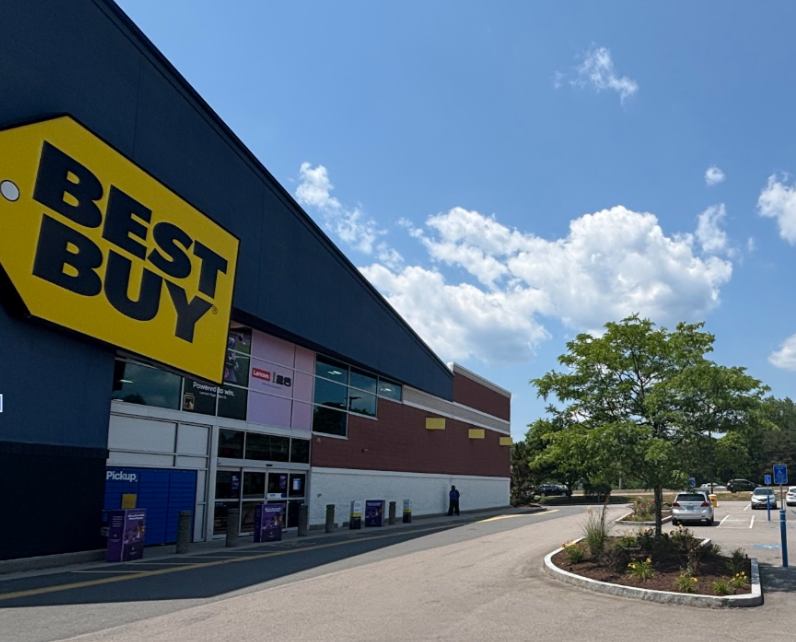
DEDHAM – In September 2025, broke and desperate, I was running food deliveries for the richest neighborhoods in Waltham while trying to get my resumé in the door anywhere and everywhere when Best Buy hired me. A friend was already working there and helped me get on the sales team with a recommendation, so that I started work full time two months before their Black Friday rush. I had never worked in sales before, barely even worked retail, but this was my last stop on a year long train of unemployment.
It was not my plan to try to unionize my workplace of 72 employees over the coming months.
My first jolt of inspiration was sent directly into my signal DMs. Travis, the managing editor of Working Mass, asked me if I could finish an article for the paper. I replied that my focus was currently dedicated to Best Buy; I wanted a good foundation here since I was fired from the last two jobs I had. Without missing a beat, he asked me a simple question that kicked off my path to organizing:
You got an organizing plan with EWOC yet?
EWOC: the Emergency Workplace Organizing Committee, a co-venture of DSA and the UE, to support new organizing. There was something about how he phrased it, like it was an already forgone conclusion that if I was working and not searching like so many comrades in the barren wasteland of Trump’s job market, I would already be hard at work building the foundation of the socialist future as a rank-and-file worker. The mode of thinking changed my whole attitude about my time there. I shouldn’t just wallow in gratitude that a corporation had decided to give me a meagerly-above-minimum-wage job. I should look to seek something more, no matter where I am in life.
This question stuck with me while I spent eight hours a day ringing out PlayStations and selling credit cards to senior citizens. I was here, I was employed, I had my parents off my back (still living at home), but I was making money. That’s all a man needs, right? Dutiful employment? But Travis was asking me about something more, about having a goal, a horizon at the end of a weekly forty hour cycle where I could look back at the time I’ve spent at 700 Providence Highway and say that I’d accomplished something more than sales numbers and a 3% annual pay raise.
I began, from a place inside myself where I knew in order to keep working monotonous, mind-numbing retail shifts, that I wanted either an exit strategy like everyone else I was working with, or a project I could commit myself to. I figured why not undermine some authority, spend some time talking to the people I spend eight hours with, and learn just how much they hated their job and more importantly, the company that employed them.
The American retail coworker relationship is mostly defined by a sequence of nods, fist bumps, and “thank yous” after completing a task together. Outside of this, you’ll have a handful of two to three minute interactions when not burdened by customers, daily tasks, or supervisors requesting your presence. My job was to distill the incredibly complicated and controversial idea of union labor into a digestible pitch and intake their opinion in the brief opportunities I had. I never had any training for being an organizer, I had never even worked in sales before I started the job, but I threw myself at every opportunity I saw, catching my coworkers in the break room, in our warehouse, and sometimes even running across the football field sized parking lot to introduce myself, my ideas, and whether they could see themselves fighting for better pay and benefits like the rest of us.
My progress was staggering given my inexperience, and I quickly found momentum in every department of the store, kids fresh out of college and tenured full timers, everyone agreed with the core of my message: something has to change.

Union Organizer, the Quality Employee?
My greatest weapon in my crusade to reach all 65 of my union eligible coworkers was a crusade to become the most well-liked guy in the store, for both my fellow hourly employees and the store’s managers. It wasn’t part of my grand strategy to end up as one of the top sales advisors in the store, but it came naturally from a desire to keep my employment secure after my last two failed attempts.
This gave me two benefits in my endeavor: it insulated myself from targeting by management based on my performance, and created real magnetic power with my coworkers to convince them of the power of our labor. The power to say to your fellow sales advisors that you rang out $200,000 of product during the Black Friday sale was pivotal to demonstrate to my coworkers how critical their labor is to the company’s operation.
Many of my coworkers didn’t need anything explained to them, and enthusiastically joined my cause as an outlet against the company that had underpaid them, undersupported them, and fired and rehired them at the corporation’s convenience. Although some were concerned about retaliation from a company that has historically created presentations about union busting tactics for internal use.
This was less of an obstacle for the majority of the retail personnel entering the workplace, many of whom live with others like their guardians while running DoorDash orders, fighting for credit cards and memberships. Kids like me who have nothing to lose and everything to gain often already are looking to jump to the next non-minimum wage opportunity they have before them — a pattern of instability.
As many people that jumped to my side in my support, there was still a fear among some of the workers that the workers would face retaliation following hallway meetings and parking lot sprint downs. Whether due to Best Buy’s faux-pleasant corporate approach to union-busting or because of my managers disinterest in firing their most reliable revenue driver, I was not the target of any visible interference from the company.

The Limited Resources of the Labor Movement
The ecosystem of Best Buy relies on a steady flow of part=timers who work for months at the store, usually during the holidays, get burnt out, quit, and then are replaced by new part timers. This is not only a foundational aspect of Best Buy’s retail structure, but a common destabilizing underpinning of global labor markets. The not-so-veiled threat behind every new hire in the store is the idea that your labor is replaceable to the corporation, whether you’ve just been put on or are a twenty year veteran, you can be cut if the numbers don’t align in your favor. Best Buy pretends and posits itself as a “people-centered” corporation, using faux-pleasantries and corporate jargon to navigate their vile practices of cutting labor at the expense of working class people and the convenience of a multi billion dollar corporation.
This phenomenon was always going to be the biggest challenge to an organic labor movement with a modern retail environment; the turnover rate is the company’s greatest weapon against organization, and the structure of the work is designed to leverage that advantage to their benefit as often as possible. The store employs just enough workers so that if you decide to call out from work, you’re not hurting the company, you’re only hurting your coworkers.
This is why when I started getting word from my union supporters that they’d started looking for other jobs and were putting in their two weeks, I knew that this was it. There wasn’t any more time to waste. I had built up my support, and it was time to call my organizer to request to make the campaign public, to push our strategic advantage based on momentum. A week passed after my phone call, before the union replied: “Dedham Best Buy’s union campaign is not viable for the local’s support.”
My first reaction was frustration and anger — all the effort and risk of organizing a workplace of around 70 employees, just to face a rebuke that felt like communication that the work was meaningless and was not deserving of formal support from the local. In a labor movement allergic to moves short of the 70% threshold prepared for union-busting, the unions seemed unwilling to support a campaign with support enough for a majority election at a major retail storefront. But in the coming weeks with the changes I began to see at my work, I started to see the larger context.
My organizer explained to me the monumentality of any union embracing a campaign like ours, with a company that had international reach and resources. In essence, the campaign was huge — it would not mean a quick or easy victory. He impressed upon me the nature of the interconnected ecosystem of union labor battles, that when one front suffers, resources from every part of the union are drained – as one example, the organizer pointed to the REI union negotiations that the company has dragged out for the last four years, which have created a black hole of sunken resources and energy. Especially now, even international unions take great pause when looking at another potential slugfest with corporate giants like Best Buy.
This is where I began to doubt my own self-assured confidence. Maybe these organizers who had been unionizing since before I was born knew more about how this was going to shake out than I did. If I thought the waiting between weeks for union communications was bad now, I wouldn’t be ready when our campaign has to be put in stasis during NLRB filings, or negotiations, or even strikes. My coworkers and I could be sparing ourselves from locking into a death grip with a company that has more time, money and employees than anyone on our side.
An obstacle to unionization that I never anticipated is federal interference in filing for a union election. The current administration has gutted the National Labor Relations Board and brought union elections and proceedings to an effective standstill. Our filing for recognition, separate from even the company’s objections and interference, could be stalled for years in legal proceedings, while Best Buy simply waits for every member of the store to filter out in the inevitable turnover that would erode the union’s support.
And most depressing thought of all is that the reality is that none of anything I’ve discussed matters in the real world of fighting for union labor. Because even if we did everything right, played by the rules and waited our turn to get the recognition we deserve as workers, the company would likely break the rules as they always do. They could hire strikebreakers, stall and delay as long as they want, and in the end if they have the most resources and the most sway with whatever biased, Trump-appointed judge our case appears in front of, they can rule against our union.
With this framing in mind, it’s easier to understand the unquantifiable risk associated with throwing the full weight of a union against a hideously anti-worker company of the techno-feudal age. I wasn’t any happier about it, but the experience underscored the importance of every arena opened between capital and labor, and how different organizers may hold different situated knowledge of our fight, from the unionists with decades of experiencew to radicalized minimum wage workers like me.
Corporate Executives Panic Over Worker Demands
Within the next week, the store responded to my union building efforts in a series of workplace changes.
First, they raised pay for every worker in the store, about $1.50 per hour, then for the rest of the district as well. Then came the parade of maintenance workers and exterminators to fix our long-neglected break room and rat infestation. And innocently, in the middle of all these changes, our store manager began meeting with every willing employee to begin the anti-union training. These were hostage meetings: our workers had the option of sitting in the comfy chairs of the office for 20 or 30 minutes and listening to propaganda from the company or to continue working their shift.


This exposed Best Buy’s incredible fear of a unionized store to myself and my fellow workers. If they were confident that a union couldn’t happen in their backyard, they would not spend the money to give a hybrid distribution center on the side of the highway the attention they were. Flying consultants and company faces from Minnesota and relenting ever so slightly on a pay increase and better working conditions, two of our store’s most core demands. This showed to my coworkers and I that our demands were not only reasonable, but very easily able to be fulfilled by the company with little effort.
Tthe current state of our campaign is relatively subdued, with numerous workforce changes and faces leaving the building and new ones being hired on, as the moment of potential momentum decreased and the boss neutralized key demands from above. Overwhelmingly among my lessons has been how to not take “no” for an answer. When discussing the nature of labor organizing with my coordinators at both unions, they agreed that persistence is the most critical skill to possess when you are taking on the task of organizing labor. You must not be afraid to embarrass yourself, or make a situation awkward, when what you are pursuing is an increase to the standard of working and living for your coworkers and yourself.
Regardless of external support or lack thereof, there is proof out there: with enough organization, the giant will blink.
Reid J is a union organizer and contributing writer to Working Mass.
The post Notes from Organizing a Union at Best Buy appeared first on Working Mass.
“}]]