
[[{“value”:”

By: Reid Jackson
BOSTON – On September 16, Boston announced the end of its contract with Flock Safety after uncovering the company sharing local data with outside law enforcement.
If this is shocking news to you, you may be a Boston City Councilmember: “Boston City Councilor Ben Weber said he was disappointed to see the agency was sharing data.”
Boston is now the latest – and largest – city in New England to find out the hard way that Flock cameras are more trouble than they’re worth. The cancellation is the latest but not the first. While City Hall can be given a crumb of credit for doing the bare minimum and shelving the contract once the threat to data security became evident, it’s strange that the eight separate cases of cops misusing Flock cameras primarily to stalk former partners did not incentivize City Council to act. It’s also hard to excuse Flock violating the data sharing policy despite being strictly forbidden by the city’s contract:
“When the Boston Police Department discovered that a Flock data-sharing function had been enabled despite a clear, contractual agreement prohibiting its use, BPD immediately directed the vendor to disable it,” the city and the Boston Police Department said in a joint statement on WCVB 5. “The city has since ended all use of Flock and will not use its services going forward.”
The public can watch city officials and police run headfirst into this laughable self-own, considering the reputation of Automated License Plate Readers across the country. The public perception of state-approved spy cameras is exactly what you think it is, and according to some organizers in the Metrowest region, exactly the weapon this
Bobbie, a Framingham resident and member of the Metrowest Neighborhood Group of the Boston chapter of Democratic Socialists of America (DSA), has been present at every step of the process of the push to get Flock cameras not just removed, but outright banned in her town.
FRAMINGHAM – The Metrowest area of Framingham and Marlborough has the largest population of Brazilian immigrants in the state, which has opened the towns up to become the main targets of ICE in the region. The movement to target surveillance technology arose from organizers within the LUCE Immigrant Justice Network of MA, after shifting from a focus on ICE verification training that characterized much of LUCE’s activity in 2025.
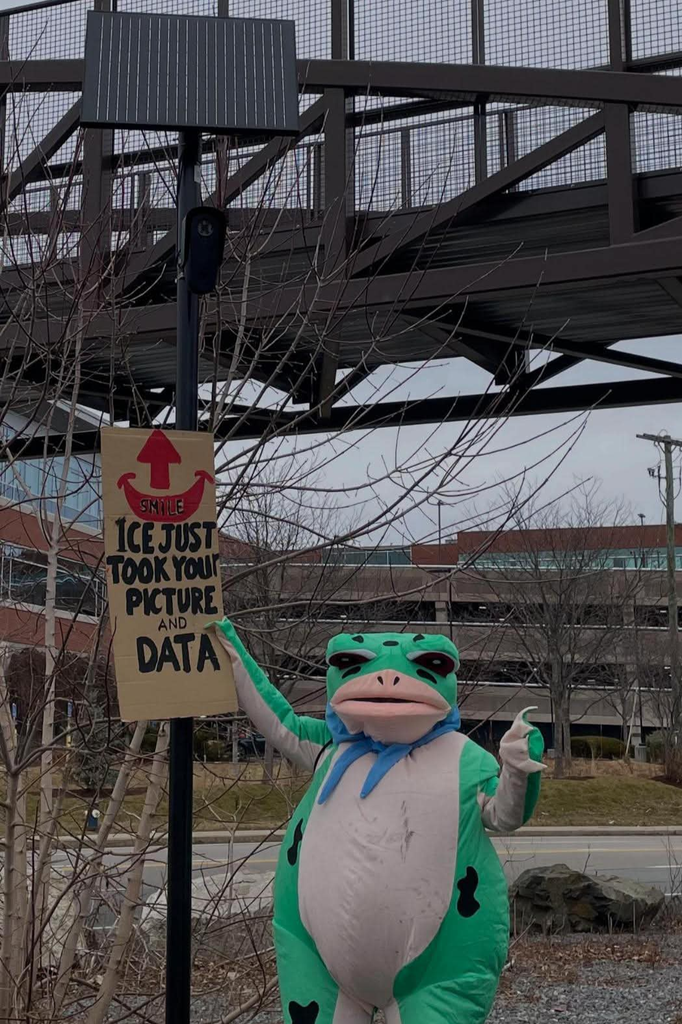
Immigrant justice organizers were aware of ICE’s use of data from cameras like Flock’s to coordinate kidnappings. According to Bobbie:
There was a lot of concern that ICE could have access to this technology to identify and kidnap our neighbors, and that the federal admin could use it to stalk activists. Plus, police forces from outside of Massachusetts could use it to track citizens looking for healthcare across state lines, which we had already seen proof of in [LUCE] reporting.
Bobbie said the first and most crucial step of their crusade against Framingham’s Flock program was to gather information, especially of the actual number of cameras in the city’s limits. This was a task that was only possible with the coordination of Framingham residents who mapped out everywhere they could find a camera on a city street, in order to accurately measure the success of the campaign. Framingham residents report using the website deflock.me to identify the cameras, as well as driving to each spot to visually confirm their location in town.
Next was the ordinary avenues of public pressure on the local government. Despite the City Council’s sidestepping and shifting of responsibility between the police chief and the mayor, organizers successfully managed to land a date for a public hearing with a Flock official in Spring 2026 through a Framingham City Councilmember arranging a public forum to ask questions of a company representative. Coalition members held the representative’s feet to the fire as they attempted to dodge questions and explain away the infringements of residents’ civil liberties.
Depending on the city leadership, campaigns here have two choices: extra pressure or public protest. Power-mapping is the strategic tool most helpful here, to determine the power relations unique to the municipality. Longer fought battles have been the case in similar campaigns against the much better funded data center projects such as the Dungeon in Lowell, which recently had its expansion paused by a state judge.
Alternatively, in towns like Natick or Waltham, the town does not need an excuse to do away with a surveillance program. In Natick’s example, the project was not made known to the public or voted on by the Town Meeting or Select Board. Natick voted unanimously to end the program this February, and Waltham shut their cameras down just this month.
For many of these towns, including Framingham’s removal of cameras this June, this marks only the first step. Since the state legislation is lagging behind this issue, municipalities are forced to set their own rules – and be pressured as organizing targets – for surveillance in their neighborhoods case-by-case.
[When we started this campaign]… a few of our organizers initially thought we would only get regulation and not a full ban,” Bobbie said. “Even though we all wanted a ban… we learned we had more support on the full council for a full ban… after a ton of public comment from our organizers.
Despite the reservations of more entrenched institutions, expanding the horizons of the politically possible is the organizers’ role. The fight against mass surveillance will be fought town-by-town, but with the help of a broad coalition like LUCE, Mass 50501, and DSA, the tools of one successful campaign can easily be repurposed for use in other towns, or in other fights against encroaching tyranny in the American empire.
With Flock and other ALPR’s only becoming less and less popular, the tide is on the side of those fighting against accountability-free data collection.
Reid Jackson is a member of the Metrowest Neighborhood Group of Boston DSA and contributing writer for Working Mass.
The post Flicking the Switch on Flock appeared first on Working Mass.
“}]]