[[{“value”:”

By: Liam Noble
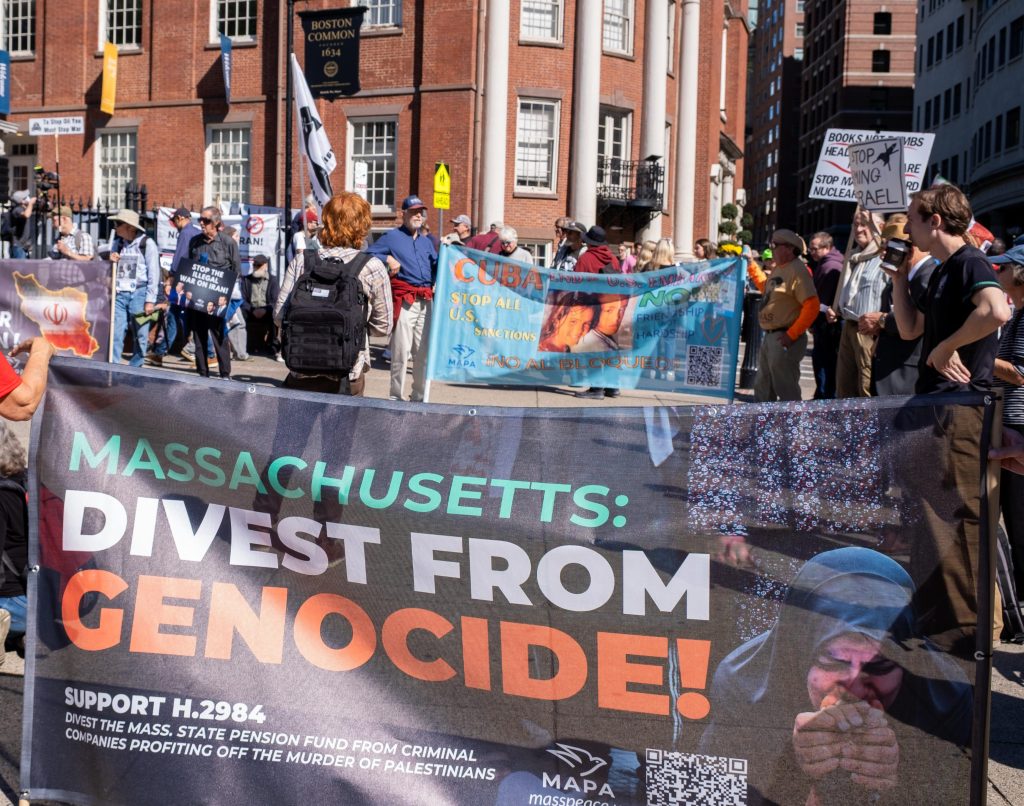
BOSTON COMMON – On Saturday, October 3, anti-war protesters and left organizations rallied against the multiple simultaneous illegal wars prosecuted by the United States under the current regime — with a particular focus on the war in Iran. Protestors and local activists including Rabbi Greg Hersh and Tony Van Der Meer gave speeches condemning the loss of life caused by imperialist violence, especially in Latin America and West Asia.
The atmosphere at the protest was one of shared outrage: against the illegal wars of aggression, the insanity of the US leadership, as well as over the deaths of and intentional targeting of civilians. At least two signs carried photographs of dead children, their gravesites, or of family photos from when they were still alive. The message spoke for itself even as many vocalized: “We Want The Murder to End Now.”
The life lost was staggering and never far from the center stage of protest. The number of dead children is particularly chilling: 247+ in Lebanon, 350+ dead children in Iran, tens of thousands of dead in Palestine. More than 220 fishermen in the Pacific Ocean and Caribbean have been murdered by the US military in senseless drone strikes. The blockade of Cuba has also been tightened, with the U.S. intercepting $3 million in fuel shipments the week of the rally alone, working people suffering and dying because of the loss of electricity to homes and hospitals. The United States stands also on the brink of potential invasion of Cuba itself.
Increasingly, the intentions of the US empire might be seen as waging a war on life.
One rallying cry in a speech by prominent Massachusetts Peace Action activist Paul Shannon was a cardinal demand: “the state should get pension funds away from murderous military contractors.” This demand to separate state employee investments, or divestment, shows the depth and pragmatism of the struggle.

Nationalist Counterprotesters
The anti-war event became tense when counterprotestors arrived.
Persian nationalists, or Pahlavi supporters, carried large flags showing Pahlavi, Trump and Netanyahu shoulder to shoulder, the national flags photoshopped to blend into one another. If nothing else, the display was a true expression of the Pahlavi movement— farce to encourage the waging of the conflict and intimidate the peace activists. A man with a bullhorn, wearing a Persian nationalist flag as a cape, screamed “USA, USA,” in an attempt to drown out the speakers.
When a woman approached him to ask the aggressor to stop, he put the bullhorn in her face and screamed, “Terrorist, terrorist.” A short time later, he tried to enter the crowd and disrupt the event, but some mischievous comrade broke his bullhorn in half, leaving him despondently carrying a broken piece of it in each hand.
At no point could the counterprotestors muster more than two people for their cause.

War Felt at the Gas Pump
The most prominent aspect of the peace protest was opposition to the war on Iran.
The most visible and tangible conflict, the Iran war is a new energy conflict. It is one of many of the wars, the pain of which is felt at the gas pump itself. Diesel, the life-blood of commercial transportation, averages $6.50 in Massachusetts – roughly double what it was at the beginning of the year. While higher gas prices can trigger a decrease in car usage by regular consumers who rely on personal vehicles, diesel is far less elastic: widely used in construction, railways, and trucking, the supply chains themselves are heavily and institutionally reliant on diesel.
Additional shortages of industrial lubricants and petroleum byproducts will continue to have knock-on effects of price inflation. These effects cannot be underestimated; one expert has called the likely impact inflation “turbocharged” beyond record numbers. All of these factors all but assure the international tightening of petroleum supply is likely at the very least to result in a worldwide recession.
In principle, the war itself is a crime, let alone the social murder caused by its externalities, but it’s remarkable to reflect on the incompetence with which it was pursued. The Iran War seems executed on impulse, with no plan. Perhaps initiated under the assumption of a mere three-day war, a weekend war, that the Islamic Republic would capitulate similarly to Venezuela following Maduro’s abduction if the leadership were murdered. Instead, Iran was prepared and immediately struck back on vulnerable American positions. Within a week, Naval Support Facility Bahrain— the logistics headquarters of the US fifth fleet— was destroyed, and will probably never be rebuilt. Subsequently, aircraft carriers like USS Abraham Lincoln were forced to withdraw from the area because keeping them properly supplied proved impossible. The radar sites in the region used to gather early warning and telemetry against Iranian ballistic missiles were also destroyed with drones.
This leaves the US/Israeli axis critically vulnerable to the most effective and well-stocked weapon Iran has: ballistic missiles.
Should the war heat up again (which seems positively inevitable), it is bewildering how vulnerable Israel’s position appears. Buttressed only by ideological fanaticism, the position of the Israeli state itself could become totally unsustainable under concentrated missile fire on its cities, infrastructure, and sensitive military sites. This has not yet come to pass because of the calculations around the potential use of nuclear weapons, and an Iranian desire to show restraint in escalation.

At the rally, a frequent question asked was: “How do you think this will end?” The better question is probably, how will this all end up?
Its corollary answer: In an unfamiliar world. But probably not anytime soon.
The curious position of war protest this year is that the Iran War is very different from the Vietnam War, or the Iraq War, or even the contemporary blockade against Cuba. Iran is a middle-tier power, a nation fighting a war of national defense. This is not an American war against a poorly-organized adversary, or against a near-defenseless civilian population; rather, the conflict is peer/peer between states. In the context of this war, the United States is a weakened country, no longer hegemonic, throwing the last of its strength at an entrenched and prepared enemy with significant moral investment and landed base. The result is that the United States has been decisively defeated and pushed out of the region.
All this is to say, regardless of flareups of the future, the United States lost a war, and lost it badly and quickly. The illusions of American fighting power seemed to have vanished quicker than a glass of neat whiskey left around Secretary Hegseth. What then is the responsibility of anti-war protestors? To champion the cause of peace, of course. And to use their activism to restrain the American military, to prevent other possible wars, to illuminate the foul intentions and terrible crimes; and to delegitimize the wars wherever they are pursued.
Liam Noble is a Boston DSA member living in Somerville and a contributing writer to Working Mass.

The post Fall is Here but Prices Aren’t Falling: Protestors Rally Against Iran War, for Divestment as Gas Prices Skyrocket appeared first on Working Mass.
“}]]