[[{“value”:”

By: Travis Wayne, Fiona P
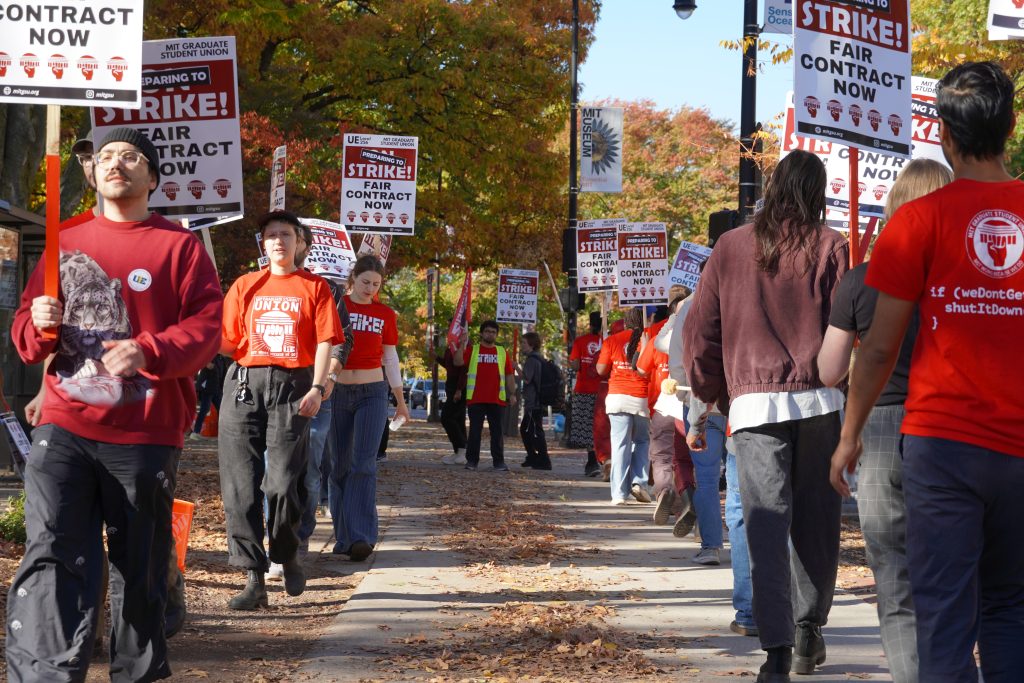
CAMBRIDGE – Grad workers unionized with MIT-GSU (UE 256) rallied with custodial staff of 32BJ SEIU this week to warn the Massachusetts Institute of Technology (MIT) that the university faces its last chance to avert a strike wave. The struggle has now openly unified two sections of the workforce, both blue-collar and academic, into conscious alliance against their shared employer.
Recognizing its academic excellence once again, U.S. News named MIT the top university in the United States in September 2026. Apparently, their rubric for institutions does not include treatment of the staff that run the university, since two different unions are fighting for a living wage and a fair contract stonewalled by MIT.
MIT holds a $29.2 billion endowment.

MIT Backtracking at the Bargaining Table
“The General Counsel and University President got double digit raises, while for us, they want to give us raises below inflation,” one fourth-year grad worker reported to Working Mass.
As with all “raises” below inflation, such offers are de facto pay cuts.
The university has also attempted to claw back gains already won band enshrined in MIT-GSU’s contract won in 2023, like healthcare packages: “the most essential things to even function as a community and a union,” in the words of one bargaining committee member. While workers previously had no comprehensive healthcare to speak for, MIT-GSU won healthcare protections when they won their contract in 2023. Since returning to the bargaining table, MIT backtracked — attempting to cut healthcare entirely.
MIT-GSU has made some advances in bargaining. For example, MIT has since agreed to maintain healthcare. But some progress is still far too little. Even though the university may finally not be fighting their workers on the question of whether they deserve healthcare at all, the institution is still arguing for steep premium hikes on insurance plans.
Workers are also fighting for non-citizen protections.
ICE off campus is one cardinal demand for a ban on federal forces invading the campus itself, as well as an international fund to fund necessary expenses faced by non-citizen workers. This fight echoes the same themes in higher ed workplaces exposed to federal intervention across Boston, from Boston University and their students’ crusade for a sanctuary campus to Harvard Graduate Students’ Union (HGSU) fight in Old Cambridge for the same demand as their union siblings in East Cambridge.
About 40% of MIT grad worker ranks are international.

The Open Shop in a Union State
Massachusetts may be one of the only states with a positive unionization growth rate, but that has not stopped it from harboring anti-labor employers: Starbucks, MGB, even MIT. In an interview with Working Mass, one bargaining committee member stressed:
They still have this ridiculous open shop proposal on the table, which is nothing but a disguised attack to gut our union and kill us… it makes sure the union can focus on what matters to our members, to focus on improving this campus, not on signing people up…. we know the history of these laws. They were made to segregate white and Black workers.
MIT has resorted to utilizing a strategy common to right-to-work states: the so-called “open-shop.” A system heavily benefiting the employer and legal since the 1947 Taft-Hartley Act, the “open shop” is a workplace design where workers can opt-in instead of opt-out of union dues. That cuts off unions’ access to their own workforces’ sustained funds in ways that can severely hamper unions’ financial capacity while leaving the bosses’ entirely unaffected. Meawhile, bosses can persuade individual rank-and-file workers under this arrangement to not join the union with far more ease. The open shop means “workers reap the rewards of union contracts without paying any of the cost of their upkeep,” aiming to starve the union till it becomes irrelevant to workers as a machine intent on signing workers up just so they pay dues just so the union can continue to exist.
As another rank-and-file worker underscored to Working Mass:
If we don’t get our union shop, then every win we get at the bargaining table is kind of meaningless because we can’t enforce our contract across grad workers.
It’s the sweeping nature of the “open shop” on workers’ lives that make MIT bosses’ demand for it so chilling.

Parallel Struggles and Strategies
“At MIT, an alliance between property service workers and graduate students shows the power of wall-to-wall organizing for living wages and workers’ rights against a shared, well-resourced management,” proclaimed Higher Ed Labor United as the simultaneous strike began to loom. 32BJ SEIU began to organize alongside MIT-GSU in late 2025, when both unions discovered their contracts, while not perfectly aligned, were separated by one month: strike shooting distance.
Custodial staff, which includes electricians and groundskeepers as well as other essential workers, have faced deep thinning of the ranks. Wages are stagnant even as every single department has faced varying levels of dramatic workload increases exacerbated by MIT not filling any new positions. 20 positions are vacant in Custodial Services and 16 unhired in HVAC.
Each unfilled position, each worker missing, means just that much more work for the remaining workers making stagnant wages forcing them to second or third jobs. The deal dealt to custodial staff ends up similar to that dealt to grad workers, one where time with people you love is routinely robbed by an institution who does not believe your dignity is worth a living wage.

The simultaneous strike is the same strategy employed now by the labor movement at Harvard now, as HGSU and HAW and UNITE HERE Local 26 all form one contract-aligned strike force. If unions take strike action when their contracts expire, aligning those actions together, can unions in the United States mimic or surpass the power generated by the sympathy strike — illegal in the United States since Taft-Hartley, the same law that legalized the “open shop” for the employers?
In the words of one fourth-year grad worker:
By dividing us as a workforce, by dividing us as a community, it’s easier to control us.
According to him, 700 undergraduates signed a pledge to student strike (stop attending classes) if either 32BJ SEIU or MIT-GSU strike, even as other unions in the wider movement off-campus have been galvanized to support the alliance of the two unions. Tufts workers and Harvard workers have joined MIT-GSU and 32BJ SEIU on the picket line; the International Brotherhood of Teamsters (IBT) Local 25 has also indicated their intent to honor any strike, if the university refuses to reach an agreement that honors their workers’ needs. The union organized across logistics of the supply chain intends to stop all deliveries to campus.
Who will emerge most transformed — MIT, or its workers?
Travis Wayne is the managing editor of Working Mass.

The post Grad Workers Rally With Custodial Staff to Warn MIT Time’s Up: “We Are Prepared to Strike” appeared first on Working Mass.
“}]]