
[[{“value”:”

By: Kieran N, Maritza S
CAMBRIDGE – On October 21, Cambridge Education Association (CEA) faced off with the CPSD School Committee (SC) in a tense meeting, the latest in nearly twenty that have defined negotiations between the union and school district leadership.
The Cambridge Education Association (CEA) represents a wide array of education professionals in the Cambridge Public School District (CPSD) in what is proving to be a long negotiation for a better contract centered on pay for paraprofessionals, affordable healthcare, and just cause termination.
A key area of negotiation between CEA and the CPSD is pay for paraprofessionals. A 2021 working paper from Brown University and the University of Washington (Bisht, LeClair, Loeb, and Sun) describes the wide range of work paraprofessionals do: supporting students with disabilities, working with students one-on-one and in small groups, managing behavior, and connecting with families. The paper cites research from North Carolina finding that when the state cut funding for teaching assistants, student achievements dropped. The effects were clearest in reading and strongest for students of color and those in high-poverty schools.
The same paper found that paraprofessionals are more likely than teachers to come from the communities they serve, and that they are a proven pipeline into teaching. “Paraprofessionals help provide consistent adult connection for our most vulnerable learners,” said one school worker. They shared that students rely on paraprofessionals for academic and behavioral help, with paraprofessionals helping students regulate themselves and get ready to learn.
The district seemed reluctant to invest in this area, with starting annual salaries being as low as $32,000, less than half of the estimated living wage in Cambridge ($67,513) according to the MIT’s living wage calculator. That’s a fraction of the $50,000 available for many paraprofessionals who work just across the street, in neighboring Somerville. This means many foundational educators are subject to constant displacement from a city that is already among the planet’s wealthiest.
CEA’s proposal includes raising that minimum to $45,000 next school year and to $55,000 the year after, which would bring CPSD paraprofessional compensation in line with Somerville paraprofessionals.

The 2026/2027 School Year
With all six bargaining units starting the school year under expired contracts, the Cambridge Education Association (CEA) showed their intent to fight a different battle than waged previously with CPSD.
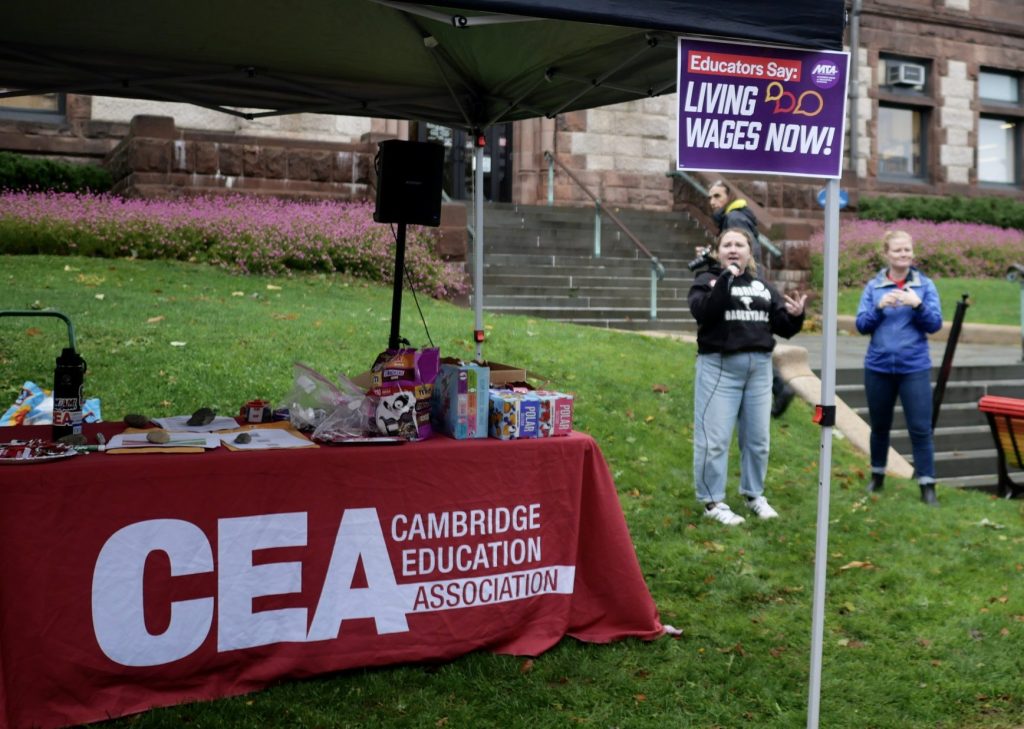
In late September, CEA rallied with community supporters before public comment at City Hall, calling for a policy order to express support for living wages for paraprofessionals, subtitute teachers, and clerks, and to have the city manager report back to the city council on the status of negotiations in one month. Among those assembled to speak to councilmembers were community members and labor leaders like Matt Bach, elected president of the largest union in Massachusetts: the Massachusetts Teachers Association (MTA).
Not only does Matt Bach’s leadership represent that of continued leadership of the MTA by militant rank-and-file leaders that has contributed to a strike wave throughout educators’ ranks in municipalities across Eastern Massachusetts in the past ten years; it shows the MTA, a powerful statewide union, has its eyes on the Cambridge Public School District.
Perhaps more significantly, though, was the approach taken by the CEA. While traditionally, the six bargaining units independently bargained with the school district, that approach has not been taken during this round of negotiations. Workers, fed up, have been driven to the same table. Now, all six bargaining units are bargaining together with CPSD, as one unified union.

Healthcare As Arena
Healthcare has been another area of staunch disagreement at the bargaining table. The district has rejected the union’s healthcare proposal, which calls for the district to cover 85% of the healthcare premium for all employees, instead reinforcing its current three-tiered system.
For educators, that has real consequences. One member of the bargaining team said during the meeting that they could not afford the district’s plan. When they needed treatment for a minor injury, they ended up paying ~$300 out of pocket. For an educator, such bills can mean skipping care or going into debt. Another educator reported:
The lowest cost plan that I was on was raised by 20% and I was horrified to hear one of our teachers on the bargaining team can’t afford the health insurance. We had a change in (health insurance) companies and the cost went up a significant amount.
The school committee asserted that they hired an outside firm to negotiate the cost of effective health insurance during the city council meeting on October 21: “That kind of thing is frustrating to hear because who knows how much they’re paying an outside firm?” asked another educator.
Access to healthcare impacts the quality of education, as well. Educators who can’t afford to see a doctor, or who go to work sick or injured, are not able to do their best work. Inadequate healthcare limits productivity and impacts student outcomes, highlighting the lasting effects of cuts to benefits.
Just cause protection is also significant in CEA priorities. Just cause ensures that educators can’t be fired without a fair reason and fair process. While some educators have such protections, many – including substitute teachers – do not. This is why the battle for substitute teachers’ compensation has joined with that of paraprofessionals in CEA priorities at the bargaining table. It also underscores the fact that the labor conditions of all educators, regardless of rank or title, are interconnected.
Kieran N. is a member of Boston DSA and a contributing writer to Working Mass.
Maritza S is an associate editor for Working Mass.
The post Bargaining Without Moving: How CPSD’s Approach at the Table is Failing Students and Staff appeared first on Working Mass.
“}]]