[[{“value”:”

By: Tony A, Adrian Aliano
CAMBRIDGE – With the first strike by their workers that year abated, and two other unions’ anger rising, Harvard executives spent the summer of 2026 carrying out far-reaching cuts that gutted the ranks of the largest union on campus: the Harvard Union of Clerical and Technical Workers (HUCTW). In the end, hundreds of people were kicked out of the halls of the university to which they dedicated their lives, just for Harvard leaders to report exorbitant earnings made off their backs only weeks later.
The decimation required an executioner and a loyalist, but started with a secretive firm: McKinsey & Company.
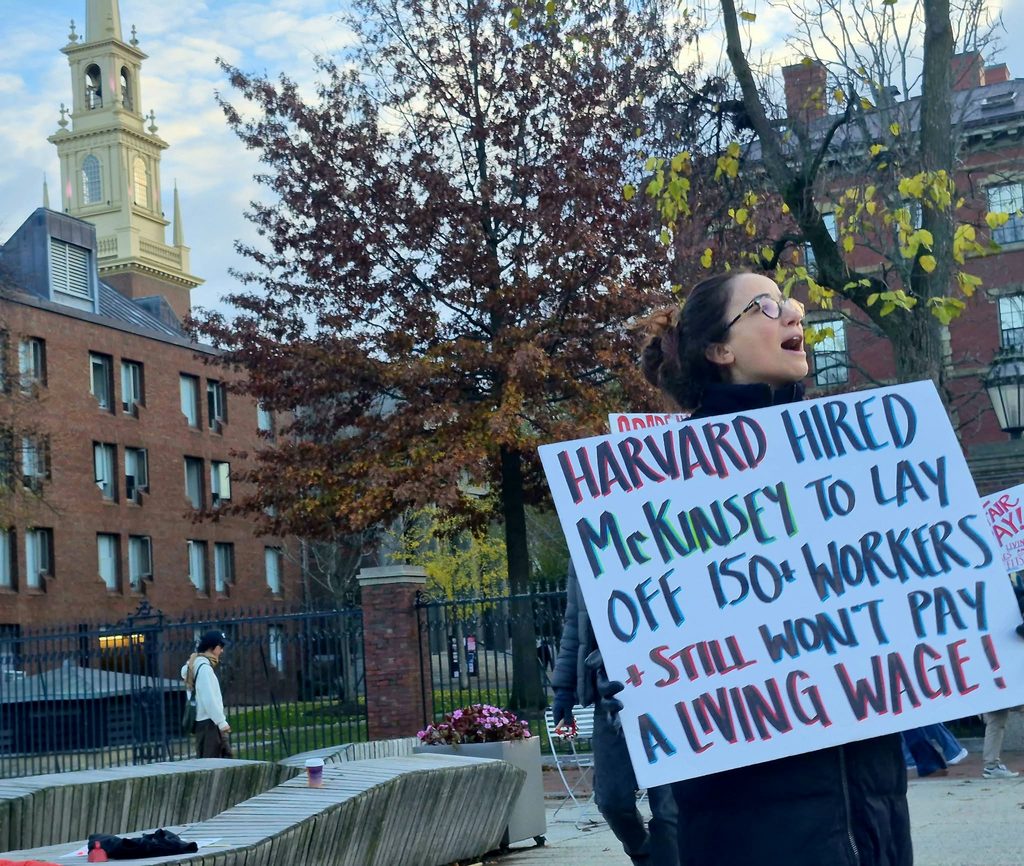
Leaders in the Faculty of Arts and Sciences (FAS) appointed a task force to address “Workforce Planning” on April 24, 2025. Under their oversight, Harvard University started paying McKinsey & Company in quiet installments starting August 2025. Harvard paid McKinsey a total of $250,000 for FAS consultation. In other words, Harvard hired a firm that not only has contracted with ICE, but where whistleblowers report consultants become “functionally the equivalent of full-time ICE employees” when working for ICE, rather than protect their international students facing deportation from that same agency.
Sinister change crept into Harvard within months of the final installment.
Hiring the Executioner
Warren Petrofsky was at Cornell University when workforce planning at Harvard FAS began.
As Associate Dean of Administration from 2023 until his departure in 2026, Petrofsky “helped shape long-term strategic vision and resource allocation for $4000M enterprise,” as he proclaims on LinkedIn. Part of his Cornell tenure included the signing of an agreement with the Trump Administration for money: $60 million, as well as compliance with the federal government’s definitions and orders regarding civil rights definitions.
Beyond big deals with bigger devils, according to Cornell Sun reporting, the College of Arts and Sciences at Cornell cut $11 million after “very specific” funding guidelines sent to every department by Petrofsky. He developed a reputation, before his hiring, as the man who would comb through every line and cut any position – ruthlessly.
Petrofsky completed his undergraduate education at the University of Pennsylvania and spent a combined over two decades at Penn working in computing and operations. In that time, he completed a Master of Business Administration (MBA) at Wharton before his promotion to Chief Infrastructure Office for the School of Arts and Sciences. That position was charged with saving Penn money, the role he took on at Cornell.
Harvard scooped Petrofsky from Ithaca within one fiscal quarter of the University’s last quiet installment to McKinsey & Company. Warren Petrofsky was appointed Dean of Administration and Finance of the Faculty of Arts and Sciences on April 20, 2025: in short, he became Harvard’s money guy, apparently strategically identified following his work saving two other Ivy League universities money. The University’s press release cited his previous experiences in “administrative transformation within complex, decentralized Arts and Sciences environments,” like Cornell.
Though Harvard recognized Petrofsky’s role at Penn in the same breath as that at Cornell, Working Mass has not been able to verify if he was responsible for extreme cost-cutting at the expense of others at Penn.
How much Harvard University currently pays Warren Petrofsky is unknown.
While his role at three consecutive institutions may have been cutting costs, the cost to human beings be damned, Petrofsky could not complete his work without cutting workers. There was one problem: the workers had a union.

“You Can’t Eat Prestige”
The Harvard Union of Clerical and Technical Workers (HUCTW), the largest labor union on campus, was founded and built through hardwon battles with executives holding the same anti-labor position as the current administration. The union has a memorable slogan: “You can’t eat prestige.”
HUCTW represents over 5000 rank-and-file support staffers distributed across the Harvard University system; in every office, laboratory, library, clinic, theatre, museum, and facility their work is evident. The union is the largest labor union on campus and among the oldest in Harvard Yard.
Harvard University never wanted to recognize HUCTW. The 1988 NLRB ratification was the culmination of a seventeen-year long struggle. As then-union director Kris Rondeau said to the audience, “their unmistakable goal was to beat the union, and they just failed.”
Organizing HUCTW had begun but ultimately failed before reaching a majority of support twice before, both starting in Longwood, but the third attempt in the mid-1980s was successful. A small core organizing committee of Medical Area workers grew the union to win the support of the over-4000 staff members across the Harvard apparatus. The union started independently, without affiliation with the United Auto Workers (UAW) or other internationals. Eventually, HUCTW affiliated with AFSCME Local 3650 in 1987, the year before winning NLRB recognition.
Harvard fought with anti-union talking points and booklets strategically distributed to supervisors across the ranks, as well as hostage meetings about why workers should not support unionization, right up till its loss.
The democratic vote was not seen as legitimate by Harvard executives. After HUCTW members won the battle for legal representation and the right to collectively bargain in 1988, Harvard still fought against recognition by appealing to the National Labor Relations Board. Harvard tried to get the union election result thrown out by arguing HUCTW coerced workers to join.
Harvard saw its case thrown out instead.

Someone Has to Do It?
Decisions are made by individual people in power. Harvard did not unconsciously, as a detached force, hire Petrofsky to do the institution’s dirty work. Just like the decision to pay a firm that whistleblowers describe as “morally bankrupt,” people made the decision to hire him.
Some are on boards; others are bureaucrats.
Hoekstra rose behind Claudine Gay to take over as the Dean of the Faculty of Arts and Sciences when the latter became president of Harvard University in August 2023 – right before Harvard’s hard turn right, the cutting down of Gay, and the ascent of health economist Alan Garber from within the bureaucracy’s top ranks to the presidency in January 2024 by convenient accident.
In November 2025, Hoekstra described in a financial update the central need to “reduce our structural deficit through lasting, mission-aligned change.” Her next update followed that winter: the hiring of Warren Petrofsky. On February 27, Hoekstra announced Petrofsky’s appointment by lauding his pivotal work at Cornell University and the University of Pennsylvania, including “helping guide one of the institution’s most consequential operational efforts” at Cornell – an apparent allusion to Petrofsky’s pivotal role in culling that $11 million in Ithaca.
“Disciplined financial stewardship,” advised by McKinsey & Company, required finding cuts in the Yard. Sometimes, hired Yes Men say the truths their bosses hide. Answering to Hopi Hoekstra directly, Deming blabbered in one April 2026 open forum that many “back office” jobs doing “things you would never really know or care about, frankly… are the first places I’m looking to try to save money.”
The rank-and-file got the message: they were on the chopping block. The institution they built decided they were excess to trim.
HUCTW leaders countered in an April 29 email obtained by Working Mass:
Would it be invisible to students if their tuition payments were delayed or mishandled because staffing was slashed?
Would it be invisible to researchers and students if their labs could not function because materials were not ordered, payments to vendors were not processed, or equipment was not repaired?
Would it be invisible to the University if admissions, financial aid, course enrollment, or fundraising—all of which sustain access to education—were disrupted due to large staffing cuts?
The implied threat was largely ignored. When contract time arrived, HUCTW leaders negotiated a tentative modest agreement and wrote a strongly worded email to Dean Deming and FAS administrators, as HGSU’s strike continued in the rush towards the end of the semester.
Hundreds of union members expressed misgivings with union leaders’ approach. When the contract ratification vote took place in May 2026, the final tally counted at 3074 in favor and 767 opposed – the largest nay vote in union history. The administration seemed to have no other methods to cost-save except culling worker ranks. Deming spouted vague musings on “new ways to do things” more economically, like renegotiating contracts with outside vendors to alleviate some of the burden of the University’s financial crisis. Executives also showed a knack for effective financial planning when Deming said, with characteristic nuance:
We’re looking under the couch cushions for quarters.
But while the University has been successful in exchanging people for dollars, many key contract negotiations have seen no success at all. Instead, Deming and the University’s record has, so far, been characterized by historic incompetence. Harvard has been unsuccessful in negotiating a single union contract this fall. Three different unions – HGSU, HAW, and UNITE HERE Local 26 – have since authorized strikes.
On July 22, the act was complete: hundreds without jobs, within 90 days of Petrofsky’s start date.
As hundreds of workers were removed and members of three unions representing other parts of the workforce driven closer to strike action, the Harvard endowment grew by $11 billion between the 2025 (~57 billion) and 2026 (~68 billion) annual reports.
The loyalist had turned around her institution’s deficit by casting the workers who built the institution out into the cold. She made a deal with the man who made deals with devils. Her job, whether “mission-aligned” or not, was a success. In a bed afforded by her near ~$700,000 annual salary, Hopi Hoekstra could sleep at night with job safety surrounded by supporters ready to reassure her she did her best.
Few others had that luxury.

When a Tenth of Your Colleagues Vanish
Among the rank-and-file, where executive decisions are felt in debts and rents, one Harvard staffer learned over Zoom that Harvard eliminated their job while waiting on the runway for takeoff.
Nearly 15 months of instability crawled by as workers waited for Petrofsky, Hoekstra, and their ilk to decide the impact of hundreds of lives. Finally, on July 22, 2026, an email obtained by Working Mass dropped: “before any individual conversation takes place, all College staff will hear from FAS HR with the information and guidance they need.”
That guidance would ultimately prove misleading. With five minutes remaining till the end of day, impacted Harvard staffers received calendar invites from FAS HR inviting them to meetings the next day, without consideration for their own schedules. Staffers were informed that while they did not need to change their plans, they were still expected to “take the meeting by phone if Zoom is not feasible.”
Despite their active membership in HUCTW, one rank-and-file worker that spoke with Working Mass reported that HR originally discussed the severance package for non-union staff with them. Only after the employee requested clarification of benefits for HUCTW members did the HR representative recognize their error and place importance on the contractual and legal obligations of the institution they represented.
Working Mass was unable to identify how many rank-and-file workers were similarly misclassified.
The mix-up is representative of some of the reported dysfunction at Harvard’s latest round of layoffs. The “reorganization plan” laid off both union and non-union workers and left remaining staff to perform workloads previously managed by multiple employees without additional compensation. The cutting especially of HUCTW members whose work was essential also placed major incentives on bosses at the University to ask graduate workers and academic workers to take on more work to make up for the gaps their colleagues left behind. These reported workload increases further incentivized workers to strike this fall.
Harvard eliminated 10% of its workforce, including 165 staff positions in FAS, before culling positions across the social sciences in a total of a third of its staff fired, after 2025 cuts of student advisors: 75 workers, in all. As part of this rollout, Deming unveiled the dismantling of the Office of Student Services (OSS) and the merging and effective closing of multiple other departments serving undergraduate students. Each closure meant workers either out of work or with more work or both.
“It’s been really hard,” bemoaned David Deming, whose position remains integral to cutting others, this week. Based on his sound understanding of the available evidence, he surmised: “I think staff feel stretched. They feel a lot is being asked of them, and I know that they know that.”
The workers more than knew how much executives were squeezing them.
Blood and “Reorganization”
Cuts were justified under a broader reorganization effort to consolidate administrators and departments. In the Financial Overview of the Financial Report for the 2026 Fiscal Year, Treasurer Timothy Barakett addressed the culling of staff ranks:
Achieving a surplus demanded an extraordinary amount from this community… to colleagues directly affected by these changes, we owe more than gratitude: our respect, and our recognition of all they contributed to Harvard.
One Harvard employee countered, quoting the HUCTW slogan:
Just like prestige, laid off workers can’t eat respect; and recognition for our contributions, as they cut our jobs anyway, offers the same impact as the calories in tap water.
About 24% of impacted employees were offered the opportunity to reapply to similar positions. This mechanism took advantage of contract language: since the positions were technically new roles, Harvard management was able to add more responsibilities without added pay.
Other elements of the “reorganization” that dramatically increased workloads were previously described in the leaked McKinsey proposed model verified as instituted by Working Mass, such as multi-unit administration. Instead of individual department administrators, which values long-term commitment and service, Harvard has consolidated multiple responsibilities from multiple departments into a handful of positions. These, in turn, answer to a smaller group. Essentially, under the consultation of McKinsey, the structure and power therein is more centralized into fewer and fewer hands.
At a rally organized by the HUCTW Rank-and-File Movement in Harvard Square in September, members shared their stories: laid off after 35 years of service, cut during parental leave, just a few examples of Harvard’s perfidy toward their own workers. Other members, some with 25 years of employment, announced that they were forced to take demotions under the restructuring despite recent glowing performance evaluations. Membership cited personal distress after the potential for layoffs was announced in the Fall of 2025, and subsequent emotional impacts of the extended period of uncertainty.
“The inability to plan has been really hard for me and a lot of my colleagues,” one worker said.
In accordance with the “WARN” Act, both union and non-union members received 60 days’ written notice in advance of their mass layoff date. One HUCTW member told Working Mass that impacted rank-and-file workers had access to the Work Security Program which, according to their website, “provides members with full pay and benefits—typically for five months, but possibly up to eight months—after layoff notification, as well as job search support, while members look for a new position.”
While additional benefits were associated with union membership, even some members expressed dismay over one significant problem: non-union colleagues were not afforded the same.
‘In a back room’
The HUCTW website outlines that “Harvard is required to negotiate with the union before finalizing any plans, to provide information around the basis for any proposed changes, and to allow for the development and discussion of alternative proposals to prevent job loss.”
However, during this process, staffers did not have the ability to directly engage in open bargaining or any form of negotiations participation that felt democratic. Instead, HUCTW leadership and management hashed out a “backroom deal” before reporting back to the membership after the fact.
Bill Jaeger, long-time staff organizer and originally a rank-and-file member during the 1980s HUCTW organizing drive, made an unusual move for a staff member: he attempted to sway membership, in the face of the largest resistance yet mustered by the HUCTW Rank-and-File Movement to a meagre contract. In an email obtained by Working Mass, Jaeger argued that members should approve the contract because HUCTW’s modest gains were bigger than other campus unions readying for strike action:
The raise we’ve arrived at for 2026 is a solid one – it beats inflation from the past 12 months and it’s a stronger increase than other Harvard employee groups have seen for this year.
Bill Jaeger left HUCTW after several decades of service following contract ratification. 20% of membership ended up voting No (767 members), which was 301 more than the previous ratification vote.
HUCTW rank-and-file members that spoke with Working Mass said unionwide meetings prior to the layoffs mostly walk through the handbook and processes. Some members are concerned that HUCTW leaders are not doing enough to push back against cuts.
“It’s not about making changes or listening to input,” one employee said.
In mid-August, HUCTW leadership sent an email to membership outlining the state of the FAS Layoffs, Reorganization, and Hybrid Work, claiming:
HUCTW leaders were able to save many staff from layoffs and provide others with more options than they would otherwise have, but ultimately FAS administrators are still moving forward with significant number of job elimination.
They reiterated that during the Layoff Consultation Process, they “insist that administrators seriously consider every available alternative to job loss.”
The words felt feeble even to many members. One laid-off worker said:
Insistence for serious considerations of alternatives to job loss feels a lot like the hopes and prayers of placating politicians.
Union leaders and reformers must surely grapple with HUCTW’s responsibility to its community and membership, beyond the narrow sectional interests enshrined in contracts negotiated behind closed doors. That’s particularly true when three other unions of colleagues have aligned their action to maximize its impact on Harvard, while HUCTW remains on the sidelines. But it is Harvard executives, with names like Petrofsky and Hoekstra, who have earned the ire of labor – and labor does not forget.
Can Warren Petrofsky sit easily knowing the children and children’s children from multiple institutions will curse his name, just like his actions, as the fiscal executioner he chose to become?
Can Hopi Hoekstra sleep at night for the rest of her life knowing the rest of the lives of hundreds of colleagues, even their ability to stay home and housed, have been forever shaped by her decision?
Can administrators walk across Harvard Yard comfortably knowing their legacies are that of monsters?
Tony A and Adrian Aliano are associate reporters for Working Mass.

The post The Executioner and the Loyalist: How Harvard Spent Summer 2026 Gutting Its Largest Union for Financial Gain appeared first on Working Mass.
“}]]