[[{“value”:”

By: Avi R
ARLINGTON – The Arlington Police Department (APD), based in a suburb of Boston, escalated to the use of a drone to surveil a small protest in September. The drone was donated by the Arlington Rotary Club, bypassing town oversight.
Arlington Police Department (APD) guidelines for drone usage are broad and do little to prevent the surveillance of protests and public gatherings. When questioned, multiple APD officials encouraged people to rely on the “positive intentions” of the police officers, but drone deployment records and local activists raise concerns around privacy and surveillance. Where will lines be drawn and how will the public know? Is this the new normal in Arlington and in police departments, big and small, across the United States?
The September Protest Against Rep. Katherine Clark
On Tuesday, September 8, around 30 pro-Palestine activists gathered outside Arlington Town Hall to protest Representative Katherine Clark’s presence at the the Union of Concerned Scientist’s (UCS) forum. The activists had called on UCS, a non-profit focused on using scientific research to improve global health, safety, and sustainability, to disinvite Clark from the panel due to her votes to fund and send weapons to Israel’s military during the ecocide and genocide in Gaza.
Clark is the House Minority Whip and the second most powerful Democrat in Congress. She has received close to $1 million from AIPAC.
The protest was co-organized by a number of local groups, including Arlington for Palestine, Boston Democratic Socialists of America (DSA), and others. The activists gathered with signs around the steps of Arlington Town Hall to chant, speak in front of a local news outlet, and hand out information to pedestrians and attendees. Their message was centered around the contradiction of advocating for environmental protections while funding the destruction of Gaza. The flyer for the event read: “Rep Katherine Clark voted to fund ecocide and genocide.”
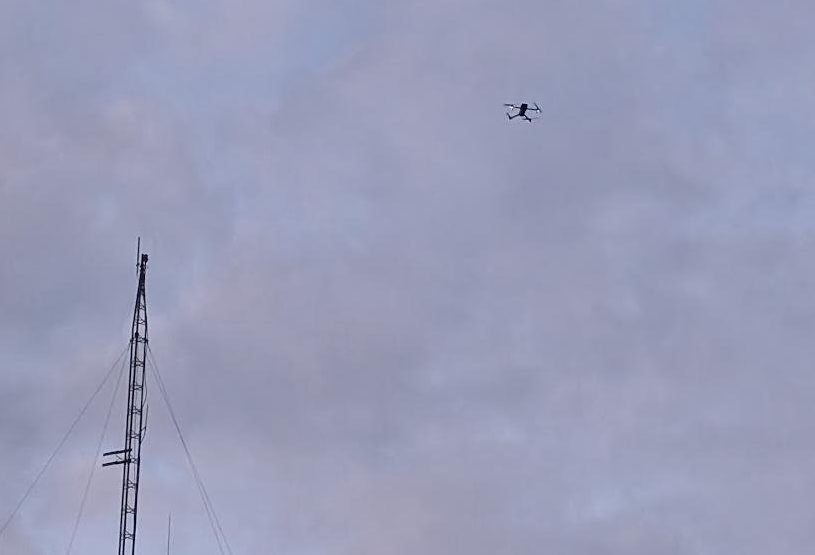
APD responded to the small protest with significant police presence, including a man who appeared to be an undercover officer, a K9 officer, and a drone. Early protest arrivals saw APD officers gathered around the drone in the Town Hall parking lot. While evidence points to coordination throughout the APD, K9 officer Michael Hogan responded on the scene that he had “no idea” who the drone belonged to when asked on camera.
A second officer later confirmed, off-camera, that the drone belonged to APD.
The undercover officer’s behavior, however, proved even more chilling. One attendee describes hearing the undercover officer calling her name, even though he was a stranger with no reason to know her name.
It was really disconcerting when this random guy hiding out in the bushes behind me called me by my name. Later he started asking me questions. I think he was taking photos of us. [I wondered] Does APD have photos hanging around the station of community members? I looked on the APD website to try to confirm he was with them but they don’t publish names or photos, which seems odd for a department bragging about ‘community policing’. They can know who we are but we can’t know who they are?”

The drone presence surprised many attendees. Some had not known about the APD drone prior to the protest, others reflected that they had not seen the drone used at larger protests that occurred after, such as No Kings or Free Her. Instead, it was seen only at the small pro-Palestine protest.
Activists in Arlington describe a history of heightened involvement from APD regarding pro-Palestine activism. In 2024, Town Meeting members put forward a resolution (non-binding legislation showcasing town sentiments) supporting a permanent ceasefire in Gaza. During the discussion and vote, police officers were stationed inside of Town Hall — highly unusual for Town Meetings.
It is unclear if APD made the decision to station officers or if a third party asked them to attend.

Drone Acquired — No Town Meeting or Public Input
Arlington Police Chief Juliann Flaherty confirmed over email that no public input process was conducted before acquiring the drone. The officer stated:
We do not typically conduct public input processes for the acquisition of department equipment.
While there is no formal review process, other police equipment budget requests have faced public scrutiny at Town Meetings. An amendment to remove $15,000 from the town budget passed in 2023 when APD requested that amount to purchase Bola Wraps, a compliance weapon that shoots kevlar ropes with barbed hooks around a person resisting police orders. Unlike the Bola Wraps, Town meeting members did not have an opportunity to discuss APD’s drone acquisition because the $6,000 drone was donated by the Rotary Club. Neither the drone nor the remote pilot training for officers appear in town budget documents from 2022 onward.
Arlington Rotary Club did not respond to a request for comment.
APD’s drone policy, which was provided by Chief Flaherty upon request, provides few guardrails on monitoring and recording people in public places. The privacy section states that without a warrant or other extenuating circumstances:
[The operator] shall not intentionally record or transmit images of any location where a person would have a reasonable expectation of privacy.
This leaves the use of drones to film protests and public events at the discretion of the police. There are no clear guidelines on when video can be recorded, only that the videos obtained “shall be handled in accordance with existing policy on data and records retention.”
APD’s policy prohibits the use of the drone for “random surveillance activities,” but specifies a number of broad use cases that do not have clear definitions and can apply to most public gatherings. Examples of appropriate drone usage, according to APD policy, include “providing direction for crowd management and temporary perimeter security” and “photographic and video deployments.” This leaves room for APD to use drones to monitor and record protesters under the banner of crowd control and security.
Police departments across the country have more access to footage, data, and technology to identify and track civilians than ever before. The country-wide network of Flock cameras and Automated Licence Plate Readers (ALPR) have been used by police departments to look up protest-related activity and associated vehicles without further justification for their searches.
Further, Arlington police will soon be implementing body-worn cameras with the stated goal of increasing police accountability. That won’t be the only outcome. The other result will be recordings: many hours of footage, including protester and civilian interactions.
Public Record Requests Show Zoomed-in Face Photographs
Obtained through a Public Records Request, there is evidence obtained by Working Mass hat the drone captured zoomed in photos of several protesters’ faces on September 8, 2026. Records Clerk Suzanne Trunfio wrote that, additionally, “aerial images were captured to assess the surrounding area and perimeter for potential threats, including an individual positioned at an elevated location who could pose a danger to those below.” Three images provided are zoomed in to reveal faces, with a total of five individuals shown in the photos.
None of the zoomed in photos show people in an “elevated location” as justified by Trunfio.
The photos also show around six officers, not including the undercover officer, surrounding the small crowd of around thirty protesters from all sides.

Special Hostility Towards Protesters
Since police responded to larger protests like No Kings with a fraction of the surveillance utilized for pro-Palestine demonstrations, questions arise about what types of protests are seen as a threat. Reporting by the Harvard Crimson shows that multiple city police departments collaborated with campus police to heavily monitor Pro-Palestine student protests after October 7, 2023, and this year, the city of Boston settled a police brutality lawsuit over the beating of protesters at a 2020 Black Lives Matters protest.
The trade publication writings of former Arlington Police Lieutenant Richard Pedrini provide insight into how some police officers view different left-wing protest groups. Pedrini penned three articles in The Sentinel, a now defunct official publication of the Massachusetts Police Association, following the killing of a Weymouth police officer by a man undergoing a psychotic episode. He blamed criminal justice reform and progressive politicians for the death of the officer, stating:
This animal needs to be put down, but unfortunately, this is Massachusetts.
Besides describing a disabled man as an “animal,” Pedrini listed several protest movements and immigrants when expressing who he believes state politicians are siding with over police. “Drop the charade and get out on the streets with BLM, Antifa, and the ‘Resist’ crowd,” Pedrini wrote. “That’s all you’re good for. We know whose side you’re on and it’s not ours.”
He continued working for APD until retiring in 2024, in spite of some town members calling for his removal.
Throughout the process of requesting information from the Arlington Police Department, multiple employees stressed the need for community members to trust in the good intentions of their officers. Suzanne Trunfio included that “[APD] deployed the drone as a public safety measure to help protect everyone present… including those exercising their first amendment rights.” And Chief Flaherty wrote in a drone-focused email:
While I understand the importance of asking questions and ensuring accountability, I also believe it is important to recognize the positive intentions and outcomes of these efforts rather than suggesting there are concerns where none have been identified.
Of course, dismissing the press’s identification of residents’ concerns does not make those concerns disappear.
While public-facing employees ask for community trust, a Diversity, Equity, and Inclusion (DEI) audit of the department completed in 2020 reveals that officers feel animosity towards community members and police officers who speak out. The audit was initiated following public outcry over Lieutenant Pedrini’s violent rhetoric and sought to increase DEI within APD and their community interactions. Officer sentiments included that “community should not be involved in decisions regarding APD if they don’t know what police go through,” and referred to those who speak up as “extreme members of the public.”
The report notes that the assessment had limitations because police culture can make it “harder/less safe for some members of the department to express criticism or concern about the actions of a fellow member.” This brings up questions around how likely APD is to hold itself accountable to already loose guidelines regarding the surveillance of protests and activists.
At least one community member who attended the protest and preferred to stay anonymous said the drone policy leaves too much room for abuse.
The APD Drone policy gives the police a broad spectrum of reasons to use the drones while it gives the people of Arlington very little safeguard against the encroachment and/or violation of their first amendment rights. The public has little to no understanding of these broad sweeping powers the police have in terms of surveillance and use of the photos and videos they collect through the drone.
Avi R is a contributing writer to Working Mass.
The post Arlington Police Used a Drone and Undercover Officer to Surveil and Photograph Pro-Palestine Protesters appeared first on Working Mass.
“}]]