
[[{“value”:”

By: Owen Mortner
CAMBRIDGE – On September 28, Cambridge City Council voted down a policy order that expressed support for school paraprofessionals, substitutes and clerks and asked the city manager to report back on the status of the School Committee’s negotiations with the Cambridge Education Association (CEA), the union that represents teachers, paraprofessionals, clerks, substitutes and other school district staff. Only the two sponsors, Councillors Ayah Al-Zubi and Jivan Sobrinho-Wheeler, voted yes. Vice Mayor Burhan Azeem and Councillors Tim Flaherty, Patty Nolan and Cathie Zusy voted no. Councillors Marc McGovern and E. Denise Simmons voted present. Mayor Sumbul Siddiqui, the only councillor who sits on the School Committee, recused herself.
On November 16, just shy of two months later, the council voted unanimously to urge the city to keep bargaining in good faith with Teamsters Local 25, representing 320 city workers who have been without a contract since June. Filed by Flaherty and Simmons, the order called for an agreement that “ensures equitable wages, protects longevity benefits, and preserves existing workplace language and protections.”
The Teamsters deserve support, but councillors’ reasons for supporting one union and not another don’t hold up. In the face of the needs of the labor movement, councillors’ inconsistency does not underscore pro-labor principles.
What the Councillors Said
Several councillors said they couldn’t support the CEA order because the council has no jurisdiction – essentially, punting the ability for solidarity from council-level municipal leadership. Zusy said she would vote no “not because I am not sympathetic to the paraprofessionals,” but because it was “very inappropriate for the City Council to be voting on this.” McGovern, a former School Committee member, said the council has no line-item authority over the schools, so it could give them “$5 million more, $20 million more, $100 million more” and still “have no say in how that is spent.” Flaherty said he favored a living wage, but worried about setting a precedent. Nolan said that although the order didn’t appropriate funds, it would signal that the city should give the schools more money.
These concerns are real. So is the disagreement over cost. Cambridge Public Schools (CPS) says the union’s current proposals would cost $30 million more than the approved operating budget in the first year and more than $125 million over three, down from the $54 million and $175 million it estimated over the summer.
Though Superintendent David Murphy has called the proposals “not financially sustainable,” the union points to the city’s free cash and excess tax revenue, each of which it says exceeds $100 million. Educators argue that their union’s full list of demands amounts to a 6% increase in the school budget, or 2% of the city’s total.
What the Record Shows
The council has no role in Local 25 negotiations. The only difference is the city manager’s office conducts Teamsters negotiations, while the School Committee negotiates directly with Cambridge Education Association (CEA). Yet its order called for specific contract terms, and the city administration told councillors that night that some of those terms are still being bargained.
Councillor Sobrinho-Wheeler brought up this exact point in debate.
I just don’t get how you can demand a specific thing in the contract for Teamsters workers, but not for education workers.
When Al-Zubi asked Flaherty whether he would co-sponsor a nearly identical order for the CEA, he answered, “We can talk about it.”
McGovern offered a better explanation: The School Committee, which is elected, negotiates with school workers, while no elected body negotiates with city workers, and he didn’t want to step on another elected body’s toes. That is a valid point of institutional etiquette. It doesn’t explain why the council unanimously urged Harvard last fall to bargain in good faith with 32BJ SEIU, the union representing custodial and security workers there. The council has no authority over Harvard University, either.
Nor is the council a bystander on school funding. Very often, the jurisdictions bleed together. City council approves the school budget and sets the tax rate every year. School Committee member Luisa de Paula Santos told Cambridge Day that the difficulty is structural: The School Committee decides on the budget and the council accepts, she said, but the one “who really controls it at the end of the day is the city manager,” un-elected.
Councillor Al-Zubi described the result in September as “tennis matches”: The council is told this is outside its authority even though it declares the budget, including the money, and then the School Committee says it doesn’t have the money. Everyone with responsibility is conveniently absolved.
The order itself, posted with the council’s September 28 agenda, expresses support for the paraprofessionals, substitutes and clerks the CEA represents and asks the city manager to report back on the status of negotiations. Its own text says the council “does not set the terms and conditions of employment” of school employees, and the sponsors said on the floor that they worked with the Law Department on the language.
The jurisdictional line is real, but the council chooses when to enforce it.
What the Work Is
Paraprofessionals started at $32,000 a year in fiscal 2026. The union originally asked for $55,000.
According to Cambridge Day, CEA has since revised its proposal to a $45,000 starting salary in 2027-28 and $55,000 in 2028-29. The district says its own offer raises base pay for its lowest-paid paraprofessionals “nearly 60% over the next two years.” The union says that offer reaches just under $50,000 by 2029, and only for employees who meet a degree or training requirement.
The gap is massive for the people doing the work. Nick Watter, previously a paraprofessional from 2019 to 2020 who now teaches ninth-grade history at Cambridge Rindge and Latin School, told Cambridge Day that within his first week he had to restrain a student – something many paraprofessionals must do, with minimal to no differentials. He remembered thinking, “I’m getting paid $32,000 a year to do this.”
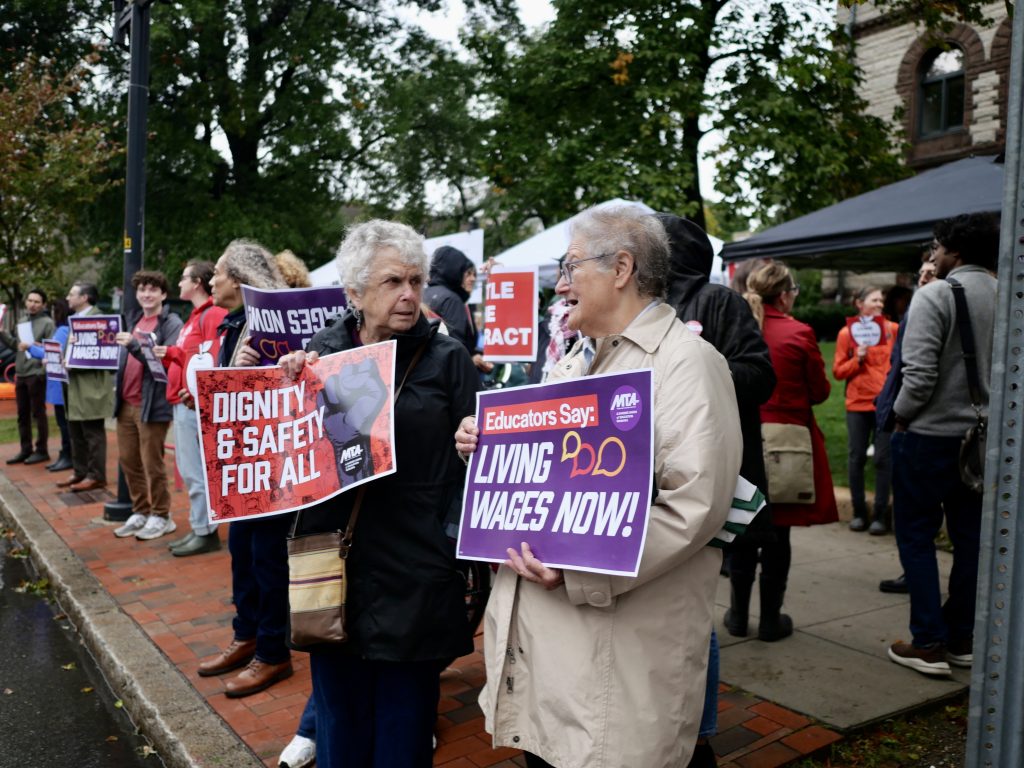
Valarie Ifill, a longtime paraprofessional, told the rally outside City Hall that the moments that stay with her most come when a student is so overwhelmed they shut down and she is able to reach them. “Shoulders drop, love comes back, and they find their way to learning again,” she said.
Dozens of speakers made similar points at the September meeting. Jo Quest-Neubert, a career public school teacher, told councillors she “would rather pay more in property taxes” than fund “a system that does not fairly compensate” its workers. Another Cambridge resident, Piper Winkler, told them that “nobody’s hands are tied when it comes to increasing the budget” and that “it’s a question of political will.”
By pointing to the exactness of the parallel between the Teamsters and CEA resolutions that Cambridge City Councillors faced, organizers touch on the question of just how far pro-labor sympathies extend within a progressive municipality. IBT Local 25, organized around the strategic nexus of the logistics industry, holds both an entirely different brand and significant amounts of economic power on the supply chain compared to any other union in Cambridge. School workers hold less immediate, more long-term power, influencing the entire trajectory of the society reproducing itself, one mentored student and taught skill at a time. Both are essential — but which Cambridge City Councilmembers’ solidarity extends just as far as the supply chain, but not future generations?
The Dispute Has Moved
On November 10, after more than 22 bargaining sessions, the Superintendent asked the Massachusetts Department of Labor Relations to appoint a mediator. The CEA declined to join the request; CEA President Chris Montero told the Harvard Crimson the two sides could keep making progress at the table and that waiting on a state mediator could delay a deal by months. The union reported 38 tentative agreements in October, and the district says it has settled with every other union.
Working Mass previously reported that all six bargaining units of CEA are bargaining at the same table together.
The two sides were scheduled to meet again November 23 and December 3. Regardless of the outcomes of mediation, a council that wants to be informed about a dispute affecting some 1,500 school employees has more reason to ask for a report now than it did in September.
The cost deserves scrutiny, and the district has a point that the union’s full list of demands may be more than the budget can absorb. But that is a reason to take a position, not to stay silent.
McGovern and Nolan have said why they treat the two orders differently; Nolan said on November 16 that the Teamsters order is not about increasing the budget and does not undermine a School Committee negotiation. The other councillors who voted no or present in September should explain why their reasoning doesn’t also apply to the Teamsters order. Flaherty said on the floor that he is open to talking it through. The next step is for him, or any councillor, to re-file an order naming the CEA and let the full council vote. The council also needs to decide what its role in school funding is, given that it approves the budget and sets the tax rate, and then apply that view consistently to every labor dispute that reaches the floor.
Small changes to how the council handles these questions can, over time, make it harder to keep saying no. CEA members have been bargaining since January and working under expired contracts since the start of September.
The paraprofessionals have made their case loud and clear and in public. The council must now answer.
Owen Mortner is a member of Boston DSA. He works on the staff of Cambridge City Councillor Ayah Al-Zubi, but writes in his own capacity.
The post Cambridge City Council Found Its Voice for the Teamsters. School Workers Are Still Waiting. appeared first on Working Mass.
“}]]