[[{“value”:”

By: Matt Wolfinger
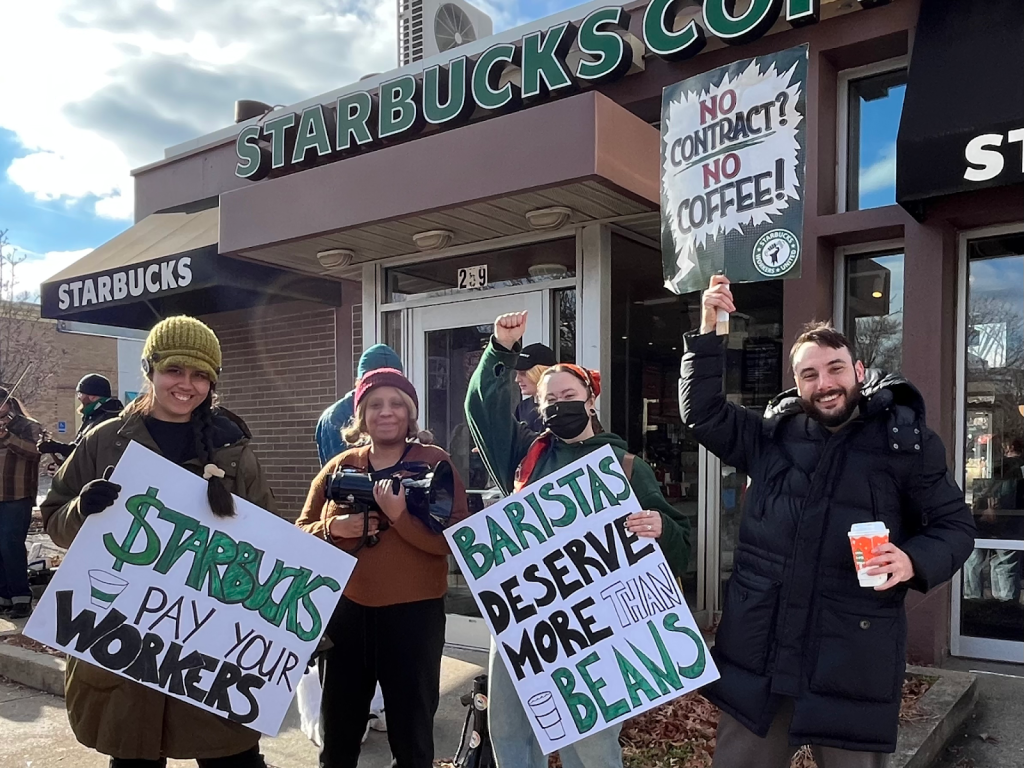
NEWTON, MA – Members of the Newton community braved the cold on Sunday, December 7 for a 5K fun run to support striking Starbucks baristas. The run, organized by Starbucks Workers United (SBWU) and Boston Democratic Socialists of America (DSA), started and ended on the picket line at the Centre Street Starbucks with a unionized Brighton location serving as the midpoint.
Runners and volunteers joined striking Workers United baristas, holding handmade signs and chanting slogans like “No contract, no coffee” and “What’s disgusting? Union busting.” The event also featured live music from the Scollay Square Skiffle Band, who played songs about working class solidarity.
The Newton Starbucks is one of more than 145 stores in over 150 cities engaged in Starbucks Workers United’s open-ended strike called the “Red Cup Rebellion.” The name is a nod to the strike kicking off on Starbucks’ “Red Cup Day” – an annual promotion where customers receive a reusable red cup with their order – disrupting one of the busiest days of the year for the coffee giant.
92% of union baristas voted to authorize a strike following a relentless series of unfair labor practice (ULP) violations.
The baristas are calling on Starbucks to address three key demands: better hours and staffing, higher-take home pay, and the resolution of hundreds of ULP violation charges filed against Starbucks by SBWU through the National Labor Relations Board (NLRB). Ellie Gonzales, a barista with Workers United in Newton, said:
The staffing conditions aren’t what we want. They’re short staffing our stores. They’re cutting our hours and refusing to give us better pay, which is causing morale to be very low while working at Starbucks.
Negotiations between Workers United and Starbucks hit a snag last December, when Starbucks denied a set of proposals put forward by union baristas to improve wages and benefits. They instead offered an economic package that did not address any of the barista’s key concerns.
Baristas at Starbucks have faced an influx of challenges due to new policies enacted by their CEO, Brian Niccol, who took over the role from Howard Schultz in September of last year. Niccol’s first massive change as CEO was his controversial “Back to Starbucks” campaign. Instead of addressing the need for fair compensation, hours, benefits, and an end to union busting. Niccol changed the dress code without warning and required baristas to write handwritten messages on every cup. The outcome was the opposite of what Niccol and Starbucks senior leadership aimed for: longer wait times and angrier customers.
“When they first launched writing on the cups,” said Gonzales, “we did short messages like ‘Hello!’ or a smiley face or their name. Then that wasn’t enough. They wanted us to write phrases, ‘Have a nice day’ or ‘You’re Brew-tastic’, everything they could think of. And that just led to even longer wait times, because we’re already short staffed and now we have to stop to write a longer message that has to keep varying. We can’t write the same message over and over.”
According to Gonzales, all of these issues weighing baristas down don’t just impact their day-to-day work: they also lead to a worse experience for their customers.
“Short staffing the stores has led to significantly increased wait times,” she said. “There’s typically only three or four people on the floor, so customers come in regardless of how they ordered, mobile or in person, and wait upwards of 20 minutes just for a drink.”
Former customers like Adam, one of the roughly 50 runners in attendance on Sunday, attested to this decrease in efficiency. “It feels like a very slow collapse,” Adam told Working Mass.
I wasn’t totally aware of the issues, but, you know, there’s been a decline. I encourage everyone to stop going. It’s the only way things are going to change, for sure.
A November report from the Strategic Organizing Center found that 86% of frequent customers surveyed say wait times have worsened or stayed the same in 2025. Long wait times were the biggest in-store complaint from Starbucks customers.
Starbucks has also opted to shutter some stores altogether. In September, Starbucks shut down hundreds of stores across the U.S.
At least twenty of the shuttered branches were in Massachusetts, including eight unionized locations. Notably, the Starbucks in the Davis Square neighborhood of Somerville was permanently closed just one week after the workers voted to unionize.
While many baristas (both current and those impacted by closures) struggle to pay their bills, executive compensation packages remain unaffected. According to the AFL-CIO’s Executive Paywatch report, Niccol took home $95.8 million in 2024 despite only joining in September of that year. At 6,666 times more than the company’s median employee, it’s the largest CEO-to-worker pay disparity in the country.
Beyond pure compensation, an inordinate amount of money is put into optimizing Niccol’s day-to-day work. His commute to Starbucks HQ in Seattle is on a company-funded private jet. A satellite office was constructed just a 5 minute drive from his California home complete with a $14,000 espresso machine and an oceanside view. The company also spent $81 million on a four-day retreat for managers in Las Vegas in June 2025.
It would take the company less than a single day’s profit or less than 0.0025% of annual revenue to settle the remaining disputes with the union.

The disparity between corporate priorities and workers’ needs both inside and outside Starbucks was highlighted at Sunday’s event. Marissa, a DSA member and organizer, encouraged attendees to take the fight beyond the Starbucks picket line and into their own workplaces. Her place of employment has faced layoffs of its own in recent weeks. With a megaphone, she said:
We had six people laid off last month. No opportunity for recourse and no compensation packages on the way out. With a union, you can.
The 5k is the latest collaboration between Workers United and Boston DSA, who’ve been long-time supporters of their union drives.
“We try to do weekly events for the picket lines to draw attention to the Starbucks workers and get more eyes on it,” said Ryan G, who co-chairs the Somerville branch of Boston DSA and hosted Sunday’s event. “We thought some kind of event like this would be more approachable for people. And Boston loves to run.”
This is one high-profile event that underscores a broader commitment. DSA has also set up a strike kitchen and logistical transportation support for Starbucks Workers United members through the strike, sustaining the workers whose pocketbooks are more impacted by the strike. DSA and Workers United are already brewing up future ideas for picket line events, including more live music and a set from a stand up comedian. “There’s really no idea too big or too small for these events,” Ryan said. “We’re trying all sorts of things.”
While the indefinite nature of the strike may seem intimidating, recent wins for the union signify that victory is not only possible – it may be within reach. A recent ruling from the New York City Department of Consumer and Worker Protection (DCWP) found Starbucks violated the city’s Fair Workweek Law more than 500,000 times since 2021, when Workers United’s first union was formed in Buffalo, New York.
Baristas are asking everyone to avoid purchasing Starbucks for the duration of the strike. They also encourage donating to their strike fund, showing up to local picket lines, and spreading the word on social media.
Matt Wolfinger is a data journalist, Northeastern University graduate and a contributing writer to Working Mass. Read more of their work here.

The post Cross the Finish Line, Not the Picket Line – Newton locals run 5k to support striking Starbucks Baristas appeared first on Working Mass.
“}]]