
[[{“value”:”

By: Jake S
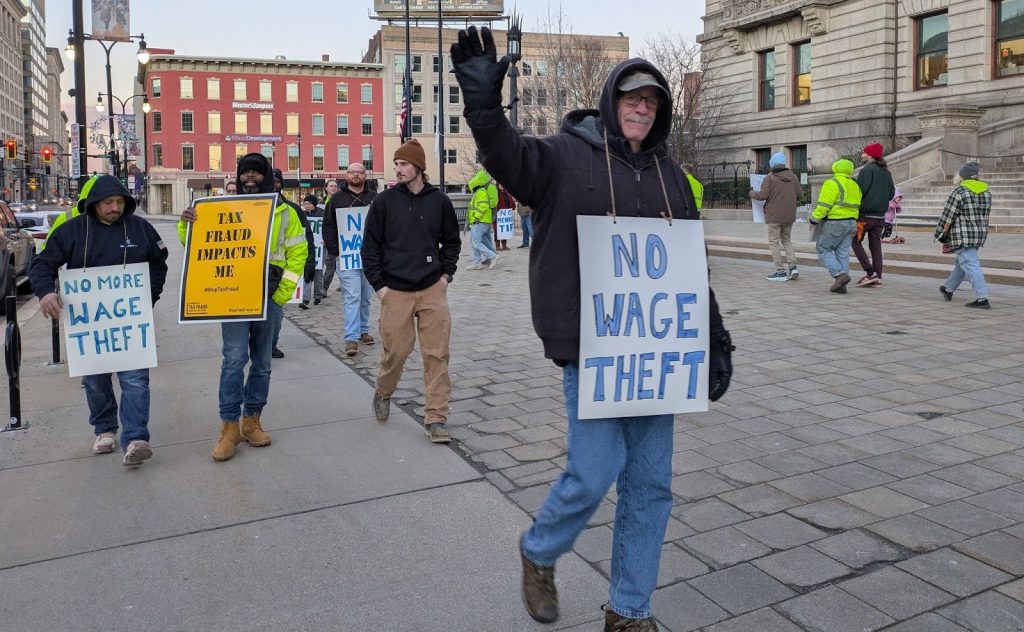
WORCESTER, MA – On Monday, January 10, North Atlantic States Carpenters Union Local 336 members gathered against a 10-year real estate tax exemption and state tax credit eligibility proposed by Worcester City Manager Eric Batista for Menkiti Group, a Washington DC developer.
They object on the grounds that Menkiti has broken the city’s Responsible Development Ordinance – a list of requirements to be eligible for such exemptions – through its hiring of Barber Drywall. The company has been cited five times over the past two years for ordinance violations relating to wages and hours. Tax exemptions and credits like these amount to a publicly-funded subsidy granted to developers by the city.
Menkiti is seeking the exemption for a project which would convert the upper floor of an office building on Main Street into market-rate apartments. Only five of the 48 planned units will be available to tenants making no more than 60% area median income, according to Chief Development Officer Peter Dunn in communication with Worcester City Council.
Ahna Wowk-Aposhian, a journey-level carpenter and 5-year member of the union, toldWorking Mass that union carpenters weren’t being “prioritized” by City Hall, despite their best efforts to support ostensibly pro-labor candidates.
[Local] 336 has spent countless hours, countless days interviewing candidates, holding political actions, going to rallies, holding signs, and being told over and over again that Worcester government and City Council values the Carpenters union and is on the side of union labor. And with this fourth proposed non-union high-rise [project] — it really is the last straw, it does feel a little insulting at this point.
Candidates that we endorse signed pledges to back union projects and union work, and we haven’t seen that. [The City hands out subsidies to] developers that hire contractors who violate multiple labor laws, who engage in wage theft against their lowest-paid workers, who do not hold themselves to any kind of OSHA standard. Union work across the board is safer, it pays better, it has more protections [for workers].

Union carpenters vocalized the need to improve wages, hours, and working conditions for all workers, and that their union exists to pursue just that. When asked more about the value of her union, Ahna said being a member:
offers a quality of life that’s absolutely unheard of for someone of my age bracket and background. As a 37-year-old, I have a pension, I have annuity, I have a guaranteed retirement. I don’t worry about breaking my leg and not being taken care of; my wife doesn’t have to worry about her healthcare. I know that if I experience workplace discrimination, the full force of the union will come down like a hammer – there are so many people to back you up.
Carpenters stood out in the leadup to a Zoning Board meeting regarding the project and subsequently entered the meeting to voice their concerns. Rather than reject the City Manager’s proposals, Worcester City Council on Tuesday delayed the agenda item until its next meeting scheduled for today: January 20.
Carpenters Local 336 will return to City Hall in the leadup to the meeting.
Not the First Time
As Ahna alluded to, this wasn’t the first time Carpenters Local 336 demanded change in the city’s distribution of subsidies (and not even the first time in relation to Barber Drywall). Back in May, several building trades unions across Worcester and Fitchburg – including the Carpenters – stood outside of 446 Main Street, the glass high-rise that houses the Worcester office of Synergy Investments.
Synergy had made the decision to hire NEI General Contracting for a similarly subsidized project to the tune of nearly $6.5 million in tax exemptions.
NEI and contractors it planned to hire had previously been charged with 37 minimum wage violations; 39 pay violations; and $15,000 in penalties for retaliating against employees who filed suit over alleged wage and hour law violations (including threats relating to immigration status), according to a press release provided by the unions.
Such infractions, the unions stated, were clear violations of municipal development ordinances, and should prohibit subsidy projects from being awarded to these contractors. Those violations occurred over the course of other projects receiving combined millions of dollars in tax exemptions and credits.

“They cheat, they don’t pay their people the right wages, they don’t pay the right overtime, they undermine the building trades, and then they get tax money,” said Michelle Arnold, a journey-level carpenter and 8-year member of Local 336.
These contractors have a history of doing this. We’ve built all kinds of buildings in this town, and we’re very disappointed the town would let these contractors not play by the rules. It takes money off everybody’s checks – union and non-union. Non-union workers are the ones working for these contractors, and they’re getting cheated.
When asked more about the role of her union, Michelle said:
Because of the union, we have a 5-day workweek; because of the union, we have safety protocols and fair wages. We can bring charges to shady contractors and help the people that aren’t getting paid the right way. Unfortunately, that sort of thing happens a lot more than people want to think, and most of the time, it flies under the radar.
She noted events like this could bring more attention to these issues of the building trades, and recalled her fellow union members joining nurses every day on the picket line of Worcester’s historic strike against St. Vincent’s Hospital. “Working people supporting working people can have a big impact. Everybody wants to earn a paycheck; everybody wants a fair wage for their time.”
Dan Mulcahey, Vice President of the Worcester-Fitchburg Building Trades Council (WFBTC) and a member of Sheet Metal Workers Local 63, agreed.
For union workers, if you show up on time and do your job, you get the proper training you need to get licensed in your trade when you’re just starting out, you get job security throughout your career, and you get to retire with dignity when you’re done.
“There’s a lot of development going on right now in the city of Worcester,” remarked Jorge Rivera, President of the WFBTC. “We’re pro-development – but it’s gotta be the responsible type of development.”
Synergy Investments has continued to be the beneficiary of that nearly $6.5 million in tax subsidies for its project – despite the protestations of the building trades unions – which was to turn the eleven-story tower at 1 Chestnut Place into 198 market-rate apartments.
To city and state governmental bodies, both Synergy and Menkiti’s business practices appear to qualify as “responsible development.” The question that Worcester’s working-class residents might ask is: “responsible to whom?”
Jake S is a member of Worcester DSA and a contributing writer to Working Mass.
The post Bad Blueprints: Worcester Building Trades Challenge Subsidies to Developers appeared first on Working Mass.
“}]]