
[[{“value”:”

By: Jackie Wilson
The views expressed in this article are the author’s own and do not represent the official position of Working Mass.
Electoralism is a strategy of electing politicians with the goal of creating political change. From a young age, many of us are indoctrinated to believe voting has great power;our childhoods are filled with lessons and stories about how voting is the way democracy is preserved and political change happens, backed by a sanitized lie that the Civil Rights Movement achieved its ends through the vote and not human struggle itself. Elections have very rarely achieved any meaningful changes for the working class or done any lasting damage to the capitalist system. As Lenin argued in The State and Revolution, “to decide once every few years which member of the ruling class is to misrepresent the people in parliament is the real essence of bourgeois parliamentarism.” Politicians will always be more loyal to preserving the system that safeguards capital rather than liberating the masses, precisely because of their relation to the electoral system of the state, even with professed socialist politics.
We have pursued a heavily electoral strategy in recent years of the Massachusetts socialist movement. Even recent debates have centered on methods of electoralism, rather than the question of its strategic value. There may be times where engaging in electoralism is strategic, even Lenin in Left-Wing Communism agrees that action by the masses, a big strike, for instance, is more important than parliamentary activity at all times. In order to combat the inevitable results of electoralism’s demobilization of mass movements, as well as its ineffectiveness in developing organizers, we need a break from electoral strategy itself in 2026.
Electoralism as a Way to Demobilize Mass Movements
Electoralism can’t have real revolutionary power if it is so encouraged and permitted by the state; this holds true in Massachusetts today, as in any other epoch where the state has used electoralism as a valve for discontent to be exhausted. As socialists, we strive to agitate workers and tenants to lose their own fear and come together in mass movements. When mass movements erupt into disruptions of the current system, politicians lockstep to stop those movements. That’s shown again and again, even in the annals of sports labor, as during the 2020 uprising. When NBA players began mobilizing to strike in solidarity with the Black Lives Matter movement, Barack Obama called Lebron James and National Basketball Players’ Association (NBPA) President Chris Paul, urging them to cancel the strike in favor of pushing voter turnout: “in one fell swoop, electoralism had shut down mass mobilization.”
Instead of instilling what Asad Haider called a “class hatred” characterized by a “consistent antagonism to the system,” elections serve as a way to make the masses feel as though they have power over the current system.Obama’s response to the NBA strike how politicians can use elections to redirect the energy of a mass movement from escalating towards revolutionary class struggle to largely meaningless civic performance, but liberal politicians are not the only figures guilty. The Communist Party, USA largely sacrificed its Black-led base-building and organizing infrastructure in Alabama for a Popular Front motioned from above, with no input from members. As Fanon wrote in Wretched of the Earth, “the leader pacifies the people.” Elections allow people to voice their anger about the oppressive system, but they do not bring together the working class in a way that can sustain active, militant mass movements.
The question of the ballot line distracts from the reality that dedicating resources to the strategy itself means losing ground. The Democratic and Republican Parties drone strike civilians overseas, expand the militarization of the police, deport immigrants, and engage in union-busting practices, co-opting left-wing dissent, while smaller third-party candidates either have no chance of winning an election or have no real means to enact the changes they promised once elected.
Rosa Luxemburg remains correct. We can talk about Socialists in Office all day, but to Luxemburg, a socialist in office can either work in opposition to the bourgeois government, which means they would not be an active member of the government and be removed from office, or they can carry out the duties necessary for the government to remain operational, which means they would not be a socialist.
The Ineffectiveness of Electoral Politics in Developing Organizers
Beyond the ineffectiveness of electoralism to achieve any meaningful change in and of itself, elections don’t raise class consciousness or increase revolutionary skill. Voting is not a form of class struggle, so participation in voting does not either. As McNally and Post argued: ”Not only do the people you ‘organize’ electorally remain isolated and passive, rather than active participants in their own liberation, but election campaigns that focus on winning must appeal to voters’ existing consciousness.”
Other strategies do not rely on activating existing consciousness, mobilizing over organizing, but rather on actual change from within. Elections de-emphasize the ability of people to liberate themselves by positing an outside savior as the key actor in political struggle.
Part of this urge to seek an outside savior comes from fear. In his work on death denial and the phenomenon of transference, Ernest Becker argues that individuals who have intense fear or denial of death will often seek out some kind of savior. In the case of revolutionary struggle, those who are afraid of their own or the revolution’s death will seek some figure that provides a sense of immortality. This is a means to avoid the weight of our responsibility as individuals to the revolutionary project, which includes the collective and one another, to the masses themselves as the ones actually capable of leading us to liberation. It’s much easier to think we can find the perfect champion whom we cheer on like any other celebrity. A core tenet of socialism is the belief in the liberatory power of the working class, not individual celebrities or champions. We should not let our fears override that belief.
Fear may be an unconscious undercurrent, but socialists offer many arguments for why electoral strategies advance the socialist struggle. When organizers prioritize electoral campaigns, they often justify the strategic move with the claim that elections bring visibility to the organization and new members into the movement. When we conflate electing a champion with bringing new members into an organization, socialist organizations take a more evangelical posturing – telling others the “good news” of the politician bringing socialism to the people at the low price of one vote – towards the working class than one that seeks to unlock workers’ and tenants’ own power to shape historical forces. People must rely on the second coming of their god for salvation. We know that there is no second coming of anything that will save us. There’s no reason for us to focus exclusively on “raising awareness” or “spreading the good news of communism” when we can engage directly as political actors in class struggles and mass movements themselves.
Rather than build an international workers’ movement, electoralist strategies at the expense of others often lead to socialists supporting reactionary leaders and forging cross-class alliances that diminish important principles. The Communist Party, USA’s abandonment of base-building in Alabama for the Popular Front is one example; During the 1960s, the Iraqi Communist Party sacrificed any principle “in order to forge a relationship with those in power.” After the 1958 revolution, the communists in Iraq united with Kassem, the military leader, and with the national bourgeoisie. This proved disastrous for the Iraqi Communist Party when the Ba’athist government turned against the communists resulting in much of the party’s central committee members exiled, imprisoned or executed.
The Iraqi Communist Party’s great weakness lay in its politics rather than its organization. Rather than forge ahead and offer independent leadership to the workers’ movement, the party retreated and refused to challenge the Free Officers’ leader Abd’al-Karim Qassem for power. By aligning with the government and the bourgeoisie, the party saw the tragic destruction of their movement which allowed for the rise of the Ba’athist Party. In the best of circumstances, bourgeois politicians and leaders will pacify and demobilize mass movements, and in the worst of circumstances, bourgeois politicians and leaders will violently repress and purge those mass movements.
DSA’s Electoral Priorities
The role of socialists in bourgeois society is to form an opposition party. Without insurgent mobilizations that advance working class power to produce political disruptions, which undergird the opposition to the system, engaging in electoralism within the capitalist state will result in a weakening of the socialist left. As a socialist organization, DSA should prioritize actions that have the potential to undermine social divisions among working people and build antiracist and feminist class solidarity. Actions that involve confrontational action have the most power to radically transform working class people to build unity across social differences.
Rather than prioritize electoral campaigns, DSA chapters should imagine ways for the working class to engage in their own liberation: union organizing for both tenants and workers, mutual aid network-building in our neighborhood groups, and anti-ICE response.
Boston DSA joined the Homes For All coalition for a campaign to get rent control on the ballot in 2026, since rent control would be a massive victory for renters across the state, unlocking room for successive victories. There are even more direct examples of such power from below: Mattapan tenants won rent control for 347 buildings after an aggressive 6-year long fight. Without waiting for legislative solutions, these tenants succeeded in making their homes permanently affordable. We could do that for other neighborhoods and in other buildings. We don’t have to beg the Massachusetts legislation to protect us from price-gouging landlords. We can take matters into our own hands and win.
By forming mutual aid networks, people do not need to beg for assistance from an uncaring government. When the government shutdown ended SNAP victims, neighborhoods across Boston sprang into action. Residents expanded food pantries, created meal trains, and coordinated food deliveries. Even after SNAP benefits have been reinstated, those networks remain. The foundation and structure created to respond to crises can be supported by neighborhood groups, the anchoring and most local formation of the DSA chapter. In neighborhood groups and other spaces, we can mobilize residents, distribute food and necessary supplies to support people facing food insecurity. Mutual aid groups like Food Not Bombs or Warm Up Boston have long been supporting our unhoused neighbors; participation and initiative like theirs can be pioneered in order to build the infrastructure of organization needed for mass disruption. As we escalate and build towards mass disruptions, we need to have infrastructure to support workers and tenants on the front lines of militant union action like striking. Strong mutual aid networks allow workers to stay on strike for as long as it takes for corporations to come to the bargaining table and meet their demands.
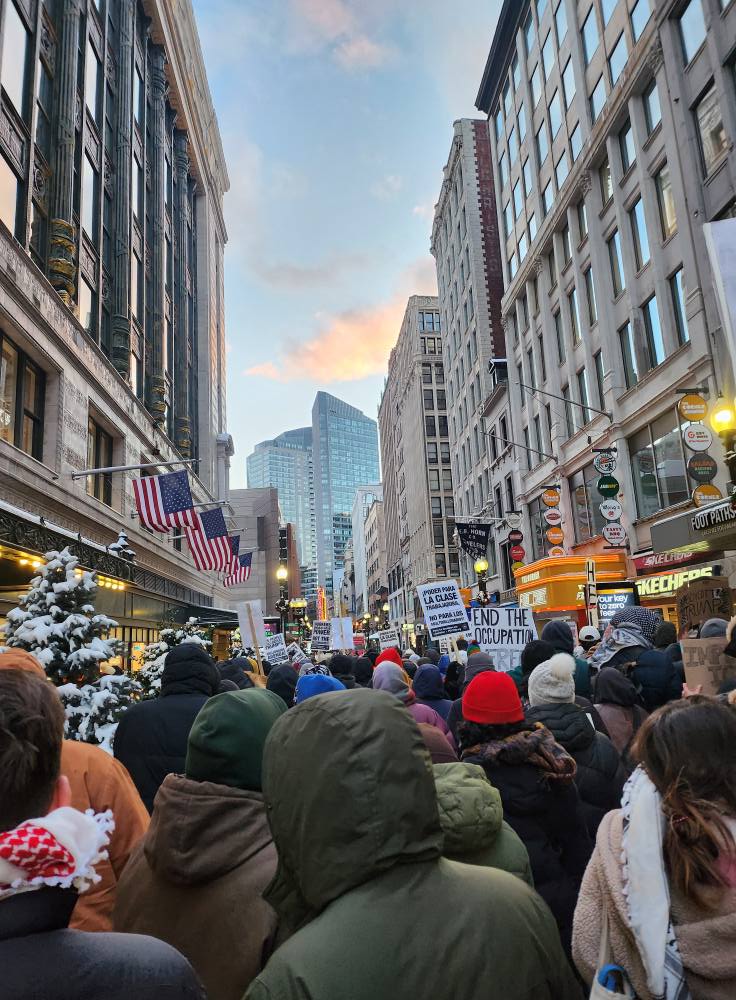
We can take back our streets and our cities from ICE and police forces. Rather than appeal to politicians who will offer little more than empty platitudes since they work for and maintain this system that abducts our neighbors, we can form ICE watch hubs, supporting and expanding the LUCE networks, while developing patrol systems as organizers have in Los Angeles and Metro DC in response to federal occupation. Chicago, New York City, and Raleigh have all had success in chasing ICE out of their cities. This is only possible by training members in de-arresting techniques and direct action skills. Organizers in Minnesota rally outside of hotels where ICE agents are hosted, which not only demoralizes the ICE agents, but also disrupts the hotel business. These are the type of actions that hurt capitalists the most, which our chapter and others should prioritize.
As the Greek poet Archilochus said, we don’t rise to the level of our expectations; we fall to the level of our training.
If we are rallying behind someone we believe may look favorably on our demands rather than fighting for those demands ourselves, we are not training ourselves for revolution. Any reforms that the government offers, the workers can win through unions and militant campaigns. When the workers win reforms through revolutionary class struggle, they have the training necessary to be part of a mass movement that can fight for and win a socialist future. The purpose of a socialist organization should be to build a mass movement of revolutionaries who have been radicalized through class struggle. A revolution requires revolutionaries.
Jackie Wilson is a Boston DSA member and a contributing writer to Working Mass.
The post OPINION: A Revolution Requires Revolutionaries, Not Candidates appeared first on Working Mass.
“}]]